



Article
Workforce Wellbeing, AI and Talent Retention: Key Priorities for Healthcare Leaders
Workforce Wellbeing, AI and Talent Retention: Key Priorities for Healthcare Leaders
![]() By eHealth Network - 27 June 2026
By eHealth Network - 27 June 2026


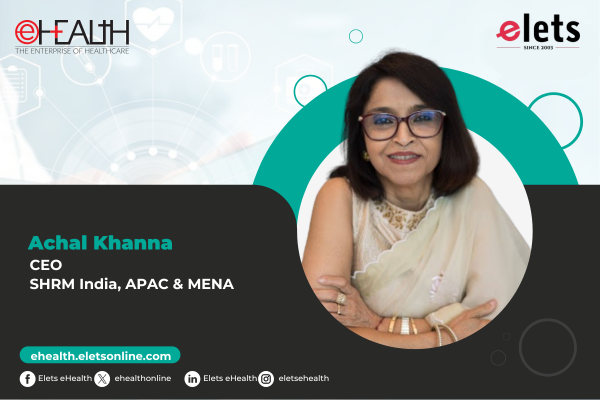
In an exclusive interview with Dr Asawari Savant of Elets News Network (ENN), Achal Khanna, CEO, SHRM India, APAC & MENA shares, shares her insights on building resilient healthcare workforces, embedding employee wellbeing into organisational culture, and preparing healthcare institutions for the future of work.

As healthcare organisations face growing workforce shortages, burnout, and evolving employee expectations, what leadership and workforce strategies are essential to build resilient and future-ready healthcare teams.
Healthcare workforce resilience starts with leaders who treat their people as the core infrastructure, not a supporting function. Organisations facing talent shortages and burnout need to move beyond reactive hiring towards proactive workforce planning that anticipates skill gaps before they become crises. Flexible work models, structured mentorship, and clear career progression pathways signal to employees that their growth matters. Equally important is training managers, not just senior leaders, to recognise early signs of burnout and respond with genuine support. Resilient teams are built through consistent investment in psychological safety, recognition, and purpose. When healthcare workers feel seen and valued, they stay, perform, and inspire others around them to do the same.

India is rapidly emerging as a global talent and innovation hub. How important is workplace wellbeing in strengthening organisational performance, talent retention, and long-term competitiveness, particularly in the healthcare sector?

India’s emergence as a global talent and innovation hub brings both opportunity and responsibility for organisations. Workplace wellbeing is no longer a soft benefit. It is a direct driver of performance, retention, and competitiveness. SHRM research consistently shows that employees who feel supported in their wellbeing are more engaged, more productive, and significantly less likely to leave. In the healthcare sector, where skilled professionals are already scarce and the cost of attrition is high, this connection becomes even more critical. Organisations that invest meaningfully in physical, mental, and financial wellbeing build a reputation that attracts talent in a competitive market. In a knowledge-driven economy, wellbeing is not a cost. It is a strategic advantage.
Many organisations have moved beyond traditional wellness programmes. What differentiates healthcare institutions that have successfully embedded wellbeing into their culture from those that continue to treat it as an HR initiative?
The difference is visible almost immediately when you walk into an organisation. Institutions that have genuinely embedded wellbeing into their culture do not run a wellness programme. They have leaders who model healthy boundaries, managers who are evaluated on team wellbeing metrics, and systems that make it easy for employees to seek support without stigma. Wellbeing is woven into daily decisions, not announced in quarterly newsletters. In contrast, organisations treating it as an HR initiative tend to focus on visible perks while leaving structural stressors untouched. Long shifts, poor communication, limited autonomy, and absent recognition remain. Sustainable cultural change requires leadership accountability, employee voice, and a genuine willingness to address the conditions that make people unwell in the first place.
Healthcare professionals operate in high-pressure environments where employee wellbeing directly impacts patient care. How can leaders foster psychologically safe workplaces that support both workforce wellbeing and clinical excellence?
Psychological safety in healthcare settings is not a luxury. It is a patient safety issue. When clinicians and frontline workers fear speaking up about errors, exhaustion, or unsafe conditions, outcomes deteriorate. Leaders who create psychologically safe environments do so by modelling vulnerability themselves, responding to concerns without defensiveness, and making it structurally easy for employees to raise issues confidentially. Regular team debriefs after difficult clinical situations, access to mental health support without career penalty, and zero tolerance for cultures of blame are practical starting points. SHRM advocates that healthcare leaders measure psychological safety as seriously as clinical quality indicators. A workforce that feels safe to be honest will always deliver better, more compassionate care.
As AI and digital transformation reshape the future of work, how can healthcare organisations balance innovation, productivity, and employee wellbeing while ensuring sustainable workforce growth?
AI and digital transformation bring genuine promise to healthcare, from reducing administrative burden to improving diagnostic accuracy. But the human dimension of this transition cannot be managed as an afterthought. Employees need adequate preparation, not just training modules, but honest conversations about what changes, what stays, and how their roles evolve. Organisations that rush implementation without addressing workforce anxiety around displacement, create stress that offsets any productivity gain. The most successful digital transformations in healthcare pair technology investment with people investment in equal measure. Change management, continuous learning cultures, and transparent leadership communication are what separate organisations that grow sustainably through transformation from those that simply digitise their existing pressures and call it progress.
Also read: From Diagnosis to Outcomes: Why Follow-Through Is Healthcare’s Next Priority
From SHRM’s global perspective, what are the most important workforce trends and people priorities that healthcare leaders in India should prepare for over the next five years?
Several converging trends will define healthcare workforce priorities in India through the rest of this decade. First, multi-generational workforce management will require more flexible and personalised people strategies, as Gen Z professionals bring fundamentally different expectations around purpose, feedback, and work-life integration. Second, mental health support will shift from being a reactive benefit to a proactive infrastructure requirement. Third, continuous reskilling, particularly around digital tools and data literacy, will become non-negotiable as clinical roles evolve. Fourth, I&D will move beyond representation metrics toward genuine inclusion in leadership pipelines. Finally, employee listening will become more sophisticated. Organisations that build strong feedback mechanisms and act on them consistently will outperform those relying on annual engagement surveys alone.

 Like
Like
 Dislike
Be a part of Elets Collaborative Initiatives. Join Us for Upcoming Events and explore business opportunities. Like us on Facebook , connect with us on LinkedIn and follow us on Twitter , Instagram.
Disclaimer: The views and opinions expressed in this article are solely those of the author and do not necessarily reflect the official policy or views of any organisation. The content is intended for informational and educational purposes only and should not be construed as medical advice.
"Exciting news! Elets technomedia is now on WhatsApp Channels Subscribe today by clicking the link and stay updated with the latest insights!" Click here!