



Article
Building a Secure and Flexible Device Ecosystem
Building a Secure and Flexible Device Ecosystem
![]() By Dr. Asawari Savant, eHealth Network - 06 June 2026
By Dr. Asawari Savant, eHealth Network - 06 June 2026


In life sciences, consistency has traditionally been derived from the environment itself. Controlled laboratory settings, standardised systems, and defined access points created a level of predictability that organisations could rely on. Stability in infrastructure often translated directly into stability in operations.

Work is now distributed across clinical sites, research facilities, and remote teams, often progressing simultaneously rather than in a fixed sequence. It also spans a wider range of devices and operating conditions, many of which fall outside tightly managed environments.
In such a setting, consistency can no longer be assumed as a byproduct of control. It needs to be established at the system level, ensuring that operations remain reliable even when the environments in which they run are not.
The Role of Devices: From Support Layer to Execution Layer
Devices have moved closer to the centre of operations. They are used for capturing and accessing research and trial data, running specialised applications, and enabling collaboration across teams and sites.

In many cases, the device is where the work happens. That makes its configuration and reliability more critical than before. When devices are part of execution, even small inconsistencies can slow down workflows or create interruptions.
The Challenges: Scaling Without Losing Visibility
As organisations expand device usage, a few constraints begin to show more clearly. Regulatory pressure requires strict compliance, particularly when handling sensitive data. At the same time, device diversity introduces complexity, with legacy systems, specialised endpoints, and modern devices all in use.
There is also decentralised usage, where devices operate outside direct IT environments. This reduces visibility and makes enforcement less straightforward. Add to this data sensitivity, and the margin for error becomes smaller.
Another factor is operational dependency. Device-related issues do not stay contained. They can delay research timelines or disrupt trials. At scale, these challenges tend to overlap, making it harder to maintain control and consistency.
The Gap: Why Existing Approaches Break at Scale
Traditional device management approaches were built for more stable conditions. They often rely on manual provisioning and updates, which becomes difficult when devices are distributed.
There is also limited end-to-end visibility across distributed endpoints, which leaves teams working with incomplete information. Systems may struggle to enforce policies uniformly across all device types, especially in mixed environments.
Compliance adds another layer. When organisations treat compliance as periodic instead of continuous, gaps appear between checkpoints. These issues may seem minor individually, but they become harder to manage as operations scale.
The Requirement: What a Scalable Device Ecosystem Must Enable
To support distributed innovation, organisations need a more consistent approach to devices. This includes the ability to ensure consistent device state across all environments and enable remote provisioning and configuration without dependency on location.
At the same time, systems must maintain continuous compliance enforcement and offer real-time visibility into device health and status. It is equally important to support secure access to applications and data without slowing down workflows. The focus shifts from managing devices to ensuring they remain ready and aligned with operational needs.
The Application: How This Translates in Real Environments
In practice, this plays out across everyday scenarios. In clinical trials, teams need rapid, standardised device deployment across sites. In lab environments, it is about managed access on shared systems without disruption, while remote teams rely on secure, uninterrupted access to critical tools.
Across multi-region operations, maintaining consistent policy enforcement across geographies becomes essential, supported by structured lifecycle management for provisioning, updates, and retirement. Across all cases, the expectation is simple: consistency, regardless of location.
The Impact: Operational Clarity for IT and Security Teams
With the right ecosystem in place, teams gain better control. They can manage all devices through a unified framework, reducing fragmentation. It also becomes easier to reduce manual intervention and configuration errors, particularly at scale. Systems can maintain compliance without constant oversight, as enforcement becomes continuous.
When issues arise, teams are better positioned to respond to issues without disrupting workflows. The shift is gradual but noticeable, moving from reactive handling to more structured operations.
The Category Shift: From Tools to Ecosystems
Device management is no longer limited to standalone tools. It increasingly requires the integration of security, compliance, and operations into a single framework.
This is driven by the need to support diverse and specialised endpoints, as well as by distributed work models. The focus moves towards building a system where components work together, rather than being managed separately.
Also read: Leadership Driving the Next Era of Healthcare Innovation
Enabling Innovation at Scale
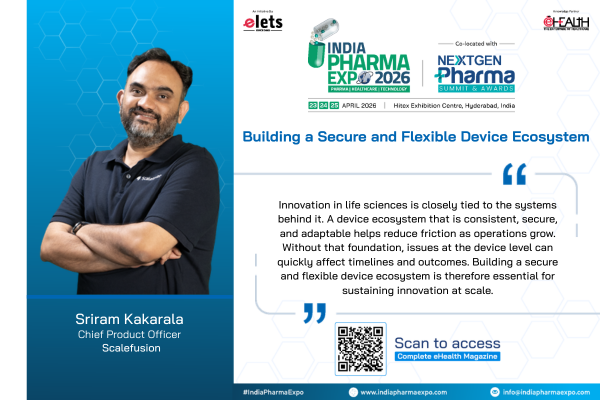
Innovation in life sciences is closely tied to the systems behind it. A device ecosystem that is consistent, secure, and adaptable helps reduce friction as operations grow. Without that foundation, issues at the device level can quickly affect timelines and outcomes. Building a secure and flexible device ecosystem is therefore essential for sustaining innovation at scale.
Views expressed by: Sriram Kakarala, Chief Product Officer, Scalefusion

 Like
Like
 Dislike
Be a part of Elets Collaborative Initiatives. Join Us for Upcoming Events and explore business opportunities. Like us on Facebook , connect with us on LinkedIn and follow us on Twitter , Instagram.
Disclaimer: The views and opinions expressed in this article are solely those of the author and do not necessarily reflect the official policy or views of any organisation. The content is intended for informational and educational purposes only and should not be construed as medical advice.
"Exciting news! Elets technomedia is now on WhatsApp Channels Subscribe today by clicking the link and stay updated with the latest insights!" Click here!