


News
Andhra Pradesh Launches AI Pilot for Diabetic Retinopathy Screening Across Government Hospitals
Andhra Pradesh Launches AI Pilot for Diabetic Retinopathy Screening Across Government Hospitals
![]() By Dr. Asawari Savant, eHealth Network - 16 June 2026
By Dr. Asawari Savant, eHealth Network - 16 June 2026


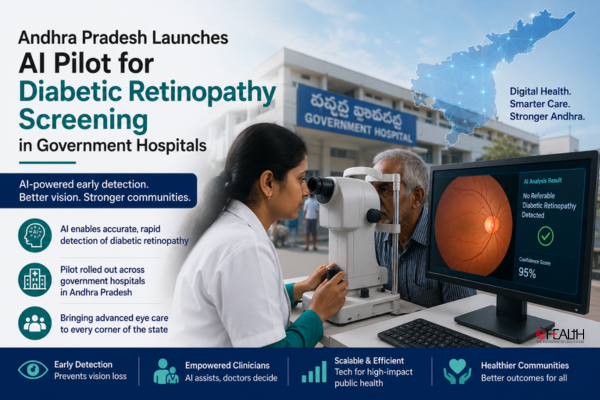
State-led initiative aims to strengthen early detection of diabetes-related vision loss through AI-enabled screening in public healthcare facilities

Integrating artificial intelligence into public healthcare delivery, the Andhra Pradesh government has launched a pilot programme for AI-powered diabetic retinopathy screening across select government hospitals. The initiative is designed to improve early detection of diabetes-related eye complications and expand access to specialised diagnostics for underserved populations.
The pilot leverages an AI-assisted screening framework modelled on proven digital ophthalmology solutions and is expected to support healthcare providers in identifying patients at risk of vision impairment at an earlier stage.
Diabetic retinopathy, one of the leading causes of preventable blindness among adults, often progresses without noticeable symptoms in its early stages. Timely screening and intervention are critical to preventing irreversible vision loss, particularly in patients with long-standing diabetes.

Expanding Access Through Technology
The programme is being rolled out across district hospitals and secondary care facilities, with a focus on improving access to retinal screening services in Tier 2 and Tier 3 locations where specialist ophthalmology resources remain limited.
Under the initiative, trained healthcare personnel capture retinal images using fundus cameras, which are then analysed by AI algorithms to identify signs of diabetic retinopathy and prioritise cases requiring specialist review.
By reducing dependence on manual image interpretation and enabling rapid triaging, the model is expected to improve screening coverage, accelerate referrals, and optimise the utilisation of ophthalmology expertise within the public health system.
Building a Scalable Public Health Model
The pilot aligns with Andhra Pradesh’s broader digital health agenda, which seeks to harness emerging technologies to strengthen disease prevention, early diagnosis, and continuity of care.
Industry stakeholders view AI-enabled screening programmes as a practical solution to addressing the growing burden of non-communicable diseases in India. With diabetes prevalence rising steadily, scalable screening mechanisms are becoming increasingly important for reducing avoidable complications and healthcare costs.
The initiative also reflects a broader shift towards embedding AI capabilities within government healthcare infrastructure, moving beyond proof-of-concept projects to real-world implementation models that can be replicated across states.
Also read: Lavender Lane Launches India’s First Paediatric Super-Speciality Care Centre in Noida
Implications for Healthcare Providers and Technology Partners
For healthcare providers, the pilot demonstrates how AI can augment clinical decision-making without replacing specialist oversight. For health technology companies, it highlights growing opportunities to collaborate with state governments on population-scale diagnostic programmes.
Experts believe that successful implementation will depend on factors such as interoperability with existing health information systems, clinician training, data governance frameworks, and clearly defined referral pathways.
As states continue to invest in digital health transformation, Andhra Pradesh’s diabetic retinopathy screening initiative could serve as a blueprint for deploying AI-driven diagnostics across other high-burden conditions, including cardiovascular disease, cancer screening, and chronic respiratory disorders.
The outcomes of the pilot are expected to inform future expansion plans and shape policy discussions around the integration of artificial intelligence into India’s public healthcare ecosystem.

 Like
Like
 Dislike
Be a part of Elets Collaborative Initiatives. Join Us for Upcoming Events and explore business opportunities. Like us on Facebook , connect with us on LinkedIn and follow us on Twitter , Instagram.
"Exciting news! Elets technomedia is now on WhatsApp Channels Subscribe today by clicking the link and stay updated with the latest insights!" Click here!