



Interview
Accelerating India’s Biopharma Transformation: Building Talent, Technology and an Innovation Ecosystem
Accelerating India’s Biopharma Transformation: Building Talent, Technology and an Innovation Ecosystem
![]() By Dr. Asawari Savant, eHealth Network - 18 August 2026
By Dr. Asawari Savant, eHealth Network - 18 August 2026


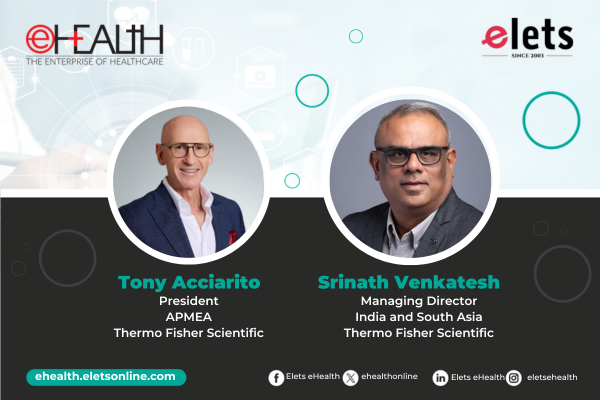
India’s biopharma ecosystem is entering a significant phase of transformation, driven by policy support, increased startup funding, growing innovation and the country’s expanding capabilities in large molecules and biologics. At the same time, access to advanced technologies, skilled talent and stronger industry-academia collaboration remain critical to sustaining this momentum.
Against this backdrop, in an exclusive interview, Tony Acciarito, President, APMEA, Thermo Fisher Scientific, and Srinath Venkatesh, Managing Director, India and South Asia, Thermo Fisher Scientific, with Dr. Asawari Savant, from Elets News Network (ENN), discusses India’s emerging role in the global biopharma landscape, Thermo Fisher’s localisation strategy, talent development, AI adoption, customer-centric innovation and the company’s long-term investment priorities. Edited excerpts
India’s Biologics Opportunity Is Accelerating
India is witnessing a clear shift towards biologics and large-molecule therapies. How do you see this transformation shaping the country’s biopharma ecosystem, and what role does Thermo Fisher play in this transition?
Tony Acciarito: We are certainly seeing that shift. Thermo Fisher has been involved in the biopharma and biotech space for many years, supporting customers from discovery through commercialisation. Over time, we have continued to build capabilities that enable customers throughout this entire journey, from pre-discovery to commercialisation.

More broadly, Asia Pacific is increasingly becoming an innovation hub compared with what we have seen over the last five to ten years. We expect this evolution to continue over the next five to ten years. India is an important part of that opportunity, and our objective is to continue building the capabilities required to support customers throughout their journey.

Srinath Venkatesh: From an India perspective, the shift is very clear and it is accelerating. There are several factors driving this transformation.
Policy is one of them. Initiatives such as the Biopharma Mission, biotechnology policies and PRIP are supporting investments in this direction. The second factor is funding. Funding flowing into startups has increased, with some reports suggesting growth of 1.5 to 1.6 times. Innovation has accelerated as well. We have seen 10 novel therapeutics emerge from India over the last few years, which is a strong indication that the shift is taking place. However, there are still gaps, and that is where Thermo Fisher can contribute. The first is access to world-class technologies. From discovery through commercialisation, companies entering high-value biologics need access to the right technologies across the workflow.
The second gap is talent. Through collaborations with DPIIT and Startup India, we will continue working with academia and academic institutions to help develop the skills required by the industry.
The third is productivity and time to market. Customers need to improve productivity and bring products to market faster, and that is central to our value proposition. So, while the country is clearly moving in the right direction, there is still considerable work to be done. Our ongoing Biopharma Summit and the products being launched here are aligned with these emerging therapies and the work happening in areas such as the GLP space.
Localisation Is About Access, Speed and Capability
Is this transformation also translating into increased business opportunities in India, particularly with initiatives such as the Biopharma Shakti Mission and greater allocation towards the sector?
Srinath Venkatesh: India is a high-growth market for us, and we continue to grow our business. Biopharma is certainly a key sector. Our approach is fundamentally customer-centric. Our customers operate across both government and private sectors, and if becoming more local enables us to provide better access and faster deliveries, then we will localise. Our air quality monitoring systems are a good example. We are a Class I supplier, which means our level of localisation exceeds the threshold required under government norms. This enables us to participate in government tenders where suppliers are required to qualify as Class I suppliers.
Beyond market access, localisation enables us to bring best-in-class technology to governments and industries to help address air pollution. Our role begins with measurement; based on those measurements, other initiatives can then be undertaken to reduce pollution. So, market access combined with the ability to provide best-in-class technology to government and private-sector customers is a strong example of how we are participating in localisation.
Building a Nationwide Capability and Innovation Ecosystem
Are you also expanding your centres of excellence and academic-industry partnerships across India?
Srinath Venkatesh: Absolutely. Rather than looking at what others are doing, I would focus on what Thermo Fisher is building. We have capability centres and centres of excellence across India, including the two experience centres you visited, the Customer Experience Centre (CEC) and the Bioprocess Design Centre (BDC) in Hyderabad. Beyond these, we have 10 such partnerships across the country. These include institutions such as IIT Guwahati, KIIT in Odisha, Atal Incubation Centre in Hyderabad and C-CAMP in Bengaluru.
Many of these partnerships are also with government agencies, including the Central Forensic Science Laboratory (CFSL) in Gandhinagar and FSSAI in Ghaziabad. We have a long history of working with these institutions, and we will continue engaging with key government stakeholders to build centres of excellence and capability centres.
India is not only an important market; it is also home to rich talent. We want to leverage that talent to deliver products and solutions, supported by our GCCs in India.
Tony Acciarito: The biopharma and biosimilar market in India is definitely growing, and our approach goes beyond simply providing technologies. We believe we also have to build an ecosystem that supports talent development and creates local expertise. That is why we have established centres such as the CEC and BDC. These centres allow customers and partners not only to see the technologies but also to use them in real-world settings. Our experts train local talent, while we learn from customers and partners as well. This ecosystem of learning accelerates innovation and helps us better understand what India needs. Those insights then feed into our localisation strategy and influence how we bring our global products and services into the local market.
The strategy is straightforward: build capability on the ground. But that requires long-term investment. We believe the biopharma market will grow significantly over the next five to ten years, so investing now for the long term is important. Ecosystem building, capability development and sustained investment are therefore at the core of our strategy.
Long-Term Investment to Match Market Growth
Has investment in India doubled in line with the growth of the industry? And are you considering further investments?
Srinath Venkatesh: We will continue to grow our investments across people, customer-facing commercial teams, Centres of Excellence and service capabilities. The service centre that you saw as part of the CEC is an important example. It provides best-in-class training to our service teams in India. We will certainly continue to double down wherever investment is required.
Tony Acciarito: India is a fast-growing market for Thermo Fisher. It has delivered double-digit growth historically, and we believe it will continue to grow at a double-digit rate in the future. Our strategy is aligned with that expectation, which makes India an exciting region for us.
New Technologies for an Era of Complex Biologics
Thermo Fisher has launched new products during the summit. Could you elaborate on these products and their significance?
Srinath Venkatesh: We are launching two products, the Orbitrap Excedion mass spectrometer and the Vanquish Amplify. Without getting into too many technical details, both represent advancements over our current offerings. They enhance the capabilities of analytical instruments to characterise increasingly complex compounds. These products are particularly relevant as the industry moves towards large molecules and increasingly complex therapeutics, including oligonucleotides, peptides, proteins and other biologics.
The Excedion, in particular, is designed for such applications. As customers and large biopharma companies move towards more complex characterisation of proteins and oligonucleotides, this technology enables them to undertake that work. Importantly, our focus is not limited to launching the technology. We also want customers to have the training required to interpret and analyse the data generated by these instruments. The summit is therefore also about demonstrating how the data can be analysed. We will continue supporting scientists through smaller training sessions to provide access to this knowledge and capability.
Making Generative AI Part of Standard Work
AI is transforming industries globally. How is Thermo Fisher incorporating artificial intelligence, particularly generative AI, to improve efficiency and customer outcomes?
Tony Acciarito: It is an extremely exciting area, particularly in India, where there is tremendous expertise. Our strategy for generative AI is built around three pillars.
The first is operational excellence, using the technology to run the company more effectively. This includes improving efficiency, reducing wasted time and enabling our teams to respond to customers more quickly. We were among the first companies to establish a collaboration with OpenAI. Today, all 125,000 of our colleagues have access to ChatGPT, and we hope they use it every day in their work.
The second pillar is products and services. We are looking at how generative AI can improve our technologies. We have established an agreement with NVIDIA from a hardware perspective. As we develop products through our R&D processes, generative AI is increasingly being built into them as a core capability. Rather than requiring customers to analyse raw data themselves, AI can generate insights from that data and provide meaningful outcomes. In other words, generative AI helps translate data into insights, allowing customers to work more effectively and efficiently.
The third pillar is customer experience. We have a significant clinical trials business, and one of the biggest bottlenecks throughout the clinical trial workflow is the translation of data, from conducting trials to generating clinical outcomes and ultimately translating those outcomes into medical outcomes. Generative AI can accelerate the collection and interpretation of data. Reducing that time can enable clinical outcomes to be delivered faster, and we are already seeing evidence of this in practice.
These three pillars provide a clear strategy for AI adoption across the organisation. Over the next three to five years, we expect AI to help us evolve significantly as a company. We are very excited about its potential. We also closely track AI use cases internally, who is using AI, what value they are creating and whether those applications can be scaled. We actively promote and reward teams that develop AI use cases with meaningful customer impact.
Our objective is to make AI part of standard work. We want every colleague to use AI in some way. We are not afraid of technology. We are working to remove barriers to adoption and create a safe environment where people can explore, experiment and make mistakes. Ultimately, our focus is on meaningful outcomes and, most importantly, customer impact. That is what we measure. AI is also being used within our cybersecurity organisation to strengthen our cybersecurity capabilities, and India is once again an excellent source of expertise in this area. I believe that one day AI will simply become part of normal work. We are not quite there yet, but we are moving in that direction.
Talent and Industry-Academia Collaboration Remain Critical Gaps
What are the biggest gaps that could potentially hold India back in its expansion and growth? What can India learn from APMEA and other global markets?
Srinath Venkatesh: From an industry standpoint, the transition from generics to large molecules and biologics will require significant talent development. Progress is being made, but much more needs to happen. The second area is industry-academia partnerships. There has been progress, but we need much greater collaboration because that is where innovation happens. To my mind, these are the two biggest gaps.
From a policy perspective, the environment is now favourable. The government has announced several programmes to spur innovation in the biologics space. However, success will require all stakeholders to come together.
Tony Acciarito: As Srinath said, this is not something that one company, organisation or region can solve alone. It requires an ecosystem involving regulators, academia, industry and multiple stakeholders working together to accelerate innovation. Within APMEA, different markets bring different strengths. Singapore has developed strong expertise in translational science and commercialisation. South Korea has significant expertise in advanced biologics, supported by several very large companies operating in that space. India is developing manufacturing excellence alongside innovation. We often talk about the Singapore-Incheon-Hyderabad connection. For Thermo Fisher, connecting those dots is important. We bring together experts, regulators, academia and industry—not only within India but across the region and globally. We have access to global expertise, and we bring those experts into forums such as this one to share perspectives on the global landscape. However, the objective is not simply to present information. Presentations should create conversations, and those conversations should generate new ideas and accelerate innovation.
That is what we are trying to build.
When we do that well, we create real impact—impact that can ultimately be seen in patient outcomes. That is directly connected to our mission: enabling our customers to make the world healthier, cleaner and safer.
India’s Role in the China Plus One Opportunity
As global manufacturing evolves around China Plus One and Europe Plus One strategies, how is Thermo Fisher positioning India and the wider region as a potential global manufacturing hub for complex biotechnology?
Tony Acciarito: Companies based in China that want to diversify their manufacturing footprint are now looking towards Southeast Asia and India as their “plus one” locations. Over the last 12 to 24 months, we have seen significantly greater interest in Southeast Asia and India as part of this strategy. However, increased interest does not immediately translate into growth. There has been a significant increase in activity, but these strategies take time to execute. Relocating complex manufacturing operations is a significant undertaking, so the transition naturally takes time. That is likely one reason why increased activity has not yet fully translated into business growth.
For us, what matters is remaining closely connected to the ecosystem across the region. Ultimately, we need to understand what our customers need and enable their strategies. Whether they choose China, Vietnam, India or another market, our goal is to support them wherever they operate. It is not about steering manufacturing towards one particular geography. It is about understanding where our customers are and helping them succeed.
Rising Customer Expectations Are Reshaping the Industry
Have customer expectations evolved significantly over the last decade with the adoption of digital technologies and new innovations?
Tony Acciarito: Customer expectations have always been high, but they are even higher today because of the adoption of new technologies and the greater availability of knowledge. That means we have to be equally informed, if not more informed, to meet those expectations. We pay considerable attention to building our talent base and capabilities. Capabilities include infrastructure and technology, but talent development is the most important component. We need people who can speak the same technical language as our customers in each region. We therefore spend significant time developing talent and attracting the best people in the market. When we get that right, the technology and infrastructure naturally follow. Customer expectations continue to rise and accelerate. We are seeing a much greater demand for speed, and I believe that has become the new normal.
Customer Needs, Not Competition, Drive Capability Building
Customer Experience Centres are becoming increasingly common in India and globally. What differentiates Thermo Fisher’s approach?
Srinath Venkatesh: The Customer Experience Centre and Bioprocess Design Centre were established in response to what our customers asked for. Our customers and stakeholders clearly told us that they wanted access to world-class technology in India so researchers could experience it firsthand. They also wanted a partner with whom they could co-create. Customers also asked us to help address challenges around productivity and time to market. Our differentiation therefore lies in responding directly to what our customers are asking us to do.
From a talent perspective, we have built partnerships with many of the country’s leading academic institutions. Our objective is to bring these efforts together into an ecosystem that helps develop the talent and skills required by the industry. The aim was never to create something unique simply for the sake of being different. It was about responding to customer needs.
Tony Acciarito: There is an important principle behind this. The day we stop listening to our customers and start focusing on being better than our competition is the day we will fail. If competitors are building similar capabilities, then congratulations to them. More capability on the ground is a positive outcome, regardless of who provides it. For us, the priority is staying close to customers. Our number one priority is to spend as much time as possible with them. When we do that well, we become smarter, learn faster and continue building local capabilities. It always comes back to people first, talent and capability, followed by infrastructure.
India Remains a Strategic Investment Priority
What is Thermo Fisher’s vision for India over the next few years, particularly in a competitive market?
Srinath Venkatesh: The future for Thermo Fisher in India will continue to centre around getting closer to our customers. That means strengthening service capabilities, warehousing capabilities and other investments that enable us to remain closer to customers. We will also continue building capabilities. Last year, we established the experience centres. This year, we inaugurated the service centre. We will continue investing wherever capabilities are needed, including on the commercial side. We will also continue investing in our own talent. Beyond specific numbers, one thing is very clear: India is an important market for both the region and the company. We will continue investing in our customers, our people and our capabilities.
Tony Acciarito: I would add that we want to deepen our partnerships with customers through greater collaboration. We do not want to be simply a transactional provider of products and services. We want to become a trusted advisor and long-term partner. We want customers to see us as more than a technology provider. We want to work alongside them, generate insights together and help shape the future of the market. To do that successfully, we need people with the right knowledge who can speak the same language as our customers. The capability of our people determines what investments we make in infrastructure and technology.
That is why we built these centres in Hyderabad. Our customers told us this was the right place. We will continue making investments based on what our customers tell us they need. India is a priority. It sounds simple, but executing it takes a tremendous amount of work. The local team is doing a fantastic job. Our customers’ expectations continue to increase. They are looking for holistic solutions rather than solutions to one or two individual problems. They want a partner capable of solving significant challenges from beginning to end. Increasingly, customers want one capable partner rather than multiple smaller partners, and we believe we are well positioned to support that need.
To do this successfully, we need to understand gaps in our capabilities, portfolio and talent, address those gaps quickly and then support customers across the entire workflow. Pharma, biotechnology and the new therapeutic modalities we have discussed are clearly important areas of growth. Overall, we believe this market will continue to grow significantly over the next five to ten years. We have good visibility into where the market is heading, but more importantly, we pay close attention to how customer behaviour and expectations are evolving. Preparing for those future expectations today is what enables us to succeed over the long term.
Industry’s Biggest Challenge
What are the major pain points or challenges that you would highlight for the industry?
Tony Acciarito: Talent. That is the biggest challenge—attracting, developing and retaining talent. It is not just an Asia Pacific challenge; it is a global challenge. There is a genuine shortage of talent. It is essential that we continue helping develop talent for the industry while also attracting talent from around the world. We do not look only locally. We also look globally at how we can bring in the right expertise. That is probably the single biggest challenge I would point to.
Accelerating Biotherapeutics to Market
The summit has placed a strong emphasis on biotherapeutics. Why has Thermo Fisher chosen to centre such a large platform around accelerating biotherapeutics in India?
Tony Acciarito: This is essentially where the industry is heading. Biotherapeutics is where all the major large-molecule players are focused. Our endeavour is to help customers bring these biotherapeutics to market faster and support them throughout the journey, from discovery to manufacturing. Ultimately, it is about creating better outcomes for patients.
Also read: UK-India FTA to Strengthen Pharma Partnerships, Says H. E. Gareth Wynn Owen
The Future of Talent: Skills, Flexibility and Adaptability
Thermo Fisher has invested in talent development for many years. What trends are you observing among today’s talent compared with 15 years ago? Are newer generations, including Gen Z, demonstrating greater digital capabilities or faster learning?
Srinath Venkatesh: This is a challenge that everyone is facing. The scientific areas we operate in require highly skilled talent. We don’t really classify talent as Gen Z, Gen X or any other generation. We are looking for the right people for the right roles, regardless of generation. One trend we are seeing, particularly across our GCCs, is that many of the candidates we interview are highly aware and digitally savvy. For some of our core functions, however, good talent is good talent, regardless of generation.
Tony Acciarito: The broader trend is that organisations have to evolve if they want to attract talent. You cannot attract talent today in the same way you did five years ago. We have to change the way we work. Flexibility is one example. People no longer necessarily need to work from the office five days a week. They can work remotely. We have evolved as an organisation to offer flexibility while ensuring that important work gets done. That flexibility is incredibly important today, although it means different things in different locations. What does not work anymore is applying one standard template across every region and saying everyone must work the same hours or spend the same amount of time in the office. That limits your ability to attract talent.
You cannot be rigid anymore. In the past, that way of working was not considered rigid. It was simply normal. Today, it is no longer the norm. Organisations that recognise this will be better positioned to attract today’s talent. Across Asia, the workplace is very different from what it was five years ago. That is helping us attract today’s talent, whether they are Gen Z or any other generation. Even personally, I no longer want to work in the office five days a week. In the past, I did. People’s expectations change over time, regardless of age, gender or generation. That is probably the biggest trend I have observed. I’m sure there are many others as well.

 Like
Like
 Dislike
Be a part of Elets Collaborative Initiatives. Join Us for Upcoming Events and explore business opportunities. Like us on Facebook , connect with us on LinkedIn and follow us on Twitter , Instagram.
"Exciting news! Elets technomedia is now on WhatsApp Channels Subscribe today by clicking the link and stay updated with the latest insights!" Click here!