


Article
Moving from Hardware-Centric Systems to Software-as-a-Medical-Device (SaMD)
Moving from Hardware-Centric Systems to Software-as-a-Medical-Device (SaMD)
![]() By Dr. Asawari Savant, eHealth Network - 06 June 2026
By Dr. Asawari Savant, eHealth Network - 06 June 2026


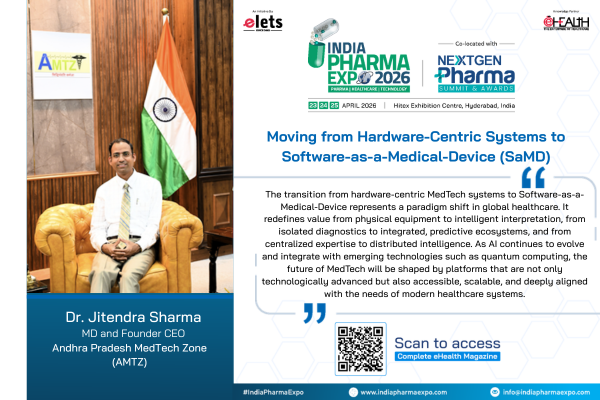
The global MedTech landscape is undergoing a profound transformation, shifting from a traditionally hardware-driven paradigm to one increasingly defined by intelligent software layers. While imaging systems such as MRI, CT, ultrasound, and X-ray machines have long been the backbone of diagnostic medicine, the emerging frontier lies not in the machines themselves, but in the algorithms that interpret, enhance, and act upon the data they generate. This transition toward Software-as-a-Medical-Device (SaMD) is redefining healthcare delivery, making it more scalable, predictive, and accessible.

A key driver of this shift is the shortage of specialized medical professionals, particularly in emerging economies like India, where limited availability of radiologists and cardiologists creates a bottleneck between diagnostic infrastructure and interpretation capacity, leading to delays in care; AI-powered SaMD solutions address this gap by enabling automated, real-time analysis of medical data, augmenting clinical decision-making and reducing dependence on scarce specialist expertise.
A key advancement in this paradigm is the convergence of Edge AI and predictive diagnostics, where point-of-care devices such as handheld ultrasound, portable ECGs, and wearables deliver real-time insights on-device without cloud dependency, enabling decentralized, fast, and privacy-preserving care even in remote settings; simultaneously, continuous data powers predictive analytics to detect early physiological changes and forecast adverse events like cardiac episodes, shifting healthcare from reactive treatment to proactive, preventive care while improving outcomes and reducing system burden.
Equally significant is the evolution of predictive diagnostics, which marks a shift from reactive “sick-care” models to proactive “health-care” systems. By leveraging continuous data streams from wearables and biosensors, AI algorithms can detect subtle physiological changes and predict adverse events, such as cardiac episodes, hours or even days in advance. This capability not only improves patient outcomes but also reduces the burden on healthcare infrastructure by enabling early intervention and preventive care strategies.
Beyond imaging, the SaMD paradigm is rapidly expanding across healthcare through AI-driven Clinical Decision Support Systems (CDSS) that analyze patient records, lab results, and imaging data to recommend evidence-based treatments, while applications in ophthalmology, digital pathology, and cardiology enable early detection, improve diagnostic accuracy, and accelerate clinical workflows, collectively demonstrating how SaMD is extending intelligent, data-driven care across the entire healthcare continuum.
To align AI-enabled healthcare systems with the Software-as-a-Medical-Device (SaMD) paradigm and ensure real-world viability, five critical pillars must be cohesively addressed:
- Interoperable system architecture integrated with national frameworks including secure authentication and consent-driven data exchange;
- Robust AI governance covering data provenance, validated model pipelines, multilingual reliability, auditability, and human oversight;
- Rigorous proof-of-concept with clearly defined sampling, real-world settings, and measurable evaluation metrics;
- Compliance with global standards such as ISO 13485, ISO 14971, ISO/IEC 42001, and IEC 62304 to ensure safety and lifecycle integrity
- Clear accountability frameworks defining responsibility across developers, clinicians, institutions, and regulators, collectively forming the foundation for scalable, safe, and intelligent healthcare deployment.
In the Indian context, integrated MedTech ecosystems, combining advanced manufacturing, regulatory expertise, clinical validation, and technology development, provide a strong foundation for scaling SaMD solutions, bridging the gap between research and real-world healthcare while enabling faster prototyping and deployment of AI-integrated devices.
Building on this, next-generation initiatives are integrating quantum-inspired computing with AI-driven imaging, exemplified by platforms like the Quantum MedTech Lab at AMTZ, to overcome limitations of conventional systems through advanced signal processing, enhanced sensing, and AI-based reconstruction, improving image quality and accelerating diagnostics; in parallel, global SaMD innovations such as AI-powered radiology triage, oncology decision platforms, and remote monitoring are driving the shift toward intelligent, software-defined healthcare.
The transition to Software-as-a-Medical-Device (SaMD) marks a fundamental shift toward intelligent, predictive, and interconnected healthcare systems driven by software rather than hardware. As AI converges with emerging technologies like quantum computing, the future will be defined by scalable, accessible platforms that are deeply aligned with modern healthcare needs.
Also read: Leveraging Precision Diagnostics, AI and Data‑Led Decision‑Making
In conclusion, the transition from hardware-centric MedTech systems to Software-as-a-Medical-Device represents a paradigm shift in global healthcare. It redefines value from physical equipment to intelligent interpretation, from isolated diagnostics to integrated, predictive ecosystems, and from centralized expertise to distributed intelligence. As AI continues to evolve and integrate with emerging technologies such as quantum computing, the future of MedTech will be shaped by platforms that are not only technologically advanced but also accessible, scalable, and deeply aligned with the needs of modern healthcare systems.
Views expressed by: Dr. Jitendra Sharma, MD and Founder CEO, Andhra Pradesh MedTech Zone (AMTZ)

 Like
Like
 Dislike
Be a part of Elets Collaborative Initiatives. Join Us for Upcoming Events and explore business opportunities. Like us on Facebook , connect with us on LinkedIn and follow us on Twitter , Instagram.
Disclaimer: The views and opinions expressed in this article are solely those of the author and do not necessarily reflect the official policy or views of any organisation. The content is intended for informational and educational purposes only and should not be construed as medical advice.
"Exciting news! Elets technomedia is now on WhatsApp Channels Subscribe today by clicking the link and stay updated with the latest insights!" Click here!