


News
IIT Kharagpur Healthcare Hub Moves to Self-Sustaining Model After 20+ Technology Transfers
IIT Kharagpur Healthcare Hub Moves to Self-Sustaining Model After 20+ Technology Transfers
![]() By eHealth Network - 08 September 2026
By eHealth Network - 08 September 2026


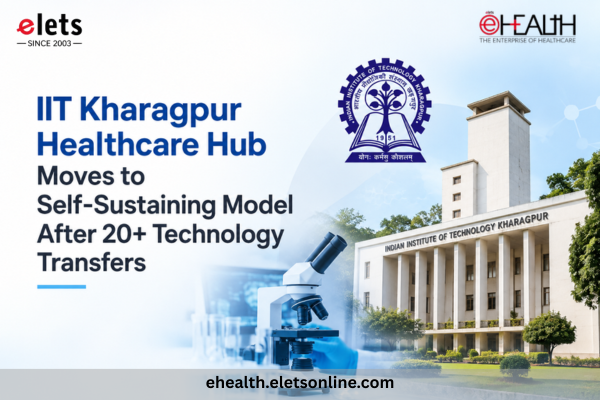
IIT Kharagpur has inaugurated the sustainable phase of its Common Research and Technology Development Hub (CRTDH) on Affordable Healthcare, marking a major step towards strengthening the development, commercialisation and last-mile deployment of affordable healthcare technologies.

The sustainable phase was inaugurated by Dr. N. Kalaiselvi, Secretary, Department of Scientific and Industrial Research (DSIR), and Director General, Council of Scientific and Industrial Research (CSIR), at the Ben Gupta Auditorium, IIT Kharagpur, in the presence of Prof. Suman Chakraborty, Director, IIT Kharagpur and Principal Investigator of the CRTDH.
Established in 2019 under the CRTDH Scheme of DSIR, Ministry of Science and Technology, Government of India, the hub has completed its initial grant-supported phase and has now transitioned into a self-sustaining national facility. Its operational costs will be supported through user fees, industry sponsorships and translational partnerships, while the facility will continue providing research infrastructure, technical expertise and technology-development support to innovators.
The 5,000-square-foot facility has facilitated more than 20 technology transfers, with several affordable medical technologies already moving towards commercialisation. The hub supports MSMEs, startups and individual innovators working on healthcare technologies and provides them with access to laboratories, technical assistance and development capabilities.

The initiative also focuses on taking affordable healthcare technologies beyond laboratories and into communities. IIT Kharagpur has worked with clinical and non-governmental organisations to establish rural health units for deploying affordable diagnostic technologies in underserved areas.
As part of its skilling initiatives, frontline health workers from remote regions, including the Sundarbans and Birbhum, have been trained to support screening, referral and follow-up services. These efforts aim to strengthen access to diagnostic and healthcare services in communities where advanced medical infrastructure may be limited.
Dr. N. Kalaiselvi highlighted the importance of self-sustaining CRTDH facilities in strengthening India’s indigenous capabilities in medical technology. She noted that continued operation beyond the initial DSIR support demonstrates the intended outcome of the programme and can help MSMEs, startups and individual innovators develop and translate healthcare technologies.
Also Read: MED-EL Introduces SONNET 3 Cochlear Implant Sound Processor in India
Prof. Suman Chakraborty emphasised the role of frugal innovation in developing technologies that are robust, accessible and suitable for real-world healthcare settings. He highlighted the need to move beyond simply reducing the cost of medical technologies and focus on creating solutions that can function effectively in settings with limited infrastructure.
The transition of the CRTDH into a sustainable model is expected to strengthen collaboration among academia, industry, innovators and grassroots healthcare organisations. By connecting research, technology development, commercialisation and community-level deployment, the hub aims to contribute to more accessible and affordable healthcare solutions across India.

 Like
Like
 Dislike
Be a part of Elets Collaborative Initiatives. Join Us for Upcoming Events and explore business opportunities. Like us on Facebook , connect with us on LinkedIn and follow us on Twitter , Instagram.
"Exciting news! Elets technomedia is now on WhatsApp Channels Subscribe today by clicking the link and stay updated with the latest insights!" Click here!