



Article
How AI-Led Fraud Detection is Reshaping Health Insurance Claims Management in India
How AI-Led Fraud Detection is Reshaping Health Insurance Claims Management in India
![]() By eHealth Network - 27 June 2026
By eHealth Network - 27 June 2026


Over the past decade, health insurance in India has moved from being a niche financial product to a near-essential household necessity, with millions of new policyholders entering the system every year. Millions of new policyholders, an expanding network of empanelled hospitals, and government-backed coverage schemes have collectively pushed claim volumes to unprecedented levels. But alongside this growth, a quieter and more troubling trend has taken hold, billing anomalies and misrepresentation have become more sophisticated, more widespread, and significantly harder to catch through conventional means.

What makes this especially critical is that it operates quietly in the background. While visible operational issues hit you hard and fast, insurance fraud seeps through the system slowly but surely distorting pricing, eroding trust, and saddling each person attached to the claims file with an invisible burden.
Why Traditional Methods Started Failing

Historically, Indian insurers have utilized a combination of manual labour and third-party administrator (TPA) oversight to detect suspicious claims. When claims volumes were at a manageable level, this process was sufficient. However, as the number of cashless hospitalizations grew dramatically and insurance policies began to penetrate more deeply into tier 2 and tier 3 cities, cracks in the process began to be exposed.

Fraudsters have used these cracks to their advantage with growing sophistication. Examples of this include ghost patients, fictitious hospitalizations, upcoded procedures, and collusion among intermediaries and hospital billing departments. The challenge is not only how to detect fraudulent activity but to do so quickly. In a cashless world where settlements must be made within hours, extended manual review is unrealistic. Traditional systems were simply not designed to operate at that speed or complexity.
Where AI Entered the Picture
The shift began when insurers started recognizing that fraud is rarely an isolated incident and it is a pattern. And patterns, at scale, are exactly what machine learning systems are built to find.
Today, leading Indian health insurers are deploying AI-driven fraud detection platforms that work in real time, analyzing hundreds of data variables the moment a claim is initiated. These systems cross-reference a claimant’s medical history against the nature of the procedure, compare billing codes against standard treatment benchmarks, assess provider behaviour across thousands of past transactions, and flag statistical outliers that would be invisible to even the most experienced human reviewer working through a physical file.
What makes this particularly powerful in the Indian context is the ability to detect network-level fraud, cases where multiple claims, filed under different names, at different hospitals, across different time periods, are actually part of a coordinated scheme. No manual process could connect those dots at the speed required. AI can.
Changing the Claims Lifecycle
One of the most important effects of this has been to move AI fraud detection further upstream in India’s health insurance industry, out of the water and into a pre-auth checkgate. Rather than simply trying to claw back money after fraudulent claims have made their way through the system, insurers are now able to flag suspicious cases before any money is paid out, and to start their human investigative process only where clearly warranted.
As a result, investigators do their job more efficiently. Rather than scouring every flagged claim manually, fraud teams prioritize high probability cases that analytics indicate could merit investigation. And claims are settled quicker, analytics cut down on the noise, and fraud interception is more effective.
Some insurers are even getting in on data sharing programmes across the industry so that they can pour anonymized data on claims and providers into shared models – giving everyone the advantage of visibility into patterns that no one single insurer can see in isolation.
The Ground Realities
AI-led fraud detection in India is not without its challenges. Data quality isn’t uniform, especially with smaller nursing homes and clinics where digital recording is still emerging. Model training requires huge, well-labelled datasets, and in a market as diverse as India, regional variation in treatment practices and billing can sometimes throw the system a false positive.
IRDAI’s ongoing regulatory push toward standardized health data and greater interoperability between insurers and providers is expected to strengthen this ecosystem further. As structured data becomes more available, detection models will only grow sharper.
ALSO READ : From Generics to Global Pharma Innovation: Can India Build the Next Women’s Health Powerhouse?
The Road Forward
Fraud in health insurance is not a problem that can be solved once and set aside. It develops beside the market, finding new vulnerabilities as old ones are closed. What AI has given Indian insurers is not a permanent solution it is a dynamic, continuously learning capability that can keep pace with that evolution.
For policyholders, that matters enormously. Every rupee recovered through better fraud detection is a rupee that does not get passed back through higher premiums. In that sense, the fight against fraud is not just a business imperative it is a commitment to the integrity of insurance itself.
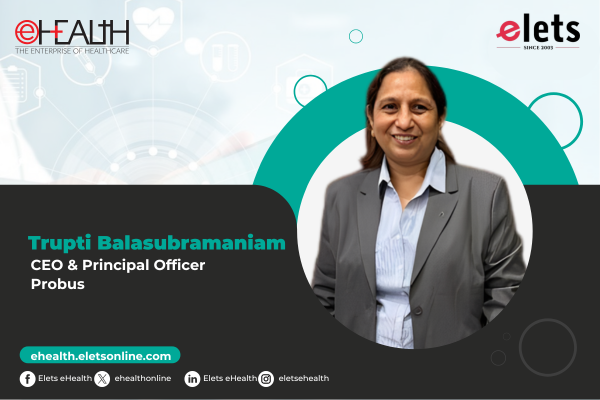
Views expressed by: Trupti Balasubramaniam, CEO & Principal Officer, Probus

 Like
Like
 Dislike
Be a part of Elets Collaborative Initiatives. Join Us for Upcoming Events and explore business opportunities. Like us on Facebook , connect with us on LinkedIn and follow us on Twitter , Instagram.
Disclaimer: The views and opinions expressed in this article are solely those of the author and do not necessarily reflect the official policy or views of any organisation. The content is intended for informational and educational purposes only and should not be construed as medical advice.
"Exciting news! Elets technomedia is now on WhatsApp Channels Subscribe today by clicking the link and stay updated with the latest insights!" Click here!