



Article
India’s Pharma GCCs: The Digital Engines of Global Healthcare
India’s Pharma GCCs: The Digital Engines of Global Healthcare
![]() By Dr. Asawari Savant, eHealth Network - 10 June 2026
By Dr. Asawari Savant, eHealth Network - 10 June 2026


The next breakthrough in medicine may not come from a lab, it may come from a line of code. India’s pharmaceutical industry is entering a defining moment, where algorithms are accelerating discovery, data is shaping clinical decisions, and innovation is no longer bound by physical laboratories. The centre of gravity has decisively shifted, from microscopes to machine intelligence, from isolated research units to interconnected digital ecosystems. In this new paradigm, the question is no longer where science happens, but where science scales.
India has been traditionally cast in a supporting role, valued for efficiency and cost. That narrative has changed. India is not just participating in global pharma innovation; it is orchestrating it. At the heart of this transformation are Global Capability Centres (GCCs), which have evolved from back-end support units into strategic nerve centres powering discovery, development, and delivery at scale. With over 1,700 GCCs and a market poised to touch USD 105 billion by the end of the decade, India represents something far more significant than a growth story. It is where deep scientific expertise converges with advanced digital capabilities to solve some of healthcare’s most complex challenges faster, smarter, and at an unprecedented scale.
From Delivery Centres To Innovation Hubs
The narrative of the Indian GCC has moved decisively beyond labour arbitrage. This shift is visible in the complexity of work being handled. Pharma GCCs now manage approximately 70% of finance, 75% of HR, and 67% of IT operations for their global parent organisations. But more importantly, they are expanding into high-value domains:

- R&D and clinical trials: India-based teams are now deeply embedded in global medicine development models, contributing to chemistry, biostatistics, and clinical operations.
- Agile problem solving: The convergence of life sciences expertise with AI and digital technologies allows these hubs to solve complex problems with precision and speed.
- Strategic integration: Increased collaboration with global stakeholders has positioned GCCs as key contributors to enterprise-wide strategy.
The engine driving this growth is India’s unparalleled talent pool. The country produces 2 million STEM graduates annually and boasts a 2.7 million-strong life sciences professional base. This unique combination of tech and bio is what enables pharma companies to build future-ready capabilities. Innovation at scale requires a cross-disciplinary approach. When you bring together a molecular biologist, a data scientist, and a digital engineer in the same room, the results are transformative:

- Compressed timelines: Indian GCCs are reportedly shaving 1-2 years off drug development cycles and reducing R&D-to-launch costs by approximately 5%.
- Rapid regulatory submissions: In some cases, teams have compressed clinical reporting timelines from 12 weeks to just two to four weeks by leveraging in-house biostatistics and regulatory science expertise.
- End-to-end discovery: From drug discovery to commercialisation, this techno-functional talent is accelerating innovation across the entire pharma value chain.
Also read: The Missing Link: Why India’s Preventive Health Future Needs a Mindset Reset
Driving Innovation Through Ownership
Perhaps the most significant marker of maturity is the shift towards end-to-end ownership. India’s GCCs are no longer just implementing work orders but are owning global platforms and delivering integrated solutions. This ownership model is redefining India’s role from a service provider to a global healthcare partner. We see this in the way GCCs now lead global mandates in product development, by owning the lifecycle of digital platforms and analytics tools. Beyond process execution, they now deliver global solutions that focus on patient outcomes.
Moreover, many GCCs now function as twins of their global counterparts, mirroring their capabilities and responsibilities. The scale of this ownership is massive. Major players have invested heavily in their Indian hubs, with centers employing associates to handle everything from drug development to manufacturing and supply chain.,
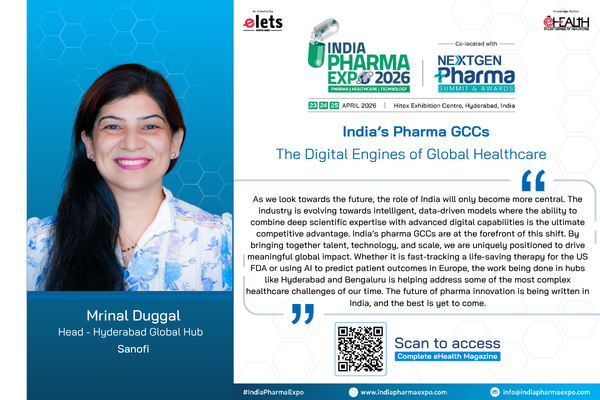
As we look towards the future, the role of India will only become more central. The industry is evolving towards intelligent, data-driven models where the ability to combine deep scientific expertise with advanced digital capabilities is the ultimate competitive advantage. India’s pharma GCCs are at the forefront of this shift. By bringing together talent, technology, and scale, we are uniquely positioned to drive meaningful global impact. Whether it is fast-tracking a life-saving therapy for the US FDA or using AI to predict patient outcomes in Europe, the work being done in hubs like Hyderabad and Bengaluru is helping address some of the most complex healthcare challenges of our time. The future of pharma innovation is being written in India, and the best is yet to come.
Views expressed by: Mrinal Duggal, Head – Hyderabad Global Hub, Sanofi
References available upon request.

 Like
Like
 Dislike
Be a part of Elets Collaborative Initiatives. Join Us for Upcoming Events and explore business opportunities. Like us on Facebook , connect with us on LinkedIn and follow us on Twitter , Instagram.
Disclaimer: The views and opinions expressed in this article are solely those of the author and do not necessarily reflect the official policy or views of any organisation. The content is intended for informational and educational purposes only and should not be construed as medical advice.
"Exciting news! Elets technomedia is now on WhatsApp Channels Subscribe today by clicking the link and stay updated with the latest insights!" Click here!