



Article
Wearable AI Detecting Pain and Distress For Non-verbal Patients
Wearable AI Detecting Pain and Distress For Non-verbal Patients
![]() By Dr. Asawari Savant, eHealth Network - 30 April 2026
By Dr. Asawari Savant, eHealth Network - 30 April 2026


Across the world, countless families care for loved ones who can’t easily communicate when something is wrong. From nonverbal autistic children to people living with advanced dementia or neurological conditions, these individuals rely on caregivers to translate behavior into meaning. What looks like a gesture might be pain; what sounds like restlessness might be fear.
For parents, partners, and professionals, that responsibility never ends. Caregivers often sleep lightly, alert for the smallest sign of distress, fearing what might happen if a cry goes unheard. Studies estimate that families providing round-the-clock care spend over 58–63 hours a week monitoring symptoms and behaviours, with emotional burnout common. Yet even with constant attention, silent suffering still slips through.
The Need to Reimagine Clinical Care with Technology

For patients who cannot speak or sign, clinicians learn to read the body instead. A grimace, a tensed limb, or a shift in breathing may carry meaning. Structured scales such as the Critical Care Pain Observation Tool score these cues, including facial expression, movement, and ventilator tolerance, while clinicians track heart rate, blood pressure, and respiratory changes. Patterns in heart rate variability or skin conductance can hint at distress, though no single signal is conclusive.

It’s hard to imagine what countless caregivers face, the heartbreak of sensing something is wrong but not knowing what or where. It also sparks a vital question: what if technology could listen when words fail? What if a wearable could sense distress before a human could see it, translating hidden physiological signals into real-time alerts that guide timely care?
Sensors Extend the Clinician’s View
Medical-grade wearables now help fill those gaps. Devices such as the Empatica E4 and Shimmer capture continuous biosignals while meeting ISO 13485 and HIPAA standards. They track heart rate and variability through PPG or ECG, measure electrodermal activity for autonomic arousal, and monitor temperature, muscle activity, and even brain waves. Some experimental models analyze sweat or tear chemistry for signs of inflammation or stress. Together, they can offer a round-the-clock physiological window into pain.
What Today’s Wearables Miss
Most commercial devices today act like smoke alarms: they cannot tell burnt toast from a house fire. Built for fitness and sleep, they lack the nuance to detect pain in nonverbal or unconscious patients. For autistic users, touch or vibration can be overwhelming, and studies report sensory processing difficulties in 69–93% and motor challenges in up to 87% of diagnosed individuals. False positives remain common, as anxiety or movement can mimic pain and trigger alert fatigue. Population averages also miss the wide variability among autistic children, people with dementia, and ICU patients.
The Edge AI Advantage
A better approach pairs human observation with adaptive edge intelligence. On-device AI can learn individual baselines, interpret biosignals privately, and alert only when true pain patterns emerge. This local processing reduces noise, protects privacy, and restores clinician confidence, turning raw data into a more trustworthy signal of what the patient’s body is trying to say.
Designing a Wearable Interpreter
Imagine a small wristband, patch, or headband that speaks when its wearer cannot. It does not use words, only quiet signals drawn from the body itself. Beneath its smooth surface, sensors listen to the pulse of life, tracking heart rate, skin temperature, skin conductance, and subtle movements.
Over time, the device learns what “normal” looks like for each individual, building a personal baseline that lives entirely on the device. When that rhythm changes in meaningful ways, such as a heart beating faster than usual, a sudden rise in skin temperature, or restless movement, the device quietly takes note and flags the change.
EEG capability may one day add deeper context, but for now, the focus is on simplicity and comfort. Each wearer can choose the form that feels right, whether a soft patch on the arm, a wristband, or a light headband that blends into daily routine.
Real-world moments reveal how powerful this can be. A child on the spectrum begins touching their mouth repeatedly, and sensors detect small spikes in heart rate and skin conductance. The device recognizes the pattern and prompts the caregiver, hinting that something, perhaps dental pain, may need attention. For an adult living with chronic pain, a pattern of disrupted sleep and restless motion can signal an early need for support before discomfort grows worse.
Pain often hides in silence. Such a device could give that silence a voice. By turning physiological signals into clear, timely prompts, it helps caregivers understand what the body is trying to say. The goal is not diagnosis but awareness, a chance for earlier attention, calmer days, and a quiet form of empathy powered by intelligence that listens.
Why Iteration Is Everything
Building such a device is one of the most demanding challenges in modern healthcare and is not a one-shot effort. Success depends on continuous refinement:
- i) Data collection and labeling must evolve to capture accurate physiological variations.
ii) Model training requires multiple feedback loops to tune accuracy without overfitting.
iii) Benchmarking and validation must ensure the device performs reliably across users and environments.
Each cycle builds on the last, a journey that demands both computational power and process discipline.
Privacy by Design: Protecting What Matters
When data represents human pain, privacy cannot be an afterthought. Shifting computation from the cloud to the edge ensures sensitive signals are processed directly on the device, reducing exposure risks and latency.
To reinforce that protection, end-to-end encryption keeps information secure through every stage, from data capture to model deployment, ensuring that personal health data remains private even as models evolve.
Also read: Clinician Time Is the New ROI
Looking ahead
Bringing it all together, the real advantage lies in having a unified, end-to-end approach that removes fragmentation from the Edge AI development journey. When data preparation, model development, testing, and deployment are seamlessly connected, teams can move faster, reduce errors, and maintain complete visibility across the lifecycle. This not only improves efficiency and lowers dependency on costly wearables but also ensures that performance, privacy, and reliability are built into every stage. Ultimately, it enables healthcare professionals to focus less on managing complexity and more on delivering high-quality, trustworthy innovations that are ready for real-world patient impact.
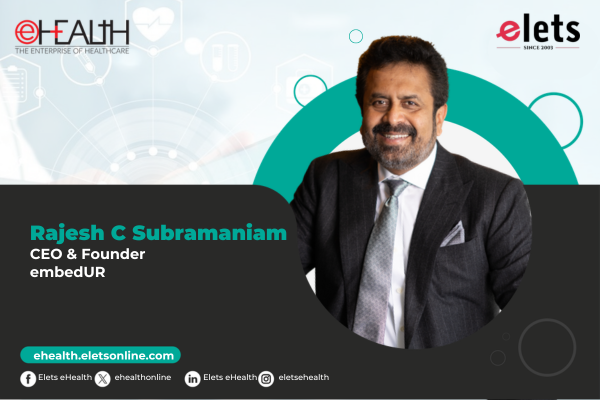
Views expressed by: Rajesh C Subramaniam, CEO & Founder, embedUR

 Like
Like
 Dislike
Be a part of Elets Collaborative Initiatives. Join Us for Upcoming Events and explore business opportunities. Like us on Facebook , connect with us on LinkedIn and follow us on Twitter , Instagram.
Disclaimer: The views and opinions expressed in this article are solely those of the author and do not necessarily reflect the official policy or views of any organisation. The content is intended for informational and educational purposes only and should not be construed as medical advice.
"Exciting news! Elets technomedia is now on WhatsApp Channels Subscribe today by clicking the link and stay updated with the latest insights!" Click here!