


News
NFHS-6 Reveals India’s Mixed Health Transition: Child Malnutrition Falls, Healthcare Access Improves, But Obesity & Lifestyle Diseases Surge
NFHS-6 Reveals India’s Mixed Health Transition: Child Malnutrition Falls, Healthcare Access Improves, But Obesity & Lifestyle Diseases Surge
![]() By Dr. Asawari Savant, eHealth Network - 30 May 2026
By Dr. Asawari Savant, eHealth Network - 30 May 2026


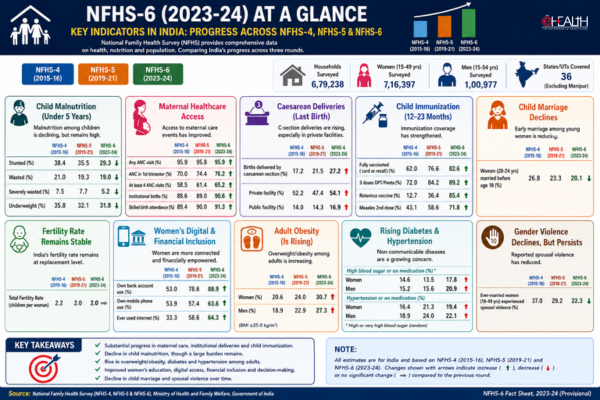
India’s latest National Family Health Survey (NFHS-6) paints a complex portrait of the country’s public health journey, one marked by significant gains in maternal and child healthcare, declining child marriage and stronger digital and financial inclusion, but also rising obesity, diabetes and high caesarean deliveries.

Released in May 2026, the National Family Health Survey (NFHS-6) 2023-24 covers 101 health, nutrition and demographic indicators across India and States/UTs. The survey gathered information from over 6.79 lakh households, more than 7.16 lakh women and over one lakh men, making it one of India’s most comprehensive health databases.
The findings signal that India is increasingly confronting a “double burden” of disease, where undernutrition and infectious health concerns coexist with rapidly expanding non-communicable diseases (NCDs).
Child Malnutrition: Shows Improvement, But Remains a National Concern
Among the most encouraging findings is the improvement in child nutrition indicators.

Stunting among children under five, a key marker of chronic malnutrition, has declined to 29.3 per cent from 35.5 per cent in NFHS-5. Wasting has marginally reduced to 19 per cent from 19.3 per cent, while severe wasting has dropped substantially from 7.7 per cent to 5.2 per cent. Underweight prevalence has also improved slightly, falling to 31.8 per cent from 32.1 per cent.
These reductions suggest that nutrition-focused interventions, including maternal nutrition programmes, immunisation drives and food supplementation initiatives, may be contributing to gradual improvements in child health outcomes.
However, the numbers also underline that nearly one in three Indian children still suffers from chronic undernutrition, indicating persistent structural gaps related to food diversity, sanitation, maternal nutrition and household income.
Another concern emerging from the survey is infant and young child feeding. Only 15.3 per cent of children aged 6–23 months receive an adequate diet, despite improvements over the previous round. Exclusive breastfeeding among children under six months stands at 55.8 per cent, lower than the 63.7 per cent reported in NFHS-5.
Maternal Healthcare Access Improves Significantly
The survey highlights notable progress in maternal healthcare access and service utilisation.
Nearly 96 per cent of mothers received antenatal care, while 65.2 per cent completed at least four antenatal visits, an improvement over the previous survey round. Early antenatal registration during the first trimester also rose to 76.2 per cent.
Iron and folic acid supplementation witnessed strong gains. The proportion of pregnant women consuming iron-folic acid tablets for at least 100 days rose to 54.9 per cent, while those consuming supplements for 180 days or more climbed to 37.8 per cent.
Institutional deliveries continue to dominate childbirth practices in India, reaching 90.6 per cent nationally, with over 91 per cent of births attended by skilled health personnel.
Postnatal care has also strengthened. More than 82 per cent of mothers and 85 per cent of newborns received postnatal care within two days of delivery.
These findings indicate steady strengthening of maternal and newborn health systems and greater uptake of healthcare services.
Caesarean Births: Rise Sharply, Triggering Fresh Debate
One of the most striking findings in NFHS-6 is the continued rise in caesarean deliveries.
Nationally, 27.2 per cent of births are now delivered through caesarean section, up sharply from 21.5 per cent in NFHS-5.
The disparity between public and private healthcare remains pronounced. Caesarean deliveries account for 54.1 per cent of births in private health facilities compared with 16.9 per cent in public institutions.
The data is likely to revive concerns among health experts regarding medically unnecessary surgical deliveries, financial incentives and variations in obstetric practices between public and private systems.
Vaccination Coverage Strengthens
Immunisation coverage continues to improve across several indicators.
Full vaccination coverage among children aged 12–23 months increased to 82.6 per cent from 76.6 per cent. Coverage for rotavirus vaccination has seen particularly dramatic growth, rising from 36.4 per cent to 85.4 per cent.
The second dose of measles-containing vaccine has also expanded considerably, reaching 71.8 per cent from 58.6 per cent in the previous survey.
Public health facilities remain the backbone of vaccination delivery, administering nearly 96 per cent of childhood vaccinations.
These findings suggest that immunisation systems have recovered and expanded following disruptions experienced during the pandemic period.
Child Marriage Declines, Fertility Stabilises
NFHS-6 records encouraging demographic shifts.
The percentage of women aged 20–24 years married before age 18 has declined to 20.1 per cent from 23.3 per cent. Teenage pregnancy remains relatively stable at 6.7 per cent.
India’s total fertility rate remains at 2.0 children per woman, indicating continued demographic stabilisation and sustained movement toward replacement-level fertility.
Family planning use has expanded modestly, with 69.1 per cent of currently married women reporting use of any contraceptive method. At the same time, unmet need for family planning has declined to 8.5 per cent.
However, female sterilisation continues to dominate India’s contraceptive basket, accounting for 36.5 per cent of contraception use, while male sterilisation remains negligible at only 0.5 per cent.
This imbalance highlights the continuing gendered burden of family planning responsibility.
Digital India Reflected in Women’s Inclusion Gains
The survey offers evidence of India’s expanding digital and financial inclusion, particularly among women.
Nearly 89 per cent of women now have and use their own bank or savings account, compared to 78.6 per cent in NFHS-5.
Women’s access to mobile phones has increased to 63.6 per cent from 53.9 per cent, while internet usage among women has almost doubled, rising from 33.3 per cent to 64.3 per cent.
Women’s education levels also improved. Nearly 46.4 per cent of women aged 15–49 now have ten or more years of schooling, up from 41 per cent earlier.
The survey’s inclusion of newer indicators such as digital literacy, financial transactions and self-help group participation reflects a broader understanding of health as closely linked to economic and social empowerment.
India Faces Rising Obesity and Diabetes Challenge
While traditional health indicators improve, NFHS-6 reveals a rapidly escalating NCD burden.
Overweight and obesity among adults have risen significantly.
Among women aged 15–49 years, 30.7 per cent are now overweight or obese, compared with 24 per cent in NFHS-5. Among men, the prevalence stands at 27.3 per cent, up from 22.9 per cent.
At the same time, blood sugar levels indicate increasing diabetes risk.
About 17.8 per cent of women and 20.9 per cent of men have high or very high blood sugar levels or are on medication for diabetes.
Hypertension also remains widespread, affecting 19.4 per cent of women and 22.1 per cent of men.
These figures reinforce concerns that India is undergoing a rapid epidemiological transition in which lifestyle diseases are becoming major public health challenges.
Gender-Based Violence Declines but Persists
NFHS-6 records a decline in reported spousal violence, though the prevalence remains substantial.
The proportion of ever-married women reporting spousal violence has fallen to 22.3 per cent from 29.2 per cent in NFHS-5.
Women’s participation in household decision-making remains high, with 89 per cent reporting involvement in major household decisions.
The use of hygienic menstrual protection methods among young women aged 15–24 stands at 79.2 per cent.
While these indicators reflect social progress, the persistence of violence and unequal access across regions indicates unfinished work on gender equity and safety.
Also read: Piyush Singla Appointed Director in Ayushman Bharat Digital Mission
A Health Transition Still in Progress
NFHS-6 presents India as a nation navigating simultaneous public health realities.
On one hand, maternal healthcare, immunisation, women’s education and institutional health access have improved substantially. Child marriage is declining and financial inclusion is widening.
On the other, stubborn child undernutrition, poor dietary diversity, rising obesity, diabetes and hypertension indicate that India’s healthcare agenda is no longer limited to infectious disease and maternal-child survival alone.
The challenge for policymakers now lies in balancing unfinished nutrition and reproductive health goals with the growing threat of non-communicable diseases.
As India advances toward its Sustainable Development Goals and universal health coverage ambitions, NFHS-6 may serve not merely as a statistical exercise but as a roadmap for the country’s next phase of public health planning.
Key takeaways:
- Big positives: institutional births, vaccination coverage, antenatal care, decline in child marriage, women’s digital and banking access.
- Major red flags: rising obesity, diabetes, hypertension, persistently high child malnutrition, low adequate diet among children, and growing C-section rates.
The survey itself notes that NFHS-6 included newer themes such as digital literacy, DBT, SHG coverage and expanded biomarker testing including HIV, and that the findings are provisional based on fieldwork conducted during 2023–24 involving 679,238 households, 716,397 women and 100,977 men.

 Like
Like
 Dislike
Be a part of Elets Collaborative Initiatives. Join Us for Upcoming Events and explore business opportunities. Like us on Facebook , connect with us on LinkedIn and follow us on Twitter , Instagram.
"Exciting news! Elets technomedia is now on WhatsApp Channels Subscribe today by clicking the link and stay updated with the latest insights!" Click here!