



Article
How India’s Pediatric Heart Care System Can Evolve: The Role of NGOs and Policy
How India’s Pediatric Heart Care System Can Evolve: The Role of NGOs and Policy
![]() By Dr. Asawari Savant, eHealth Network - 26 August 2025
By Dr. Asawari Savant, eHealth Network - 26 August 2025


Every child deserves a healthy heart. Yet in India, nearly 240,000 children are born each year with congenital heart disease (CHD). Of these, close to 60% require early intervention to survive. Tragically, many never receive it. This gap is not due to medical limitations—it is a systemic problem, one that we must acknowledge and fix together.

Pediatric heart care in India is heavily skewed. Specialised services exist, but they are scattered and concentrated in urban centres. For most children in remote areas, timely treatment remains out of reach. Shortages of trained doctors, underfunded programs, and inadequate hospital infrastructure further worsen the challenge.
Government schemes have begun to move the needle. Initiatives like Ayushman Bharat, Rashtriya Bal Swasthya Karyakram (RBSK), and Janani Shishu Suraksha Karyakram have brought pediatric heart conditions into the mainstream of public health. Many now cover up to 55% of surgeries in government hospitals, with some states achieving even higher coverage.
Kerala provides a strong model. Its Hridyam platform tracks each diagnosed child from detection through treatment and follow-up. Real-time data ensures that local and tertiary centres remain connected, reducing dropouts, shortening delays, and keeping every child visible in the system. This kind of visibility is urgently needed across India. Every state must know its numbers and act on them.

Another critical gap lies in early detection. National guidelines recommend universal newborn screening for heart defects, but in practice, this remains inconsistent. Primary health centres need better equipment, and obstetricians and nurses require training. Screening must become routine, not optional.
The Role of NGOs
NGOs are not bystanders in this mission—they are co-pilots. Many are stepping in where public systems fall short: conducting awareness drives, organising free screening camps, funding surgeries, and even supporting families with transport and accommodation.
Their role goes beyond charity. NGOs are increasingly embedded in the system—training paediatricians, supporting digital innovations, and partnering with state governments and private hospitals.
Yet despite government schemes and NGO efforts, families are still paying out of pocket. Roughly 35% of all procedures remain partially self-funded. For low-income households, this can mean postponing—or worse, foregoing—lifesaving treatment. This is unacceptable.
What Must Be Done
- Scale What Works: Kerala’s Hridyam model should be adapted nationwide. Every region must have at least one Center of Excellence for pediatric heart care, digitally linked to smaller hospitals and primary care centres.
- Institutionalise Partnerships: NGOs should not have to knock on government doors. Their participation must be built into health planning. Shared infrastructure, co-funding models, and integrated training programs can expand reach and efficiency.
- Universalise Screening: Every child born in a public or private facility must be screened for congenital heart defects. The technology exists; what is needed is the will to make it mandatory.
- Innovate Financing: Beyond government schemes, we need targeted insurance products, pre-paid treatment vouchers, and a dedicated pediatric heart fund. These tools can ease the burden on families and reduce treatment delays.
- Invest in People: India has the talent, but not enough trained pediatric cardiologists and surgeons. Continuous training—led by NGOs, hospitals, and international partners—must become a national priority. This extends to frontline health workers as well.
Also read: How the Insurance Amendment Act Can Power India’s Healthspan & Lifespan Revolution
Moving Forward
The future of pediatric heart care in India does not rest on one institution. It depends on collaboration.
- Government programs provide the foundation.
- NGOs bring speed, reach, and innovation.
- Digital platforms ensure visibility and continuity.
But above all, it is our collective urgency that will determine how many children survive and thrive. We have the knowledge. We have the tools. Now we must act—together, and fast.
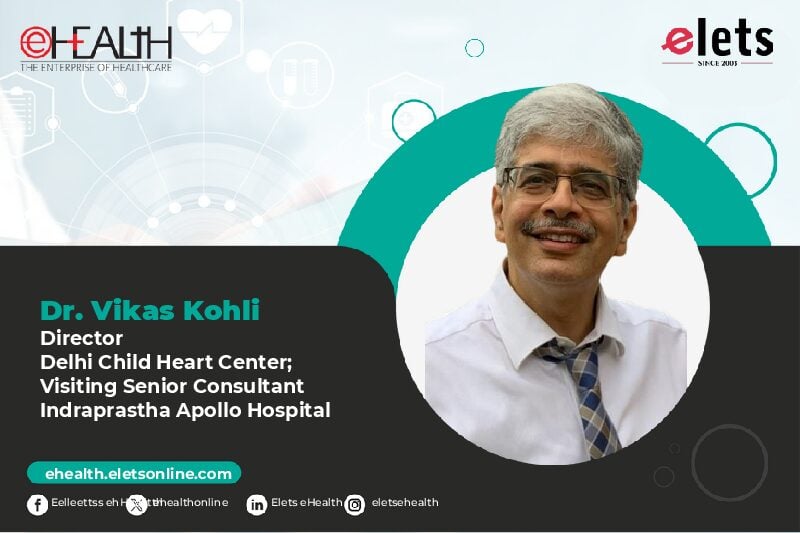
Views expressed by: Dr. Vikas Kohli, Director, Delhi Child Heart Centre and Visiting Senior Consultant, Indraprastha Apollo Hospital

 Like
Like
 Dislike
Be a part of Elets Collaborative Initiatives. Join Us for Upcoming Events and explore business opportunities. Like us on Facebook , connect with us on LinkedIn and follow us on Twitter , Instagram.
Disclaimer: The views and opinions expressed in this article are solely those of the author and do not necessarily reflect the official policy or views of any organisation. The content is intended for informational and educational purposes only and should not be construed as medical advice.
"Exciting news! Elets technomedia is now on WhatsApp Channels Subscribe today by clicking the link and stay updated with the latest insights!" Click here!