


Magazine
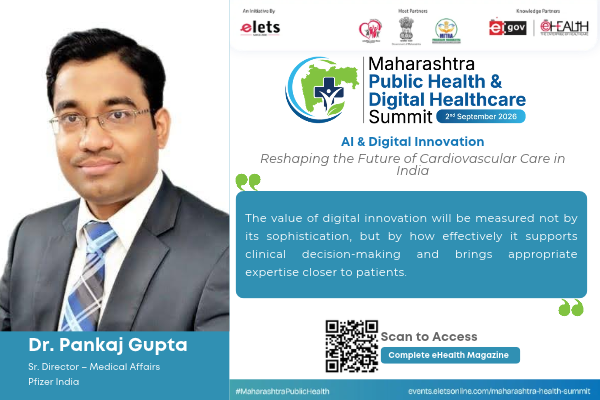
AI & Digital Innovation: Reshaping the Future of Cardiovascular Care in India
AI & Digital Innovation: Reshaping the Future of Cardiovascular Care in India
![]() By Dr. Asawari Savant, eHealth Network - 13 October 2026


Cardiovascular disease (CVD) is India’s leading cause of death, responsible for close to one-third of all deaths.¹ Yet within this familiar burden lies a quieter challenge: heart conditions that often announce themselves first not as symptoms, but as a sound – a murmur, long before a patient feels unwell.

Valvular and rheumatic heart disease are cases in point. India carries a heavy share of the global rheumatic heart disease burden, South Asia alone accounts for more than half of the world’s RHD deaths, and undetected sub-clinical disease is estimated to be seven to ten times more common than clinically diagnosed cases.³ These conditions tend to strike early and silently, concentrated among younger adults and in underserved rural communities.
Advertisement
The paradox is that they are frequently detectable at the very first point of care. The stethoscope remains the frontline screening tool, yet conventional auscultation identifies fewer than half of clinically significant valve lesions even in experienced hands.⁴ This is precisely where digital innovation and artificial intelligence can strengthen care at the front line.
Strengthening Care Through Digital Innovation
Digital health and artificial intelligence (AI) are creating opportunities to strengthen healthcare delivery by supporting clinicians, improving care coordination and extending access to specialist knowledge. Rather than replacing clinical judgement, these technologies complement medical expertise and provide additional information at the point of care.

One area where this potential is particularly relevant and is seeing green shoots is cardiovascular screening. AI-enabled tools can support frontline healthcare professionals during routine assessments and help identify patients who may require further evaluation.
A technological breakthrough that is changing patients’ lives today is Ai-Steth, an AI-enabled smart stethoscope developed by AI Health Highway and supported through Pfizer’s INDovation programme. The technology is designed to screen and detect heart disorders using AI and machine learning.⁵ Through Pfizer’s support under the INDovation programme, Ai-Steth was deployed across 18 Primary Healthcare Centres in Satara, Maharashtra to screen more than 3,850 individuals, including for valvular heart disorders⁶ as part of chronic noncommunicable disease screening. Beyond the pilot, the real value lies in scale: if such frontline screening tools were integrated across thousands of PHCs, they could strengthen early identification and referral for cardiovascular conditions, particularly where specialist access is limited. The clinician remains central interpreting the findings and deciding the next step with the technology serving to support, not replace, clinical judgement.
Digital transformation can also support care beyond initial screening. Electronic Medical Records (EMRs), interoperable health systems and digital clinical pathways can improve communication across providers and support continuity throughout a patient’s journey. As initiatives like the Ayushman Bharat Digital Mission expand India’s digital health backbone, screening, referral and follow-up can be connected more seamlessly, easing specialist burden and improving system efficiency.⁷ For these technologies to deliver meaningful value, however, they need appropriate validation, training and integration into clinical workflows, guided by data quality, privacy and accountability.
Building an Ecosystem for Innovation
Translating promising technologies into practical healthcare solutions requires collaboration. Technology developers, healthcare professionals, public health systems, academia and industry each bring capabilities that can contribute to responsible innovation. Pfizer’s INDovation programme supports healthcare start-ups working on healthcare-focused innovations, including digital health and medical technologies, through grants and incubation support, alongside mentorship and technical expertise from its partner network.⁸ Ai-Steth is one example of how healthcare innovation can move beyond product development towards real-world implementation. Ultimately, the success of digital innovation will depend on its ability to be adopted, integrated and scaled within existing healthcare systems.
Looking Ahead
India has the clinical expertise, innovation ecosystem and expanding digital health infrastructure to build a more connected model of cardiovascular care. What excites the medical community is the opportunity to move beyond individual pilots, scaling validated AI-enabled solutions to enable earlier detection, wider reach and greater efficiency. Realizing this will require continued investment in digital infrastructure, robust validation of AI-enabled technologies and collaboration across the healthcare ecosystem from the ground up.
As digital technologies evolve, their value will be judged not by sophistication, but ultimately measured by how effectively they support clinical decision-making and care delivery. By combining scientific progress with responsible innovation and strong partnerships, India can truly strengthen cardiovascular care in a way that brings appropriate expertise closer to patients and supports healthcare professionals at the point of care.
Views expressed by: Dr. Pankaj Gupta, Sr. Director – Medical Affairs, Pfizer India
Edited by: Dr. Asawari Savant, ENN
Disclaimer: The health information contained herein is for awareness purposes only and is not intended to replace discussions with a medical practitioner and/or medical advice. Your doctor is the best source for medical advice and information. While due care and caution has been taken to ensure that the content is free from mistakes or omissions, Pfizer makes no representations or warranties of any kind, expressed or implied as to the accuracy completeness or adequacy of the same, and will not be liable for any damages adverse events and personal liability arising therefrom.
References
- World Health Organization. Cardiovascular diseases (CVDs). Accessed August 2026.
- Negi PC, Sondhi S, Asotra S, Mahajan K, Mehta A. Current status of rheumatic heart disease in India. Indian Heart J. 2019;71(1):85–90. doi:10.1016/j.ihj.2018.12.007.
- Naseeb K, Khan MN, Soomro NA, et al. Temporal trends and burden of rheumatic heart disease in South Asia: a comprehensive analysis of three decades from the Global Burden of Disease Study. Glob Heart. 2024;19(1). doi:10.5334/gh.1336.
- Gardezi SKM, Myerson SG, Chambers J, et al. Cardiac auscultation poorly predicts the presence of valvular heart disease in asymptomatic primary care patients. Heart. 2018;104(22):1832–1835. doi:10.1136/heartjnl-2018-313082.
- Pfizer India. Six start-ups in Oncology and Digital Health to receive grants of 65 lakh each under Pfizer’s INDovation Program. 12 September 2022.
- Pfizer Limited. Annual Report 2023–24. [Documents Ai-Steth’s deployment across 18 PHCs in Satara and screening of more than 3,850 individuals.]
- National Health Authority. Ayushman Bharat Digital Mission (ABDM). Accessed August 2026.
- Pfizer India. INDovation – Healthcare innovations made in India. Accessed August 2026.

 Like
 Dislike
Be a part of Elets Collaborative Initiatives. Join Us for Upcoming Events and explore business opportunities. Like us on Facebook , connect with us on LinkedIn and follow us on Twitter , Instagram.
"Exciting news! Elets technomedia is now on WhatsApp Channels Subscribe today by clicking the link and stay updated with the latest insights!" Click here!