



Magazine
How India Can Close the Gap Between Maritime Medical Regulation and On-Ground Reality?
How India Can Close the Gap Between Maritime Medical Regulation and On-Ground Reality?
![]() By Dr. Asawari Savant, eHealth Network - 13 October 2026


The rising maritime ambitions of India are giving birth to a healthcare problem worthy of serious consideration. As India gears up to create more seafarers to meet the shipping needs of the country, the mechanisms validating the medical fitness of such people need to be upgraded in tandem. The Seafarer Workforce Report 2026 by BIMCO and International Chamber of Shipping cites India as the second biggest source of seafarers in the world with 311,936 seafarers making up 12.16% of the total global seafarers’ workforce. The increase in the volume of seafarers means an increasing amount of people go through India’s medical and certification procedures for the ship crew. Medical fitness is not just a formality at the start of employment. When seafarers spend considerable time away from home with no access to specialized medical options, fitness becomes crucial for individual health and the safety of the crew and operations.

India has a highly defined regulatory framework for this objective. The Directorate General of Shipping (DG Shipping) determines medical standards and requirements through an approved medical checkup process that complies with international requirements like Standards of Training, Certification and Watchkeeping Convention, plus the Maritime Labour Convention, 2006. These standards must maintain rigour. However, with an increasing maritime workforce, the question of accessibility, capability and coordination of the system for implementing these standards has emerged.
A larger seafarer workforce puts greater pressure on medical systems
The strictness of maritime medical examinations can be explained by the working environment. The reason for this belief is that seamen spend weeks and months on ships, with the access to emergency and specialized care limited. Thus, such medical examinations as sight and hearing tests, tests for cardiovascular health and physical ability, are important in establishing whether a person can perform his duties.
It can be seen that the valuation of the legal framework is to be based not only on the requirements it has as there are other criteria to be assessed. Thus, if a medically fit person gets delayed in appointment, passing of necessary tests, preparation of medical document, the objective of the legal framework is achieved to a certain extent only. The next step of the maritime medical framework is to make the way to the achievement of the objective easier rather than to make requirements lower.

Where the certification journey can slow seafarers down
Cadets and seafarers face the challenge of not only the examination but also the logistics involved in traveling to the examination center. Depending on their base location, this may mean traveling far to an approved center, planning the travel around appointment availability and completing numerous clinical and diagnostic requirements in a set time. Delays in the whole procedure could lead to a difficult situation for the candidates.
That’s why the difference between medical turnaround time and end-to-end certification turnaround time is important. Even if the examination itself goes smoothly, the overall time can still be influenced by delays related to appointments and documentation. As the number of candidates increases, approved centers should pay more attention to candidate management in addition to carrying out examinations.
Private healthcare can add capacity without diluting standards
The role of private healthcare service providers in addressing the challenge of capacity must be built on the foundation of regulation. The strategy must not be aimed at coming up with alternatives to the DG Shipping system but increasing the amount of healthcare infrastructure accessible to those working under this system.
Integrated facilities can combine clinical evaluation and appropriate diagnostic services into a single process, thus minimizing the need to transfer from one provider to another. Improved scheduling of appointments, clear workflows, and coherent documentation will help to reduce delays and improve the effectiveness and accessibility of the private healthcare sector.
Turning medical certification into a pathway for ongoing care
There is an opportunity to reconsider the process of post-examination. Medical examination can detect a medical issue that requires further assessment or treatment. In addition, while certification should be strictly focused on assessing fitness for duty, more appropriate ways for further treatment can ensure that the employee’s fitness level is kept at a good level.
Connecting medical examination with checking the patient’s diagnosis, consultation with relevant specialists, preventive healthcare and necessary further assistance can motivate sailors to treat their medical problems before they escalate. This is especially important for this working area, as spending long periods away from the shore can hinder access to regular healthcare.
Building a more connected healthcare ecosystem for seafarers
For MedRabbits clinic, its DG Shipping certification represents a starting point for building a more connected healthcare ecosystem for India’s maritime workforce. The clinic has been authorised to conduct mandatory pre employment medical examinations for Merchant Navy officers and crew in accordance with DG Shipping standards, with a focus on making evaluations more accessible, organised and seamless for seafarers, shipping companies and crewing agencies.
Going forward, MedRabbits aims to build on this foundation by connecting medical evaluations with diagnostics, consultations, preventive healthcare and appropriate follow up. Its existing clinic to home model already brings consultations, diagnostics, preventive health assessments, chronic disease management, physiotherapy and home healthcare support into a connected care ecosystem. The larger opportunity is to ensure that maritime healthcare does not begin and end with certification, but can evolve into continuous support that helps seafarers address health concerns early and remain better prepared for the demands of life at sea.
Strengthening implementation as India’s maritime workforce grows
India’s maritime industry must implement rigorous quality standards while maintaining easy access to them. The legal framework defines the minimum required for the protection of seafarers and maritime activities, and it is up to the healthcare system to enable people to reach that minimum using the efficient method.
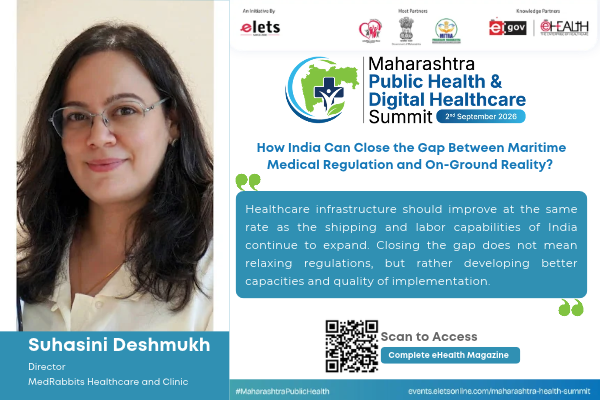
Healthcare infrastructure should improve at the same rate as the shipping and labor capabilities of India continue to expand. Closing the gap does not mean relaxing regulations, but rather developing better capacities and quality of implementation.
Views expressed by: Suhasini Deshmukh, Director, MedRabbits Healthcare and Clinic
Edited by: Dr. Asawari Savant, ENN

 Like
 Dislike
Be a part of Elets Collaborative Initiatives. Join Us for Upcoming Events and explore business opportunities. Like us on Facebook , connect with us on LinkedIn and follow us on Twitter , Instagram.
"Exciting news! Elets technomedia is now on WhatsApp Channels Subscribe today by clicking the link and stay updated with the latest insights!" Click here!