


Article
The Rise of Real-Time AI in Diagnostics
The Rise of Real-Time AI in Diagnostics
![]() By Dr. Asawari Savant, eHealth Network - 07 May 2026
By Dr. Asawari Savant, eHealth Network - 07 May 2026


Healthcare has always been constrained by time. In diagnostics, delays are not just operational inefficiencies; they directly affect clinical outcomes, costs, and patient trust. What is changing today is not just how fast we diagnose, but how diagnosis itself is evolving. Real-time AI is moving diagnostics from a sequential, delayed process to one that is continuous, responsive, and increasingly embedded into clinical workflows.
From sequential workflows to live decision support
Traditionally, diagnostics follow a linear path: image acquisition, queueing, reporting, and then clinical action. Even in efficient systems, this creates unavoidable delays. In high-acuity scenarios such as stroke or trauma, those delays are critical.
Real-time AI changes this model by processing data as it is generated whether imaging, vitals, or clinical records and surfacing actionable insights almost instantly. In radiology, CT scans can now be triaged at the point of acquisition, with suspected abnormalities flagged before a radiologist even opens the case.

This is not just about speed it is about reordering workflows. Urgent cases move to the top automatically, while routine scans are deprioritised or pre-processed. The result is a system where clinical attention is directed where it is needed most, without relying on manual intervention.

Speed that holds up in real-world conditions
The value of AI lies in combining speed with reliability. Across multiple deployments, AI models in imaging are demonstrating sensitivity and specificity in excess of 90% for well-defined use cases, while also reducing reporting turnaround times significantly particularly in triage workflows.
Consistency is equally important. Human interpretation varies with workload and fatigue, whereas AI systems operate within a narrower performance band. In emergency settings, especially for conditions such as intracranial haemorrhage, this consistency becomes a critical safety layer. This is not about replacing radiologists. It is about augmenting clinical judgement with systems that work continuously, flagging what must not be missed.
Solving for scale in the Indian context
The relevance of real-time AI becomes sharper when viewed through India’s healthcare constraints. The country has *fewer than 15 radiologists per million people, significantly below global benchmarks, while imaging demand continues to rise. CT scan volumes in India have been growing at an estimated 10-12% annually, driven by expanding access, urbanisation, and increasing disease burden.
In this context, delays are driven less by diagnostic complexity and more by capacity bottlenecks.
AI helps address this imbalance. By handling initial analysis and triage, it allows radiologists to focus on clinically significant cases. Routine scans, many of which turn out to be normal, can be processed faster, often with structured assistance.
The impact extends beyond large hospitals. Diagnostic centres in Tier-2 and Tier-3 cities, which may not have round-the-clock specialist availability, can deliver a level of diagnostic support that was previously limited to metro settings. AI, therefore, is not just improving efficiency it is expanding access to quality diagnostics.
Beyond imaging: towards a connected diagnostic ecosystem
Real-time AI is also expanding beyond standalone imaging use cases. Its role is increasingly tied to the broader diagnostic workflow integrating patient history, clinical data, and imaging outputs into a unified decision-support layer.
This enables a more connected system where insights are continuously updated rather than generated in isolation. For clinicians, it means better-informed decisions. For healthcare providers, it represents a shift towards integrated care pathways instead of fragmented diagnostic steps.
However, adoption requires more than procurement. Integration with hospital systems, alignment with clinical workflows, and strong data governance remain critical to successful deployment.
The economics of real-time AI
From a business perspective, real-time AI is no longer a discretionary upgrade it is an operational lever. For diagnostic chains and hospitals, the benefits are tangible: reduced turnaround times, improved utilisation of radiology assets, higher patient throughput, and lower dependence on outsourced reporting. At scale, these translate into *meaningful cost efficiencies and faster revenue cycles, while improving clinical service quality.
Also read: Transforming Patient Experience with Needle-Free Injection Technology
From optional to foundational
The rise of real-time AI in diagnostics is not a sudden disruption. It is a structural shift. It reduces delays, improves consistency, and expands access but more importantly, it changes how time is managed within healthcare systems. For healthcare leaders, the question is no longer whether AI will be part of diagnostics. It already is. The real challenge is how effectively it can be operationalised in a way that aligns with clinical workflows, regulatory requirements, and economic realities.
In the coming years, diagnostics will not be defined by how quickly reports are generated, but by how seamlessly insight is embedded into care delivery. Real-time AI is not just accelerating diagnostics it is redefining it as a continuous, integrated process.
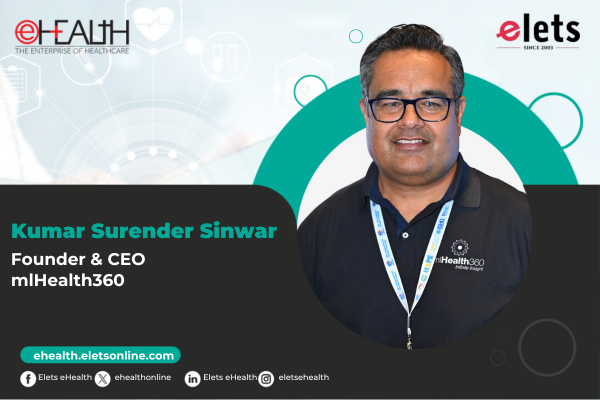
Views expressed by: Kumar Surender Sinwar, Founder & CEO, mlHealth360

 Like
Like
 Dislike
Be a part of Elets Collaborative Initiatives. Join Us for Upcoming Events and explore business opportunities. Like us on Facebook , connect with us on LinkedIn and follow us on Twitter , Instagram.
Disclaimer: The views and opinions expressed in this article are solely those of the author and do not necessarily reflect the official policy or views of any organisation. The content is intended for informational and educational purposes only and should not be construed as medical advice.
"Exciting news! Elets technomedia is now on WhatsApp Channels Subscribe today by clicking the link and stay updated with the latest insights!" Click here!