


Article
Geriatric Care Beyond Hospitals: Healing, Dignity, and Meaningful Longevity
Geriatric Care Beyond Hospitals: Healing, Dignity, and Meaningful Longevity
![]() By Dr. Asawari Savant, eHealth Network - 27 December 2025
By Dr. Asawari Savant, eHealth Network - 27 December 2025


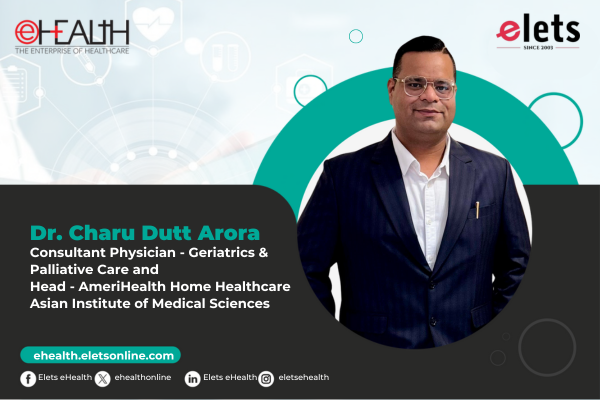
As India’s population ages rapidly, the conversation around elderly healthcare must evolve beyond episodic hospital-based treatment. As a consultant physician in geriatrics and palliative care, and as the Head of AmeriHealth Home Healthcare at the Asian Institute of Medical Sciences, I see every day that ageing is not merely about managing diseases—it is about preserving function, dignity, comfort, and meaning.

One of the most common misconceptions about geriatric care is that recovery is synonymous with hospitalisation. In reality, hospitals play a critical but time-bound role. The true journey of recovery—physical, emotional, and cognitive—often unfolds at home. I recall an 82-year-old gentleman who came to us after a prolonged ICU stay following a stroke. Medically stable, but bedridden, withdrawn, and labelled “non-improving.” With structured home-based rehabilitation involving physiotherapists, speech and swallow therapists, trained nurses, and behavioural therapy support, he not only regained mobility but also began eating independently and engaging with his family again. Healing, in his case, required continuity and familiarity—something no ward could offer.
Geriatric care is inherently multidisciplinary. Older adults rarely present with a single problem; they live with multiple chronic conditions, frailty, cognitive changes, and psychosocial vulnerabilities. Home-based care allows us to address these layers holistically. A fall-prone elderly woman with early dementia once told me, “Doctor, I don’t want to get better in a place where I feel lost.” With supervised nursing care, environmental modification, and cognitive stimulation therapy at home, her anxiety reduced, her falls stopped, and her quality of life improved—without repeated hospital admissions.
Palliative care, often misunderstood as end-of-life care alone, is an essential pillar of geriatric medicine. It focuses on symptom control, emotional support, and shared decision-making—right from the diagnosis of serious illness. I have seen families transform when pain is controlled, breathlessness eased, and difficult conversations are held with honesty and compassion. End-of-life care, when done right, is not about giving up—it is about ensuring dignity of death. A peaceful passing at home, surrounded by loved ones, with symptoms well managed, is a profoundly humane outcome that our healthcare system must value.

Wellness in ageing is another neglected domain. Healthy ageing is not accidental; it is cultivated through mobility, nutrition, mental engagement, and social connection. Geriatric care must therefore extend into preventive and rehabilitative spaces, supported by trained manpower and structured care models.
Also read: From Innovation to Implementation: Digital Public Health Transformation in India
As India braces for its silver wave, we must reimagine geriatric care as a continuum—spanning acute care, home-based recovery, palliative support, and dignified end-of-life care. The future lies not in more hospital beds alone, but in skilled human touch delivered where elders feel safest: their homes. Only then can longevity truly become meaningful longevity.
Views expressed by: Dr Charu Dutt Arora, Consultant Physician – Geriatrics & Palliative Care and Head – AmeriHealth Home Healthcare, Asian Institute of Medical Sciences

 Like
Like
 Dislike
Be a part of Elets Collaborative Initiatives. Join Us for Upcoming Events and explore business opportunities. Like us on Facebook , connect with us on LinkedIn and follow us on Twitter , Instagram.
Disclaimer: The views and opinions expressed in this article are solely those of the author and do not necessarily reflect the official policy or views of any organisation. The content is intended for informational and educational purposes only and should not be construed as medical advice.
"Exciting news! Elets technomedia is now on WhatsApp Channels Subscribe today by clicking the link and stay updated with the latest insights!" Click here!