



Article
The Missing Link: Why India’s Preventive Health Future Needs a Mindset Reset
The Missing Link: Why India’s Preventive Health Future Needs a Mindset Reset
![]() By Dr. Asawari Savant, eHealth Network - 06 June 2026
By Dr. Asawari Savant, eHealth Network - 06 June 2026


India is rapidly advancing in healthcare technology. Artificial intelligence, digital health platforms, wearables, telemedicine, and data-driven diagnostics are reshaping how healthcare is delivered across the country. From AI-enabled imaging to app-based consultations and population-scale health data systems, the tools for transformation are firmly in place.
Yet, despite this progress, a fundamental gap remains unresolved – the individual mindset toward health.
Most Indians continue to engage with healthcare only when illness strikes. Preventive health remains peripheral, episodic, or optional. This disconnect between advanced technology and everyday health behaviour is the missing link that India must urgently address.

Technology Is Ready. Behaviour Is Not.
India’s healthcare burden today is dominated by non-communicable diseases such as diabetes, hypertension, cardiovascular disease, chronic respiratory illnesses, and cancer. What is often overlooked is that many of these conditions are predictable, preventable, or manageable when detected early.

Technology and AI are designed precisely for this purpose, early detection, risk stratification, longitudinal tracking, and timely intervention. Yet adoption at the individual level remains inconsistent. Health apps are downloaded but rarely used. Wearables collect data without triggering sustained lifestyle change. Screening reminders are ignored until symptoms worsen.
The issue is not lack of innovation.
It is a lack of health ownership.
India’s Preventive Paradox
India presents a unique paradox in global healthcare. While healthcare costs in many developed countries are prohibitively high, India offers relatively low-cost diagnostics, consultations, and treatments. This makes preventive healthcare far more affordable and scalable here than in most parts of the world.
However, out-of-pocket expenditure remains high because care is often sought late. When diseases are detected at advanced stages, costs escalate rapidly—hospitalisation increases, complications multiply, and families bear significant financial and emotional stress.
In the Indian context, prevention is not just good medicine.
It is smart economics.
Technology’s True Role: From Tools to Daily Habits
The real promise of technology lies not in digitising hospitals alone, but in embedding health into daily life.
AI-driven platforms can move beyond diagnostics to influence behaviour, by personalising risk insights, simplifying health decisions, and delivering timely nudges. Predictive analytics can identify risk long before symptoms appear. Digital tools can turn annual check-ups into continuous health journeys.
For a country as diverse as India, technology enables localisation at scale, across languages, literacy levels, regions, and socio-economic groups. This makes preventive health more relatable, accessible, and actionable.
When prevention becomes intuitive and routine, behaviour begins to shift.
From Reactive Care to Predictive Health Systems
AI allows healthcare systems to transition from episodic care to predictive and preventive models. Risk scoring, remote monitoring, and real-time data analytics enable early interventions that reduce hospital admissions and improve outcomes.
However, technology alone cannot drive this shift. Individuals must participate actively. Systems must be designed with trust, transparency, and simplicity, placing people, not platforms, at the centre.
The next phase of healthcare evolution in India must focus on engagement, not just infrastructure.
Why This Moment Matters
India is at a defining moment. Digital health adoption is accelerating. Public and private investments are rising. AI is increasingly integrated into healthcare delivery. But unless we address the mindset gap, unless individuals see preventive health as a personal responsibility rather than a medical event, the full value of technology will remain unrealised.
If technology can make payments digital, travel seamless, and information instantaneous, it can also make prevention habitual.
The missing link is not capability.
It is my intention.
Closing the Gap
Healthcare leaders, technology providers, pharma companies, insurers, and policymakers must collectively push prevention from the margins to the mainstream. AI must be used not only to optimize systems, but to influence healthier choices ethically and at scale.
India has the cost advantage.
It has the technology.
It has talent.
What it needs now is a mindset shift, one where individuals become proactive partners in their own health, supported by intelligent, accessible, and human-centred solutions.
Also read: Building a Secure and Flexible Device Ecosystem
Toward a National Preventive Health Movement
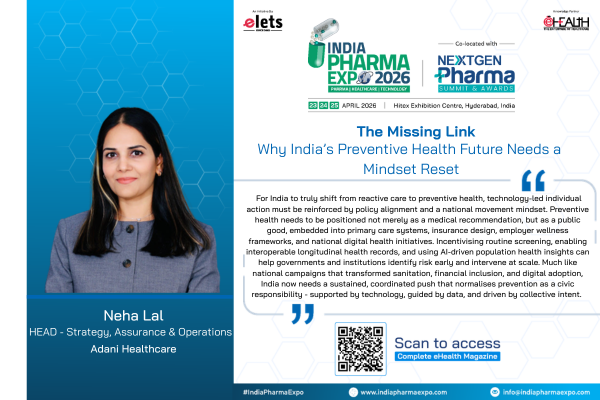
For India to truly shift from reactive care to preventive health, technology-led individual action must be reinforced by policy alignment and a national movement mindset. Preventive health needs to be positioned not merely as a medical recommendation, but as a public good, embedded into primary care systems, insurance design, employer wellness frameworks, and national digital health initiatives. Incentivising routine screening, enabling interoperable longitudinal health records, and using AI-driven population health insights can help governments and institutions identify risk early and intervene at scale. Much like national campaigns that transformed sanitation, financial inclusion, and digital adoption, India now needs a sustained, coordinated push that normalises prevention as a civic responsibility – supported by technology, guided by data, and driven by collective intent.
Views expressed by: Neha Lal, Head- Strategy Assurance & Operations, Adani Healthcare

 Like
Like
 Dislike
Be a part of Elets Collaborative Initiatives. Join Us for Upcoming Events and explore business opportunities. Like us on Facebook , connect with us on LinkedIn and follow us on Twitter , Instagram.
Disclaimer: The views and opinions expressed in this article are solely those of the author and do not necessarily reflect the official policy or views of any organisation. The content is intended for informational and educational purposes only and should not be construed as medical advice.
"Exciting news! Elets technomedia is now on WhatsApp Channels Subscribe today by clicking the link and stay updated with the latest insights!" Click here!