



Article
Building Future-Ready Hospitals: Where Clinical Governance Meets Digital Health
Building Future-Ready Hospitals: Where Clinical Governance Meets Digital Health
![]() By Dr. Asawari Savant, eHealth Network - 18 September 2026
By Dr. Asawari Savant, eHealth Network - 18 September 2026


Ask a patient how they chose their surgeon, and the answer is often based on word of mouth, a recommendation from a relative, a friend’s experience, or simply a name they have heard repeatedly. This is not because patients do not value clinical quality, but because healthcare has traditionally lacked accessible, objective measures that allow them to evaluate clinical expertise and outcomes.

While statutory and regulatory bodies play an important role in licensing and accreditation, there remains a gap between point-in-time compliance and continuous clinical oversight. Procedure volumes, complication rates, adherence to protocols and patient outcomes need to be understood continuously, rather than reviewed only after an incident or during a periodic audit. As healthcare systems grow larger and more complex, clinical governance must evolve from being a compliance exercise into a real-time framework for improving care.
The future-ready hospital is not one where technology simply digitises paperwork. It is one where technology becomes a continuous engine of clinical governance.

For decades, clinical quality review has largely been retrospective. Hospitals have relied on periodic audits, incident reports and peer reviews to identify gaps, often after an event has already occurred. While these mechanisms remain important, they are no longer sufficient in an environment where clinical decisions need to be supported in real time.

Clinical Decision Support Systems are enabling governance to move closer to the point of care. Instead of identifying errors weeks later, clinicians can receive evidence-based guidance while decisions are being made, from evaluating differential diagnoses and identifying potential drug interactions to considering appropriate care pathways. Artificial intelligence can add another layer of capability, but its role should be to strengthen clinical judgement, not replace it.
That distinction is critical. AI-generated recommendations must themselves be validated against trusted medical literature before they influence patient care. Equally important is building non-punitive feedback loops. When electronic medical records are converted into structured clinical data, variations from established protocols can be identified while still allowing clinicians to document the rationale behind decisions made for individual patients. Governance, therefore, shifts from finding fault to continuously improving care delivery.
As hospital networks expand across locations, clinical governance becomes significantly more challenging. A model that depends entirely on senior leaders manually reviewing every clinical encounter cannot scale. Hospitals need a continuous oversight ecosystem built around reliable, longitudinal clinical data. This can begin with dynamic physician profiling that tracks credentials, active privileges, continuing medical education and clinical case volumes, and extend to balanced clinical scorecards that combine procedure volumes, complication rates, patient feedback and adherence to evidence-based guidelines.
Most importantly, governance should not end when a patient leaves the hospital. Longitudinal outcome audits that measure patient-reported outcomes, recovery trajectories and indicators such as 30-day readmissions provide a more meaningful assessment of whether care delivered inside the hospital translated into better health outside it. When this information is available continuously, clinical leaders can identify patterns that might otherwise remain invisible, whether prolonged surgical times, variations in infection rates or unexpected trends in patient outcomes and intervene before they become systemic issues. The importance of digital clinical governance will only increase as healthcare transitions towards value-based care. In this model, success is measured not by the volume of interventions performed, but by delivering the right care at the right time while improving outcomes and managing the total cost of care.
Digital governance supports this transition by encouraging appropriateness of care. Real-time clinical prompts can help avoid unnecessary investigations, unwarranted surgical interventions and preventable hospital admissions. Beyond discharge, digital platforms can support rehabilitation, monitor chronic conditions and ensure continuity of care, making patient outcomes the central measure of healthcare quality.
This shift is also reflected in evolving accreditation standards. Frameworks such as the NABH 6th Edition increasingly emphasise measurable outcomes, including unplanned readmissions and post-operative surgical site infections, rather than documentation alone. The conversation is moving from asking whether hospitals have the right processes to asking whether they can demonstrate that those processes consistently improve patient outcomes.
The ultimate challenge for an expanding hospital network is not creating more bureaucracy; it is preserving clinical consistency, accountability and patient safety at scale. No clinical leader can personally oversee every operating theatre, outpatient consultation or inpatient encounter. Technology, however, can create the infrastructure that makes continuous oversight possible across an entire health system. A hospital’s digital ecosystem should function like a central nervous system, continuously capturing clinical information, monitoring adherence to protocols, tracking outcomes and surfacing potential risks to the teams responsible for acting on them.
The opportunity before us is therefore much larger than simply digitising healthcare. By bringing digital health and clinical governance together, hospitals can build systems where clinical excellence is measurable, physician decision-making is supported by evidence and patient safety is embedded into everyday care.
Future-ready hospitals will not be defined by how much technology they deploy, but by how effectively they use technology to make healthcare more accountable, more transparent and consistently focused on better patient outcomes.
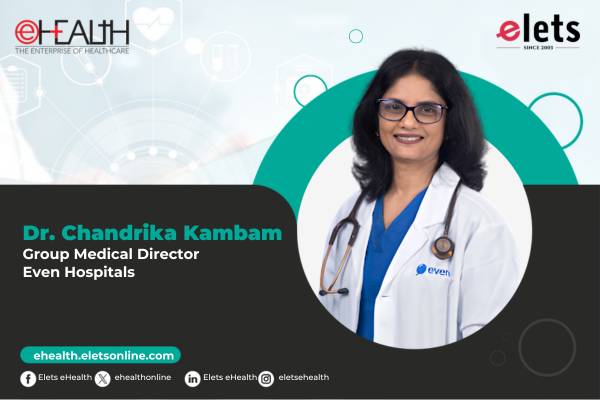
Views expressed by: Dr. Chandrika Kambam, Group Medical Director, Even Hospitals

 Like
Like
 Dislike
Be a part of Elets Collaborative Initiatives. Join Us for Upcoming Events and explore business opportunities. Like us on Facebook , connect with us on LinkedIn and follow us on Twitter , Instagram.
Disclaimer: The views and opinions expressed in this article are solely those of the author and do not necessarily reflect the official policy or views of any organisation. The content is intended for informational and educational purposes only and should not be construed as medical advice.
"Exciting news! Elets technomedia is now on WhatsApp Channels Subscribe today by clicking the link and stay updated with the latest insights!" Click here!