




Article
How Research Peptides Are Made: Solid-Phase Synthesis and Analytical Quality Control
How Research Peptides Are Made: Solid-Phase Synthesis and Analytical Quality Control
![]() By eHealth Network - 13 November 2026


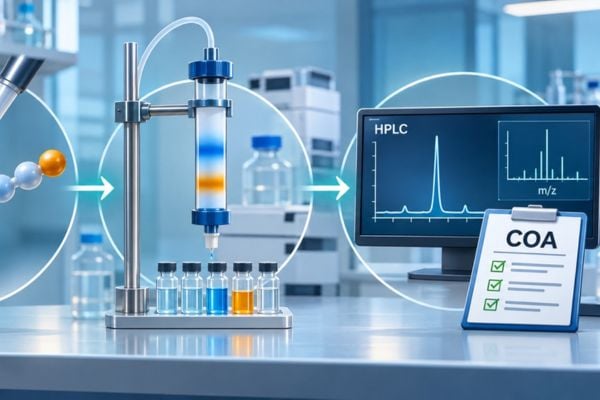
A research peptide is built, not grown. Chemists assemble the sequence on a tiny resin bead, adding one amino acid after another, then cut it loose, clean it up, and test it before it ever ships for lab work. That last part matters more than anything else. These are research-use-only materials – made for the bench, never for people or animals.

Two routes, one winner
A peptide can come from one of two places. You either pull it out of something living, or you build it yourself, residue by residue. Extraction still has its uses. But when a lab orders a specific sequence and expects the exact same thing to arrive next month, building it on purpose beats fishing it out of biology every time. Control is the whole reason. And it is why almost everything on the research-reagent shelf is synthetic.
Advertisement
Building the chain, residue by residue
The method itself is old. Bruce Merrifield worked it out in the 1960s, and nothing since has really pushed it aside. Here is the gist. The first amino acid gets fixed to a small bead, and the chain grows from there, held on that bead the whole way. After that you just repeat the loop: attach a residue, rinse off what did not react, uncap the end, go again. Why bother anchoring it? Because then you can rinse reagents and leftovers right through the bead, and the peptide never goes down the drain with them.
Here is the snag. No cycle runs at a flawless 100 percent, and every small miss stacks up as the chain gets longer. Ten residues? Easy. Push to thirty or forty and the failed couplings start piling on each other, the by-products crowd in, and both the synthesis and the cleanup afterward get a lot harder. So length is not some minor detail. It is one of the biggest things that drives what a peptide costs to make.

One advance made all of this routine: Fmoc chemistry. It is a gentler way of protecting each incoming amino acid, using a group that comes off under mild conditions when the residue’s turn arrives. That is the chemistry a modern synthesizer leans on to run cycle after cycle without trouble, and it is still the standard today.
The step that actually sets quality
What comes off the synthesizer is not a clean product. It is a mix. Your target sequence is in there, sure, but it has company: chains that quit early, chains short one residue where a step misfired, odd bits thrown off by side reactions. None of it is visible. None of it leaves by itself. Getting rid of it means purifying the batch, and that usually means preparative chromatography.
People tend to skip past this step. A peptide is not good simply because a machine built it. The synthesizer makes no guarantee about what actually lands in the vial. That gets decided later, during cleanup: how much of the junk you manage to strip out, and whether anyone bothered to measure what is left standing.
And it has to come out the same next time, too. Labs rarely buy one vial and disappear. They expect this batch to act like the last, so results from one run still match the run before it. Holding a process that steady, same purity, same impurity profile, order after order, is much of what sets a serious maker apart from a sloppy one. And the data is the proof.
Checking the work: two instruments, two answers
Most of the checking falls to two instruments, and they are not asking the same thing. One is high-performance liquid chromatography, or HPLC. It splits the sample apart and tells you what share of it is really the peptide you were after, which is the purity figure everyone cites. The other is mass spectrometry. It puts the molecule on the scale, in effect, and confirms its identity by weight. Neither one covers for the other, so you want both.
A figure on its own is worth little. It only counts when it is pinned to the actual batch sitting in your bottle, and that is what a certificate of analysis is for. Last year’s lot? Its purity number says nothing about this vial. So when someone lines up peptides for sale and compares them, what they are really weighing is the paperwork: batch-specific HPLC and mass-spec data, with identity and purity spelled out. No paperwork, and all you are buying is a number with nothing behind it.
Reagent, not drug
All of this draws a firm boundary for anyone selling these materials. A research reagent is defined by what it is for, namely lab work, and it stands on data, not on a regulator’s blessing. A medicine is another beast altogether – set specifications, a complete safety and efficacy file, a licence to back it. And regulators keep sharpening that distinction. The European Medicines Agency’s guideline on synthetic peptide manufacture came into force on 1 June 2026, and it lays out plainly how far a medicinal peptide stands from a bench reagent. For a maker the rule is short: keep the synthesis, the cleanup, and the records honest, and the boundary holds.
The bottom line
Strip it down and a research peptide is just its steps added up: built on a resin, freed, purified, then checked. The machine hands you a sequence, nothing more. Trust comes from the cleanup and the data behind it. Buyer or seller, that is the part worth keeping in mind. Quality gets measured and written down, one batch at a time. On its own, a label proves none of it.
References
- Merrifield RB. Solid phase peptide synthesis. I. The synthesis of a tetrapeptide. Journal of the American Chemical Society. 1963;85(14):2149–2154. doi:10.1021/ja00897a025
- Stawikowski M, Fields GB. Introduction to peptide synthesis. Current Protocols in Protein Science. 2012;Chapter 18:Unit 18.1. PMID: 22851497
- Hansen PR, Oddo A. Fmoc solid-phase peptide synthesis. Methods in Molecular Biology. 2015;1348:33–50. doi:10.1007/978-1-4939-2999-3_5
- European Medicines Agency. Guideline on the development and manufacture of synthetic peptides (EMA/CHMP/CVMP/QWP/367182/2025), effective 1 June 2026. Link
- US Food and Drug Administration. Distribution of in vitro diagnostic products labeled for research use only or investigational use only, guidance for industry and FDA staff (2013). Link

 Like
 Dislike
Be a part of Elets Collaborative Initiatives. Join Us for Upcoming Events and explore business opportunities. Like us on Facebook , connect with us on LinkedIn and follow us on Twitter , Instagram.
Disclaimer: The views and opinions expressed in this article are solely those of the author and do not necessarily reflect the official policy or views of any organisation. The content is intended for informational and educational purposes only and should not be construed as medical advice.
"Exciting news! Elets technomedia is now on WhatsApp Channels Subscribe today by clicking the link and stay updated with the latest insights!" Click here!