



Magazine
The Triple Engine Driving MRI’s Next Big Leap
The Triple Engine Driving MRI’s Next Big Leap
![]() By Dr. Asawari Savant, eHealth Network - 03 June 2026
By Dr. Asawari Savant, eHealth Network - 03 June 2026


Healthcare sits at the intersection of innovation and accountability, where the stakes are high, and change must be deliberate. Medical imaging reflects this reality. Magnetic Resonance Imaging, or MRI, is one of the most advanced applications of engineering and computing in clinical practice, showcasing both technological progress and the complexity of deploying it at scale.
For years, adoption has been tempered by high capital costs, infrastructure intensity, and the stringent requirements that enable clinical precision. Today, digital technologies and intelligent automation are beginning to shift that equation, making advanced imaging more scalable and efficient.[1]
Innovation sits at the heart of this shift, powered by a triple engine driving its transformation: acceleration, co-creation, and its purpose-led design. Together, these forces are reshaping how imaging technologies like MR evolve, making them smarter, more sustainable, and intentionally designed to address the real-world needs of both patients and clinicians alike.

Engine One: Faster, Focused Innovation
Imaging innovation has traditionally moved in long, hardware-led cycles, often taking years to deliver meaningful upgrades. Meanwhile, healthcare systems are managing rising patient volumes, limited budgets, and workforce shortages. This gap is accelerating a shift toward more agile, modular progress, that strengthens quality through continuous improvements across hardware, software and workflows – rather than periodic large-scale overhauls.

Artificial intelligence is central to this evolution. Used effectively and responsibly, it can help reduce scan times, improve image quality, standardize protocols, and streamline workflows. These advancements are not about speed alone: they strengthen diagnostic accuracy, improve both patient and clinician experience, and ease operational pressure.
The challenge is to innovate rapidly without escalating costs or environmental impact. Progress must balance access and performance with quality and responsibility.
Engine Two: Co-Innovation with the Frontline
Healthcare systems may be cautious adopters, but they are also keen observers. The most meaningful advancements in imaging are increasingly shaped through close collaboration between technologists and care teams such as radiologists, technicians and operational leaders – all working together from design through deployment.
Co-creation ensures that technology aligns with real-world constraints: from space limitations and workflow complexity to climate conditions and staffing patterns. It shortens feedback loops and improves usability.
This approach is especially critical in the era of AI. The healthcare ecosystem demands transparency, explainability, and safeguards against bias. AI in imaging must recommend optimal scan parameters, flag anomalies responsibly and automate repetitive tasks while keeping clinicians firmly in control. Trust is non-negotiable. Responsible AI, built with clear guardrails, is now foundational to adoption.
Engine Three: Innovation with Purpose
The third engine is perhaps the most transformative: aligning technological advancement with broader societal goals, including sustainability and accessibility. MRI systems are energy-intensive, requiring continuous cooling and shielded infrastructure. As hospitals face increasing pressure to de-carbonise, sustainability is becoming as important as image quality or throughput. Patients are also more aware of healthcare’s environmental footprint. The expectation is clear: innovation must improve outcomes while protecting the planet.
Efforts across the industry are focusing on reducing helium dependency, lowering power consumption, enabling remote upgrades and extending system lifecycles through refurbishment and circular design. AI contributes here as well by reducing repeat scans, optimising scheduling and improving first-time diagnostic accuracy. Efficiency becomes not only a cost-saving measure for hospitals, but sustainability in action.
At the same time, accessibility is emerging as a parallel imperative. Advances in low-field and portable MRI systems which reduce infrastructure, power, and siting requirements, are bringing diagnostic imaging to rural, resource-limited, and point-of-care settings that were previously underserved, while cloud-enabled workflows and AI-driven reconstruction help deliver high-quality images without large, traditional scanners.
Also read: Leveraging Precision Diagnostics, AI and Data‑Led Decision‑Making
A More Balanced Future
When accelerated innovation, deep collaboration and shared purpose operate together, they create a compounding effect. The innovation pipeline becomes more agile. Solutions become more relevant. Incentives align around long-term value rather than short-term gains.
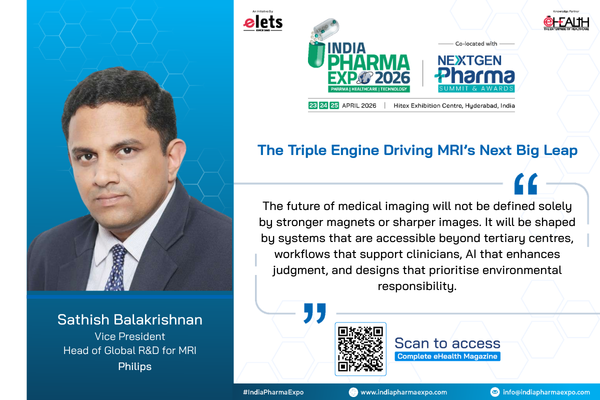
The future of medical imaging will not be defined solely by stronger magnets or sharper images. It will be shaped by systems that are accessible beyond tertiary centres, workflows that support clinicians, AI that enhances judgment, and designs that prioritise environmental responsibility.
Views expressed by: Sathish Balakrishnan, Vice President, Head of Global R&D for MRI, Philips
Disclaimer: The views expressed are for general informational purposes only and reflect industry perspectives on medical imaging. They do not constitute legal advice or specific product representations by Philips.

 Like
Like
 Dislike
Be a part of Elets Collaborative Initiatives. Join Us for Upcoming Events and explore business opportunities. Like us on Facebook , connect with us on LinkedIn and follow us on Twitter , Instagram.
"Exciting news! Elets technomedia is now on WhatsApp Channels Subscribe today by clicking the link and stay updated with the latest insights!" Click here!