



Magazine
Leveraging Precision Diagnostics, AI and Data‑Led Decision‑Making
Leveraging Precision Diagnostics, AI and Data‑Led Decision‑Making
![]() By Dr. Asawari Savant, eHealth Network - 03 June 2026
By Dr. Asawari Savant, eHealth Network - 03 June 2026


Healthcare is undergoing a fundamental transformation, moving steadily from reactive treatment to earlier, more accurate diagnosis and proactive care. Precision diagnostics, artificial intelligence (AI), and data‑led decision‑making are redefining how clinicians detect, manage, and prevent disease. As healthcare systems face rising patient volumes, workforce constraints, and increasing disease complexity, diagnostics is emerging not just as a support function, but as a central pillar of clinical decision‑making.
Precision Diagnostics: The Foundation of Early and Accurate Care
At the heart of this shift is the growing emphasis on early and accurate diagnosis. Precision diagnostic systems enable clinicians to identify disease markers faster, supporting timely intervention and improved patient outcomes. Laboratory diagnostics has become integral to clinical workflows, with hematology, clinical chemistry, immunoassay, and coagulation testing playing a critical role in diagnosis, prognosis, and therapy selection. Blood‑based diagnostics, in particular, provide a rich source of clinical data capable of revealing early signs of infection, inflammation, anemia, and chronic disease progression.
AI and Advanced Analytics: Converting Data into Clinical Insight
As laboratories generate increasing volumes of data, the challenge lies in translating numbers into meaningful clinical insight. AI and advanced analytics are addressing this challenge by enabling more efficient interpretation of laboratory parameters. Rather than evaluating isolated values, AI systems recognize complex patterns across multiple data points, supporting clinicians by flagging early risk indicators and transforming routine reports into actionable insights that enhance decision‑making.

Smarter Hematology Through Intelligent Diagnostics
Hematology provides a compelling example of how intelligence is being embedded into modern diagnostics. In high‑throughput laboratories common across India, early signs of serious illness can easily blend into routine results. AI‑enabled hematology analyzers such as the Yumizen H2500, Yumizen H1500, and Yumizen H550E from HORIBA move beyond traditional measurement to intelligent observation. These platforms analyze cellular populations, track evolving trends, and raise alerts when abnormalities suggest emerging infection, inflammation, or hematological disorders.

Through advanced flagging and pattern recognition, subtle indicators such as left shifts, marrow activation, and atypical cell populations can be detected early—often before conditions such as sepsis or severe infection become clinically apparent. In India’s endemic setting, AI‑supported alerts for malaria and dengue enable laboratories to raise early suspicion in febrile cases without increasing manual smear workload, balancing efficiency with heightened clinical vigilance.
Extending Precision Beyond Hematology
Precision diagnostics extends beyond hematology into other critical laboratory disciplines. In coagulation testing, platforms such as the Yumizen G800 support rapid and reliable assessment of clotting disorders, anticoagulation monitoring, and critical care evaluation. Clinical chemistry systems like the Yumizen C560 enable comprehensive biochemical analysis that informs diagnosis and long‑term disease management, particularly for metabolic disorders, organ function assessment, and chronic disease monitoring. Together, these technologies form a robust diagnostic foundation for timely and informed clinical decisions.
Connected Laboratories and Data‑Led Workflows
Another major trend shaping the future of healthcare is the integration of laboratory data with patient records and digital diagnostic workflows. Connected systems enable seamless information exchange across laboratories and hospitals, providing clinicians with a unified patient view. Data‑led platforms also improve laboratory efficiency through automation of sample tracking, result validation, quality control, and remote diagnostics support—reducing turnaround time while improving reliability and consistency.
Predictive and Preventive Healthcare Through Intelligent Diagnostics
Predictive and preventive healthcare is gaining momentum as diagnostic platforms are increasingly used for early risk detection and longitudinal monitoring. Advanced analyzers integrated with AI models can identify early warning signs of critical conditions using routine diagnostic data. By enabling earlier recognition of systemic inflammation, infection risk, or disease progression, these systems support faster clinical intervention and improved patient outcomes.
AI as a Clinical Decision‑Support Partner
While AI accelerates diagnostic workflows and enhances interpretation, human clinical judgment remains essential. Technology excels at pattern recognition and early alerts, but final diagnosis, treatment planning, and patient‑specific decisions require clinician expertise and laboratory oversight. The future of healthcare therefore lies in AI as a decision‑support partner—augmenting, not replacing, doctors and laboratory professionals.
Also read: The Evolving Face of Indian Clinical Research & Regulatory Shifts
A Smarter, More Proactive Healthcare Future
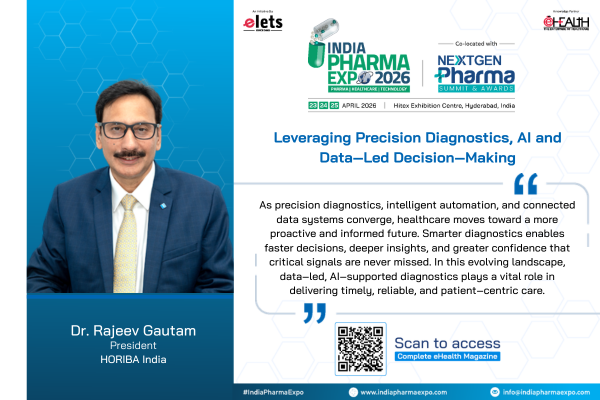
As precision diagnostics, intelligent automation, and connected data systems converge, healthcare moves toward a more proactive and informed future. Smarter diagnostics enables faster decisions, deeper insights, and greater confidence that critical signals are never missed. In this evolving landscape, data‑led, AI‑supported diagnostics plays a vital role in delivering timely, reliable, and patient‑centric care.
Views expressed by: Dr. Rajeev Gautam, President, HORIBA India

 Like
Like
 Dislike
Be a part of Elets Collaborative Initiatives. Join Us for Upcoming Events and explore business opportunities. Like us on Facebook , connect with us on LinkedIn and follow us on Twitter , Instagram.
"Exciting news! Elets technomedia is now on WhatsApp Channels Subscribe today by clicking the link and stay updated with the latest insights!" Click here!