


Magazine
The Digital Transformation of Pharma and Clinical Research in India
The Digital Transformation of Pharma and Clinical Research in India
![]() By Dr. Asawari Savant, eHealth Network - 29 May 2026
By Dr. Asawari Savant, eHealth Network - 29 May 2026


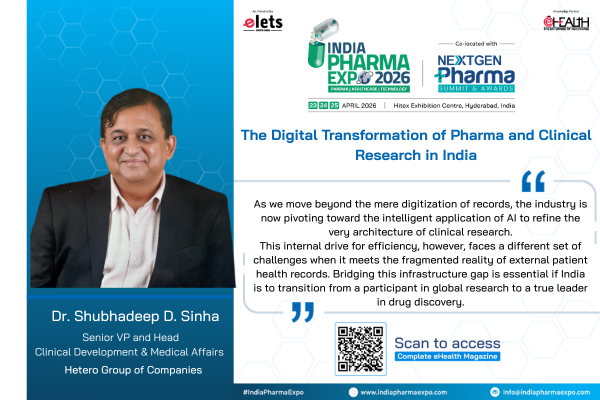
A veteran leader in global clinical trials and pharmacovigilance, Dr. Shubhadeep D. Sinha, Senior VP and Head- Clinical Development & Medical Affairs at Hetero Group of Companies sits down with Elma Fatima, from Elets News Network (ENN), for an exclusive dialogue, and shares a masterclass for the readers on the digital transformation of the pharmaceutical industry. This conversation examines the critical intersection of AI, data integrity and India’s evolving mandate to move from a global “catchment area” to an original discovery powerhouse. Edited Excerpts
The Digital Foundation: From Paper-Based Legacy to Electronic Integrity
The strategic transition from physical records to digital ecosystems in pharmaceutical research is far more than a move toward convenience; it is a mitigation strategy for data integrity and regulatory risk. In an industry governed by regular and rigorous inspections, the digital systems bd ts 21CFRpart11 compliant features such as “audit trail”, system role based user access, electronic signature etc. serves as the bedrock of data reliability and quality.
Modernization ensures that every data point is permanent and traceable, creating an unbreakable chain of evidence that prevents the unauthorized modification of critical research findings, a fundamental requirement for global compliance.

How have digital platforms specifically transformed the execution of clinical trials and the assurance of patient safety?

The evolution over the last two decades represents a seismic shift from manual-heavy legacy workflows to a streamlined electronic environment. We have effectively engineered data integrity into the process.
| Clinical data management and statistical analyses | Manual Excel entry; “double data entry” to mitigate error.
Non- SAS tools for statistical analysis |
Electronic data management with real time data
Advanced statistical outputs using SAS and similar tools. |
| Informed Consent | Handwritten signatures; often unstructured. | e-Informed Consent: A structured, multi-language digital process. |
| Validation | Physical signatures on paper documents. | DocuSign and PDF-protected electronic signatures.
Computer state validations (CSVs) |
| Pharmacovigilance | Paper based | Validated software tools such as Argus safety, Argus Lifesphere |
The “So What?” Layer: The adoption of EDCs has fundamentally compressed the clinical development timelines.. Because site investigators enter data in real-time, data management teams can identify discrepancies and raise queries instantaneously. This shift from months-long lags to immediate resolution reduces “time-to-market”, the ultimate strategic driver in pharma, while significantly bolstering patient safety.
Similarly in Pharmacovigilance, usage of modern automated case processing and aggregate safety reporting tools have crunched timelines of case management, signal management and aggregate safety reports.
Generative AI and the Intelligent Automation Frontier
There is a critical strategic distinction between basic automation, which merely digitizes a task and cognitive AI, which introduces “thinking” capabilities. While the industry has been automated for years, specialized Generative AI (GenAI) is moving beyond generic outputs to provide industry-specific applications that meet stringent regulatory standards. These tools are moving from “crude” assistants to sophisticated partners in the R&D lifecycle.
What specific roles are AI and GenAI playing in the modernization of clinical trials, manufacturing, and pharmacovigilance?
We must distinguish between “crude” AI and pharma-specific intelligence. E.g., while generic tools like ChatGPT or Gemini can draft a protocol, make a basic presentation, clinical study reports etc., their outputs lack the nuances required for regulatory acceptance. Advanced, pharma-specific AI analyzes published literature and historical data to create “applicable” protocols that think like a human expert.
Smart Manufacturing: AI is being leveraged to minimize SOP-driven redundancies. It optimizes product synthesis, reduces manufacturing steps, and significantly lowers environmental effluents, leading to more sustainable and cost-effective operations.
Pharmacovigilance (PV): Within mission-critical databases like Oracle Argus or ArisGlobal LifeSphere, we are moving from “auto-narratives” to “smart narratives.” While auto-coding has existed, it often lacked accuracy. Smart auto-narratives ensure that case descriptions are contextually appropriate and medically accurate, significantly reducing the manual burden on PV scientists.
Medical Writing: AI based solutions have made it easier for medical writers in clinical trials, regulator, medicomarketing and Pharmacovigilance with ground breaking solutions which are also regulatory I’ll accept .
Labor Impact Analysis: Contrary to fears of displacement, AI is a catalyst for “skilled job” creation. Historically, when the industry moved from paper to automation, the workforce increased. By handling redundancies, AI allows human scientists to focus on higher-level cognitive tasks, improving overall productivity and shifting the labor force toward more sophisticated roles.
Patient-Centricity and the Fragmented Data Landscape
A significant difference in approach exists between “disease-centricity” and true “patient-centricity.” R&D pipelines are not developed in a vacuum; they are highly structured based on treatment guidelines and, increasingly, the commercialisation of specific disease areas. While the industry makes strides in high-tech interventions, the lack of unified Digital Health Records (DHR) across hospitals in India and emerging markets presents a logistic hurdle for comprehensive, longitudinal patient care.
How can the industry ensure innovation remains patient-centric, particularly in complex fields like oncology and chronic illness?
Currently, much of what we call patient-centricity is actually “commerce-centricity.” R&D is heavily concentrated in high revenue generating disease segments and thievery like oncology, diabetes, and cardiology. Meanwhile, rare diseases and communicable diseases have faced long periods of neglect. For example, India is a hub for communicable diseases, yet we saw a massive gap in the development of anti-TB and anti-malarial drugs. Crucially, antibiotic resistance is a looming crisis where innovation has stalled despite the clear patient need.
Furthermore, the infrastructure for patient data remains underdeveloped in India, hindering the ability to track outcomes effectively:
| Sector | State of Digitization | Connectivity |
| Private Hospital Networks | High; excellent internal DHR systems. | Separate ; disparate networks (e.g., Apollo, Medanta) are silos and do not “speak” to each other. |
| Government Setup | Nascent; digitization is in early stages. | Very limited; automation is the necessary first step. |
| US Model (Benchmark) | High; cloud-based systems. | Connected; records are accessible across platforms via the cloud. |
While we see high-tech “bright spots” such as AI-enhanced ECGs, robotic surgeries, and advanced angioplasties, the underlying foundation of unified, accessible health records is the missing link in patient-centric innovation.
Strategic Imperatives for India’s Leadership in Global R&D
India stands at a strategic crossroads. While it has become a “catchment area” for global trials due to its vast patient population, the nation remains a “generic player.” To reach the next tier, Indian multinationals, currently functioning as midsized global players, must evolve from being a destination for foreign-led research into a hub for original drug discovery and intellectual property.
Also read: Pharma Innovation & Strategic Association Opportunities for Indian Exporters
What strategic steps are required to strengthen India’s leadership in global clinical development and biosimilars?
India has mastered the biosimilar and generic markets, but our discovery pipelines are lacking. Most trials conducted in India are driven by foreign multinationals. To change this, we must address the “Innovation Deficit.”
Regulatory & Government Role: Recent initiatives, such as the Parliamentary outlay for 1,000 clinical trial centers and support from agencies like BIRAC, PRIP and SERB, are positive developments. However, these are often viewed as “too little, too late.” We need more aggressive incentivization to foster a true discovery environment.
The Discovery Mindset: Original discovery requires a high risk appetite, these operate on a model where you accept that 10 molecules may lead to development o flag produce one successful product. This 10:1 ratio is a structural necessity of discovery. In India, even those with “deep pockets” are often hesitant to risk capital on such high-failure-rate endeavors.
AI based modern discovery methods have moved beyond traditional methods to include but not limited PBPK models, simulations and precise screening and experimentation.
The Post-Covid Outlook: There is hope. The pandemic demonstrated the power of Indian collaboration. The transition from a “generic player” to a “solution provider” will take time, but the knowledge base is already in place.

 Like
Like
 Dislike
Be a part of Elets Collaborative Initiatives. Join Us for Upcoming Events and explore business opportunities. Like us on Facebook , connect with us on LinkedIn and follow us on Twitter , Instagram.
"Exciting news! Elets technomedia is now on WhatsApp Channels Subscribe today by clicking the link and stay updated with the latest insights!" Click here!