

Magazine
Pharma Innovation & Strategic Association Opportunities for Indian Exporters
Pharma Innovation & Strategic Association Opportunities for Indian Exporters
![]() By Dr. Asawari Savant, eHealth Network - 29 May 2026
By Dr. Asawari Savant, eHealth Network - 29 May 2026


The High Cost of Being First
In the high-stakes theater of global drug development, India stands at a precarious crossroads. Currently, the “first applicant” for a new drug in the Indian market is forced to play a game where the rules are heavily rigged against the pioneer. To bring an innovative product through rigorous clinical trials, a first filer must commit between 8 to 10 crore rupees. Meanwhile, the “second applicant” sits on the sidelines, waits for the trial data to be published, and then launches a competing product for a fraction of the cost, a mere 25 to 50 lakhs for a simple bioequivalence study.

This is more than a financial disparity; it is a form of state-sanctioned regulatory arbitrage. When the barrier to entry for a follower is 1/40th of the innovator’s investment, the “pharmacy of the world” becomes a graveyard for original research. We have built an ecosystem that incentivizes waiting over leading, creating a “stagnation trap” that threatens our long-term competitiveness in the advanced therapeutic era.
The Innovation Trap: Why the “Waiting Game” is Killing R&D
The current regulatory environment actively penalizes the very players it should be nurturing. By allowing followers to launch at a negligible cost, the system grants them the ability to capture market share through aggressive pricing, effectively cannibalizing the innovator’s ROI before they can even recoup trial costs. This creates a “bad negative cycle” where the rational strategic move for any Indian company is to never be the first to file.
Without immediate intervention, the pipeline of new treatments tailored for the Indian population will evaporate. The discouragement factor is not just a boardroom concern; it is a public health risk.
Beyond Patents: The Case for Absolute Data Exclusivity
To dismantle this cycle of discouragement, India must move toward absolute data exclusivity as a regulatory norm. Our current “standalone” approval system—where patent status and clinical data protection are treated as separate, disconnected silos—is a relic of a generics-only mindset.
True reform requires a “linked” approval process where data protection is the primary engine of market entry. We must expand the umbrella of protection to include:
- Repurposed Molecules: Granting exclusivity to old molecules when they are scientifically adapted for new therapeutic roles.
- Reformulated Drugs: Protecting the R&D required to improve drug delivery and efficacy.
- New Indications: Encouraging the exploration of existing treatments for unaddressed pathologies.
Critically, this protection shouldn’t be limited to exclusivity periods alone. The regulator must utilize pricing protection as a lever to ensure a level playing field. If followers wish to enter the market without conducting the original 10-crore clinical trials, they should be mandated to compete on terms that respect the innovator’s capital outlay, ensuring that being first is a strategic advantage rather than a financial liability.
The New “50/50” Rule for Modern Pharma Boards
For decades, Indian pharma boards focused on “geographic hedging”—balancing 50% domestic revenue with 50% exports. That era is over. We are now in the age of modality hedging.
The global market has moved on; of the top 20 molecules worldwide, the presence of traditional small molecules is vanishingly small. To survive, Indian boards must pivot from volume-based manufacturing to high-value advanced therapies. The new strategic imperative is a 50/50 split between small molecules and advanced modalities like cell and gene therapy, stem cells, and genomics.
The Boardroom Shift
| Strategy Aspect | Traditional Strategy | Future Strategy |
| Market Hedging | 50% Domestic / 50% Export | 50% Small Molecules / 50% Advanced Therapies |
| Technology Focus | Generics & Small Molecules | Cell & Gene Therapy, Stem Cells, Genomics |
| Growth Drivers | Volume-based manufacturing | M&A, Talent Acquisition, Advanced R&D |
| Investment Engine | Internal CapEx | Strategic Mergers and Global Talent Influx |
This shift is not optional. Without the regulatory protections mentioned in Section 3, boards will remain hesitant to commit to the “Future Strategy” column. Regulatory reform is the essential enabler of this boardroom evolution.
Ecosystems Over Sponsorships: The Rise of the Collaborative Platform
The growth of the Indian sector is no longer driven by traditional financial sponsorships but by the rise of “Non-Financial Collaborative Models.” A prime example is the Federation of Pharmaceutical and Allied Merchant Exporters (FPME). These are not domestic wholesalers; they are purely global exporters who do no business within India.
For these players, the value proposition has shifted:
- Branding over Cash: Associations now trade on visibility and branding rather than direct financial contributions. Non-profit models that offer “buzz” and industry reach are replacing the old sponsorship deck.
- Digital Intelligence: Professional “WhatsApp ecosystems” with 300+ members have become the new infrastructure for market intelligence, moving faster than any formal trade body.
- Visibility Arbitrage: By partnering with major expos (like those in Mumbai or Hyderabad), these groups leverage booth space and logo placement to create global visibility for small and large exporters alike.
Also read: Engineering Access, Delivering Outcomes: A New Vision for Indian Pharma
The Long-Term Horizon
India’s transition from a provider of low-cost generics to a global leader in medical science requires more than just individual corporate ambition; it requires a collective, industry-wide think tank to organize the ecosystem. We must move beyond the “10-crore gamble” and create a framework where innovation is a mathematical certainty for success, not a high-risk bet.
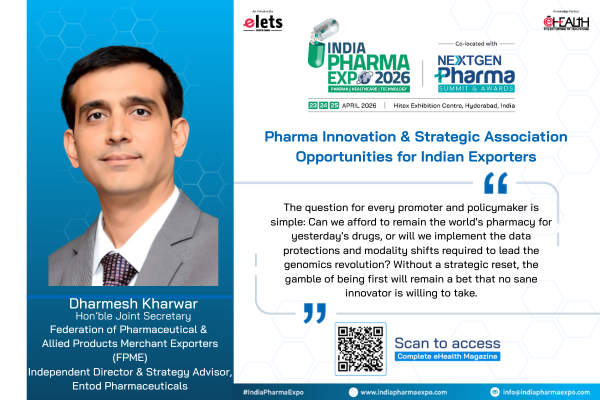
The question for every promoter and policymaker is simple: Can we afford to remain the world’s pharmacy for yesterday’s drugs, or will we implement the data protections and modality shifts required to lead the genomics revolution? Without a strategic reset, the gamble of being first will remain a bet that no sane innovator is willing to take.
Views expressed by: Dharmesh Kharwar, Hon’ble Joint Secretary, Federation of Pharmaceutical & Allied Products Merchant Exporters (FPME) & Independent Director & Strategy Advisor at Entod Pharmaceuticals
Interviewed by: Elma Fatima & Shruti Agarwal, ENN | Edited by: Dr. Asawari Savant, ENN

 Like
Like
 Dislike
Be a part of Elets Collaborative Initiatives. Join Us for Upcoming Events and explore business opportunities. Like us on Facebook , connect with us on LinkedIn and follow us on Twitter , Instagram.
"Exciting news! Elets technomedia is now on WhatsApp Channels Subscribe today by clicking the link and stay updated with the latest insights!" Click here!