


Magazine
Engineering Access, Delivering Outcomes: A New Vision for Indian Pharma
Engineering Access, Delivering Outcomes: A New Vision for Indian Pharma
![]() By Dr. Asawari Savant, eHealth Network - 28 May 2026
By Dr. Asawari Savant, eHealth Network - 28 May 2026


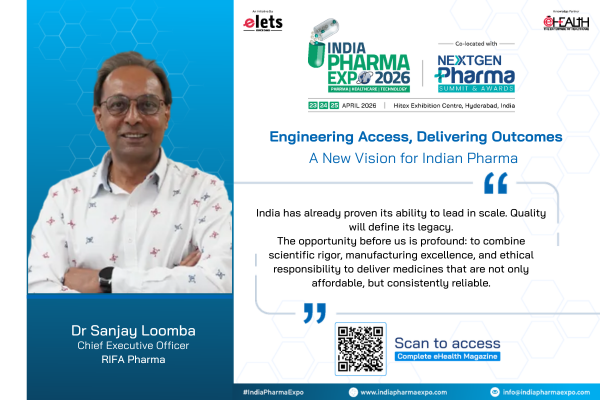
As India strengthens its position as a global pharmaceutical powerhouse, in this exclusive conversation with Dr Sanjay Loomba, Chief Executive Officer, RIFA Pharma, Elma Fatima from Elets News Network (ENN), explores areas from scale to sustainability, quality, and patient-centric impact. With evolving regulatory landscapes, emerging technologies, and rising global expectations, industry leaders must rethink how innovation and access are delivered. This dialogue becomes essential to understand how clinical insight, strategic partnerships, and ecosystem collaboration can shape the next phase of India’s pharma growth. Edited excerpts
You transitioned from a medical and surgical background into pharma leadership. How has your clinical experience influenced Rifa Pharma’s approach to product strategy, operational excellence, and patient-centric solutions?
After nearly two decades in the Operation Theatre as a practicing surgeon, I developed a deep understanding of how dependent patient outcomes are on the reliability of medicines, devices, and supply chains. In surgery, there is no margin for approximation, every protocol, every tool, every decision directly affects a patient’s life.

Clinical training instils precision, accountability, and patient-first decision-making.

At Rifa Pharma, those principles shape everything we do. Our product strategy begins with a question I asked myself before every procedure: Will this truly improve the patient’s outcome? Having experienced therapeutic limitations firsthand, availability gaps, constraints & inefficiencies, I remain deeply conscious of real-world clinical needs.
Operational excellence, for us, mirrors the discipline of the Operation Theatre. That translates into zero-compromise quality standards, rigorous documentation, resilient supply networks.
Importantly, Rifa Pharma is not a manufacturer. We are enablers of access. We specialize in regulatory registration and strategic market introduction of human APIs and excipients, veterinary APIs and premixes, nutraceuticals, medical devices, hospital devices, and advanced technologies such as continuous flow chemistry and bioreactors. Our responsibility lies in selecting, evaluating, and introducing globally benchmarked products into India through compliant and structured pathways.
My clinical background fundamentally changes how Rifa assesses partnerships. We do not evaluate a dossier only through a regulatory lens, we assess it through a patient-outcome lens. Would I trust this in my own Operation Theatre? Would I rely on this molecule or device in a critical moment?
That filter is uncompromising. And it defines our credibility.
Rifa Pharma works across APIs, packaging, and medical devices, veterinary APIs and premixes, nutraceuticals, hospital devices, and advanced technologies. What role does innovation play in strengthening the company’s global reach, especially in emerging therapeutic areas and import / introduce the same to India Market?
Rifa Pharma operates at the intersection of global science and Indian healthcare demand. We act as exclusive and non-exclusive distributors, indentors, and regulatory partners for companies across the USA, Europe, China, and Taiwan. Our strength is not in manufacturing volume — it is in building compliant, intelligent bridges between global innovation and the Indian market.
Innovation, in our model, is the ability to identify globally benchmarked technologies and responsibly introduce them into India through rigorous documentation, regulatory alignment, and strategic distribution.
In emerging therapeutic areas and advanced technologies, our role is to bridge three critical gaps:
- The Regulatory Gap.
- The Market Gap.
- The Access Gap .
Our strength lies in being the bridge that makes that possible.
What opportunities do you see for deeper collaboration between Indian pharma manufacturers, technology partners, and policy stakeholders to accelerate access to high-quality medicines both in India and globally?
India’s pharmaceutical industry has achieved scale. The next leap will come from synergy.
To evolve from being the “pharmacy of the world” to becoming an “innovation partner to the world,” collaboration must move from transactional engagement to ecosystem alignment.
Three key opportunities will shape the future of Indian pharma:
- Technology-driven manufacturing: Partnering with tech firms to use AI, predictive analytics, and real-time compliance systems will make manufacturing smarter, more reliable, and globally competitive.
- Smarter regulation and policy support: Closer alignment with policymakers can streamline approvals while keeping safety uncompromised. Incentives for specialty APIs, complex formulations, and advanced technologies will reduce import dependence and strengthen resilience.
- Co-development and global partnerships: Collaborating with biotech startups, device innovators, and international R&D teams can speed up biosimilars, drug-device combinations, and specialty therapies, bringing advanced treatments to patients faster.
The future of pharma won’t be built in silos, it will thrive through intelligent collaboration and globally aligned strategies.
As someone steering a vertically diversified pharma company, what is your vision for the industry over the next 5 years especially in terms of sustainability, supply resilience, and Patient-Centric Quality.
Over the next five years, the pharmaceutical industry will be shaped by the following pillars: sustainability, supply resilience, Technology and measurable patient outcomes.
Sustainability will move to a performance metric, green chemistry, energy efficiency, solvent recovery, and responsible waste management will define long-term competitiveness.
Supply resilience will become strategic. Backward integration, diversified sourcing, and regional manufacturing capabilities will be critical to navigating global uncertainties.
Technology-driven efficiency.: Continuous manufacturing, advanced bioprocessing, and data-driven regulatory management will separate leaders from followers.
And importantly, the industry will increasingly be judged not only by volume, but by outcomes—pharmacovigilance strength, adherence improvement, and real-world effectiveness. Quality will no longer be defined by certificates alone. It will be assessed through consistent performance, end-to-end traceability, and measurable impact on patient outcomes.
The winners will be those who combine regulatory depth, global partnerships, and disciplined execution.
Also read: Bridging Scientific Discovery with Market Reality in Pharma
If you could share one message about how the Indian pharma industry can lead not just in scale but in quality-driven impact, what would it be?
India has already proven its ability to lead in scale. Quality will define its legacy.
The opportunity before us is profound: to combine scientific rigor, manufacturing excellence, and ethical responsibility to deliver medicines that are not only affordable, but consistently reliable.
If we collectively aim not just to meet global standards but to exceed them, we move from being cost-competitive to trust-competitive. And trust is what sustains global leadership.
If the industry collectively commits not just to meeting global standards, but to exceeding them, we move from being cost-competitive to trust-competitive, and trust is what sustains global leadership.
When scientific discipline meets policy insight and responsible market access, India can rise from the ‘pharmacy of the world’ to a benchmark for global healthcare innovation.
Edited by: Dr. Asawari Savant | ENN

 Like
Like
 Dislike
Be a part of Elets Collaborative Initiatives. Join Us for Upcoming Events and explore business opportunities. Like us on Facebook , connect with us on LinkedIn and follow us on Twitter , Instagram.
"Exciting news! Elets technomedia is now on WhatsApp Channels Subscribe today by clicking the link and stay updated with the latest insights!" Click here!