


Magazine
Bridging Scientific Discovery with Market Reality in Pharma
Bridging Scientific Discovery with Market Reality in Pharma
![]() By Dr. Asawari Savant, eHealth Network - 28 May 2026
By Dr. Asawari Savant, eHealth Network - 28 May 2026


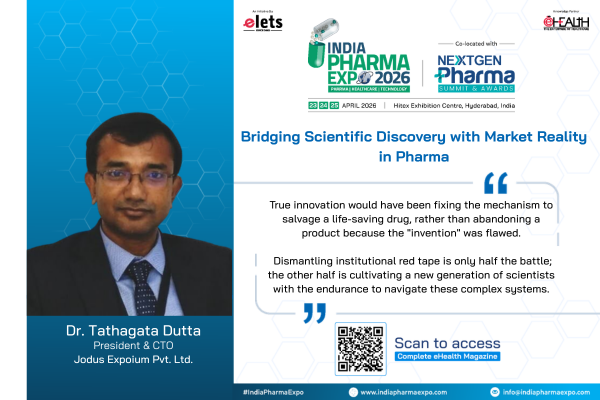
As the President & CTO of Jodus Expoium Pvt. Ltd., Dr. Tathagata Dutta operates at the high-stakes intersection of pharmaceutical R&D and global commercial strategy. In this exclusive dialogue with Elma Fatima, from Elets News Network (ENN), he shares the precarious transition from laboratory discovery to market-dominant product, offering a masterclass in how scientific rigor must be tempered by commercial pragmatism to succeed in a competitive global landscape. Edited excerpts

The Philosophy of Commercialization: Invention vs. Innovation
The graveyard of the pharmaceutical industry is littered with “inventions” that failed the test of “innovation”, a distinction defined not by the lab, but by the market. For a pharmaceutical enterprise to remain sustainable, its research efforts must be tethered to rigorous market demand; scientific brilliance in a vacuum is a luxury the industry cannot afford. As the sector moves away from purely grant-funded models, even national institutes are recognizing that revenue generation is the only true validator of scientific success.
You often draw a sharp line between “invention” and “innovation.” In the context of pharmaceutical commercialization, where does that line sit?
The distinction is fundamental to survival. An invention is any discovery or creation, but its commercial viability is often an afterthought. Innovation, conversely, is the deliberate development of a commercially viable product. To achieve innovation, a scientist must work backward from the market. This requires deep immersion in market research and direct feedback from clinicians, doctors, and patients. Without a definitive “problem statement” or a verified market requirement, a scientific discovery remains a mere curiosity, never a product.

Can you provide a case study where identifying a specific market “problem statement” redefined a drug’s potential?
Early in my career, there was a blockbuster anti-retroviral drug for HIV, a “wonder drug” that even prevented mother-to-child transmission. Yet, clinicians noted a catastrophic side effect: patients were developing severe suicidal tendencies within weeks of starting treatment. This was a clear market requirement. I approached the innovator company, suggesting that we address the specific biological mechanism triggering these tendencies. Remarkably, they chose to discontinue the product rather than invest in solving the mechanism. To me, that was a failure of innovative vision. True innovation would have been fixing the mechanism to salvage a life-saving drug, rather than abandoning a product because the “invention” was flawed.
Engineering Bioequivalence: The Role of Morphology in Complex Injectables
Generic drug development is often oversimplified as a replication exercise, yet in the realm of complex injectables, it is an engineering feat where structural nuances dictate clinical outcomes. The industry frequently overlooks how microscopic physical states govern drug release, leading to expensive failures in the final stages of regulatory scrutiny.
Your research on Irinotecan liposomes highlights the critical role of physical morphology. Why are generic companies struggling to replicate this specific product?
Irinotecan is a highly toxic chemotherapeutic agent for pancreatic cancer, but when formulated as a liposome, its toxicity is drastically reduced. The industry struggle lies in a fundamental misunderstanding of bioequivalence. Many generic firms focus purely on matching the initial release profile in a test tube. However, the release profile is a slave to morphology. Most liposomes are spherical, like a football. Irinotecan liposomes, however, are uniquely oval, shaped like a rugby ball.
Is the dismissal of these morphological details as “academic” a systemic issue in the industry?
Absolutely. Many professionals dismiss morphological characterization as “academic,” but this is a fatal strategic error. If you cannot replicate that rugby-ball shape through your excipients and process, your in vivo behavior will never match the innovator. You can match the release profile on paper all day, but you will fail the bioequivalence test every time. Understanding the “why” behind the physical shape is not an academic exercise; it is the non-negotiable path to commercialization.
Navigating the Industry-Academia Divide
The collaboration between industry and academia is essential for the future of the Indian pharmaceutical ecosystem, yet it remains fraught with systemic inefficiencies. The friction arises from a fundamental mismatch in metrics: while industry lives and dies by time-bound delivery, academia often remains insulated within a “publication-only” framework that lacks translational accountability.
You’ve noted a lack of professionalism and urgency in academic collaborations. How does this manifest in real-world development timelines?
The core issue is the metric of success. In government institutes, targets are often set by the number of publications per year. In the industry, a publication is irrelevant if it isn’t translatable into a commercially viable product. We operate in a time-bound environment where every delay is a financial bleed. Academia, shielded by government grants, lacks that same “success-or-failure” pressure, resulting in a lack of professional alignment with industrial timelines.
You’ve shared a “bitter experience” regarding bureaucratic red tape in a collaboration. What does that tell us about the current state of “translational” research?
We had an MOU with a premier government institute for an anti-cancer efficacy study required to answer a regulatory query. These queries are strictly time-bound; you usually have one month to respond. If you miss that window, it is considered a resubmission, which costs a fortune and resets your timeline to zero. The scientist at the institute, paralyzed by red tape, switched off his phone and went silent for ten days. He later confessed he was terrified of losing his job because he couldn’t get the necessary internal approvals, from his boss to the CFO to the Director. We eventually had to outsource the work to a private CRO to save the filing. This level of bureaucracy is a chokehold on innovation; professors must be empowered to act with industrial speed.
Cultivating the Next Generation: Beyond the “Shelf-Life” of Freshers
The pharmaceutical R&D sector demands a level of professional endurance and lifecycle expertise that is becoming increasingly rare. The “shelf-life” of new entrants is shrinking, as the allure of immediate salary gains often overrides the value of deep, end-to-end technical mastery.
What is your primary critique of the career trajectories of young R&D scientists today?
Today’s “job-jumpers” are sacrificing their long-term value for short-term gains. They see one-third of a project here and half of a project there, but they never see a product through its entire lifecycle. I advise young scientists to stay with their first company for several years. You must witness at least one or two products move from initial development through filing, then through the grueling process of responding to regulatory queries and bridging studies, and finally to commercialization. Without that end-to-end experience, you lack a complete foundational knowledge of the trade.
Also read: From Innovation to Implementation: Digital Public Health Transformation in India
How does this “end-to-end” philosophy compare to the environment that shaped your own career?
We were trained in a “ground-up” era. There were no technicians; we carried the heavy luggage, literally and figuratively. Our mentors were unapologetically rigorous, it was an intense, sometimes harsh environment, but they taught us the trade through sheer immersion. Today’s freshers run after money, but they lose the bigger picture. I often wonder what these individuals will do when they grow old without the expert-level knowledge that only comes from staying the course. True success in this trade isn’t found in a higher paycheck at a new firm; it’s found in the discipline of seeing a product through to the patient.

 Like
Like
 Dislike
Be a part of Elets Collaborative Initiatives. Join Us for Upcoming Events and explore business opportunities. Like us on Facebook , connect with us on LinkedIn and follow us on Twitter , Instagram.
"Exciting news! Elets technomedia is now on WhatsApp Channels Subscribe today by clicking the link and stay updated with the latest insights!" Click here!