


Article
Beyond OCR: How AI agents are transforming prescription intelligence
Beyond OCR: How AI agents are transforming prescription intelligence
![]() By Dr. Asawari Savant, eHealth Network - 07 April 2026
By Dr. Asawari Savant, eHealth Network - 07 April 2026


In document-intensive fields such as healthcare and pharmaceuticals, the speed and accuracy of data extraction are critical for patient safety and timely care. Prescriptions are a critical document in the healthcare workflows, and a single transcription error can cascade into clinical risk, financial loss, or both.

Across India, healthcare organizations are modernizing this critical layer, improving the speed and accuracy of data extraction and prescription generation by replacing traditional optical character recognition (OCR) with specialized AI agents.
Rethinking Pharmacy Operations in India’s Next Growth Phase
The Indian pharmacy sector is facing rising prescription volumes, tight margins, and increasing demands for speed and accuracy. As the third‑largest pharmaceutical market globally by volume, India generates billions of outpatient prescriptions annually. Yet, much of the dispensing still depends heavily on manual prescription reading, data entry, and verification, particularly across retail and semi‑urban pharmacies. This manual reliance increases error risk and operational inefficiency.
At the same time, pharmacies are operating under increasing financial pressure. Pharmacist wages have grown, while reimbursement pressure from pharmacy benefit managers (PBMs) and operational friction continue to compress profitability. Pharmacies face a structural challenge: delivering faster, safer dispensing at a time when labor is costly, workflows are increasingly complex, and reimbursement is becoming more volatile.

Indian pharmacies are experiencing a dual squeeze of rising workload and falling margins:
- The labor gap: Pharmacist wages average ₹300–₹700 per hour, yet a large proportion of their time is consumed by manual data entry and clerical verification.
- The audit: Pharmacy benefit managers recoup billions annually via clawback, retroactive payment reversals triggered by minor documentation errors.
- The revenue shift: Dispensing margins continue to decline, while clinical services offer materially stronger economics for pharmacies.
Moving Beyond Traditional Entity Extraction
For many years, optical character recognition has been the de facto technology for transcribing prescriptions. However, it continues to face real-world complexity, such as:
- Lack of standardized formats: Prescriptions vary widely in format, and handwritten prescriptions further increase complexity due to differences in handwriting and language.
- High error rates: This variability is due to frequent errors in processing optical character recognition from written text, requiring significant manual review and correction.
- Custom software stack: Most optical character recognition-based solutions employ a custom software stack. As such, healthcare systems struggle with licensing, upgrades, and staff training.
- Privacy regulations: There’s a high degree of regulatory compliance (such as DPDP Act 2023, Information Technology Act 2000) around patient records, which constrains storage and transmission of processing of health records.
The Business Value of AI-Enabled Prescription Verification
AI-enabled verification strengthens, not replaces, pharmacists by automating repetitive, potentially error-prone steps and converting unstructured prescriptions into reliable data, an increasingly critical need in India’s regulated healthcare environment. To meet these requirements, enterprises are adopting Private AI in practice, running advanced AI applications directly where sensitive data lives, under strict governance, access control, with data lineage and traceability in place.
As a result, enterprises are able to achieve materially improved accuracy through certified medical database validation that reduces documentation errors, lower operational costs by minimizing manual review, error correction, audit‑related rework and faster processing. These benefits are further amplified by automated inference that shortens fulfillment cycles and frees pharmacist capacity, all while maintaining regulatory compliance and protecting patient data by design.
Labor Optimization
Verification is one of the most time-intensive steps in the dispensing workflow, as pharmacists must intake, interpret, transcribe, and confirm each prescription. AI-enabled optical character recognition automates prescription intake and verification, reducing manual effort and allowing pharmacies to meet demand with existing staff, lowering overtime and reliance on relief pharmacists.
Reallocated Capacity
By reducing time spent on fulfillment, pharmacists regain time for higher-margin clinical services, such as vaccinations, medication therapy management (MTM), and point-of-care testing, improving overall margin mix.
Error Reduction
Medication errors and clerical discrepancies often stem from inconsistent handwriting, incomplete information, or manual data entry. During pharmacy benefit manager audits, even small documentation errors can result in full claim clawbacks, creating significant financial exposure. AI-enabled optical character recognition adds an automated safety layer by flagging ambiguous or inconsistent data before submission. This improves documentation quality, reduces dispensing errors, and lowers the risk of audit recoupments.
Reimbursement Accuracy
Pharmacy benefit managers manage most prescription claims and enforce strict documentation standards. Small discrepancies in directions, quantities, or prescriber information frequently trigger claim denials, creating rework and administrative burden. AI-enabled optical character recognition improves documentation accuracy at the point of entry, reducing avoidable denials and the time spent correcting and resubmitting claims. This results in fewer reworks, faster reimbursement, and more predictable cash flow in an already margin-constrained environment.
Next Steps
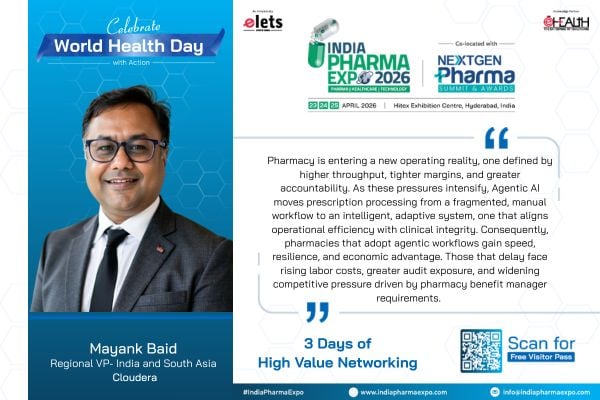
Pharmacy is entering a new operating reality, one defined by higher throughput, tighter margins, and greater accountability. As these pressures intensify, Agentic AI moves prescription processing from a fragmented, manual workflow to an intelligent, adaptive system, one that aligns operational efficiency with clinical integrity. Consequently, pharmacies that adopt agentic workflows gain speed, resilience, and economic advantage. Those that delay face rising labor costs, greater audit exposure, and widening competitive pressure driven by pharmacy benefit manager requirements.
Views expressed by: Mayank Baid, Regional Vice President – India and South Asia, Cloudera
Don’t just read about pharma transformation, experience it at India Pharma Expo 2026. Connect with top pharma & life sciences leaders, innovators, and policymakers. Click here to claim your free visitor pass.

 Like
Like
 Dislike
Be a part of Elets Collaborative Initiatives. Join Us for Upcoming Events and explore business opportunities. Like us on Facebook , connect with us on LinkedIn and follow us on Twitter , Instagram.
Disclaimer: The views and opinions expressed in this article are solely those of the author and do not necessarily reflect the official policy or views of any organisation. The content is intended for informational and educational purposes only and should not be construed as medical advice.
"Exciting news! Elets technomedia is now on WhatsApp Channels Subscribe today by clicking the link and stay updated with the latest insights!" Click here!