


Article
The 2026 Middle East Conflict & Strategic Survival for India’s Pharma Sector
The 2026 Middle East Conflict & Strategic Survival for India’s Pharma Sector
![]() By Dr. Asawari Savant, eHealth Network - 19 March 2026
By Dr. Asawari Savant, eHealth Network - 19 March 2026


On February 28, 2026, the global pharmaceutical landscape underwent a fundamental structural realignment. The escalation of the US-Israel-Iran conflict has transcended regional instability, evolving into a systemic shockwave that threatens the primary arteries of global healthcare. For India, the “Pharmacy of the World,” the era of supply chain orthodoxy, as defined by lean, just-in-time efficiency – is over.
In my view, this not merely as a logistical hurdle, but as an existential mandate for logistical elasticity. With Middle Eastern trade corridors transforming into tactical fortresses, the ability of Indian B2B leaders to pivot from reactive firefighting to sophisticated operational hedging will determine who survives this “perma-crisis” and who succumbs to margin erosion.

The Dubai Deadlock: When the World’s Logistics Heart Stops
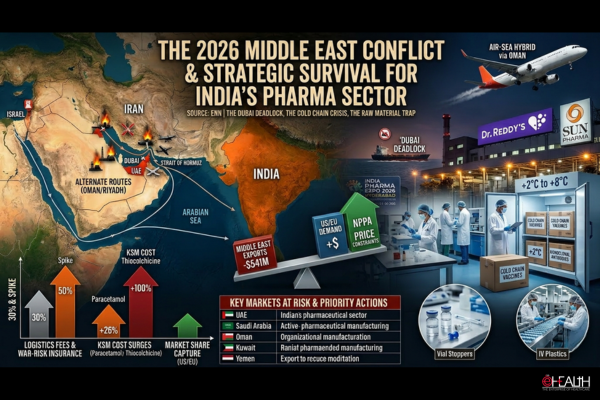
The retaliatory strikes on the United Arab Emirates have paralyzed the “re-export hub” that serves as the central nervous system for Indian exports to Africa and Europe. The suspension of Dubai International (DXB) and Jebel Ali Port is the most severe logistics shock since 2020.
- Air Freight Paralysis: High-value, time-sensitive shipments including APIs, biologics, and injectables are currently grounded. Rerouting via Istanbul or Frankfurt is no longer a simple detour; it adds 2 to 15 days to transit and forces firms to compete for dwindling global capacity.
- The China-Logistics Link: This crisis is compounded by a secondary shock: a critical scarcity of container ships in China, which is India’s primary supplier of raw materials. This “vessel vacuum” has restricted the movement of Key Starting Materials (KSMs), driving up freight surcharges to between $4,000 and $8,000 per shipment.
- Cost Escalation: We are seeing a 30% to 50% spike in total logistics fees, driven by surging war-risk insurance premiums and fuel surcharges.
As air freight is a primary channel for pharma, this suspension has grounded shipments and created immediate backlogs, with rerouting adding significant days and costs to an already tight capacity.

The Cold Chain Crisis: The 4-Week Window for Life-Saving Medicines
For temperature-sensitive oncology drugs, vaccines and monoclonal antibodies, time is the ultimate enemy. The disruption of established “cold-chain corridors” puts millions of dollars of inventory at risk of “temperature excursions.”

At-Risk Categories:
- Insulin: High-volume metabolic management.
- Vaccines: Critical pediatric and public health supplies.
- Oncology Treatments: Monoclonal antibodies requiring strict +2°C to +8°C ranges.
The “Micro-Component” Threat:
Beyond the medicine itself, we are observing a “forensic” supply chain risk. As noted by industry leaders, a shortage of $0.05 vial stoppers or IV bag plastics, which is often overlooked in high-level planning, can halt the distribution of a million-dollar drug batch.
Hospitals in the region report that stocks of expensive, short-shelf-life medicines may run low within 4 to 6 weeks. Tactical reliance on dry ice and emergency rerouting via Jeddah, Riyadh, or Oman are now the only viable short-term stopgaps.
B2B Market Breakdown: The $541 Million Seesaw
The Indian pharma industry faces a paradox: A massive surge in demand driven by panic stockpiling, set against a potential collapse in export stability.
- The Loss Side: Indian pharma faces export losses estimated at $541 million (up to Rs 5000 crore). This jeopardizes the significant growth seen in the WANA (West Asia and North Africa) region, where exports rose from $1,320 million in FY21 to $1,749 million by FY25.
- The Strategic Opening: While Israeli bellwethers like Teva Pharmaceuticals face manufacturing disruptions, Indian giants- including Sun Pharma, Dr. Reddy’s, Cipla, Biocon, and Lupin have a window to capture market share in the U.S. and Europe. With attractive P/E ratios (Sun Pharma ~30, Dr. Reddy’s ~25), Indian firms offer a more stable investment and supply proposition than their Middle Eastern counterparts.
Key Markets at Risk & Priority Actions
| Country | Dependency | Key Drug Categories | Priority Strategic Action |
| UAE | Critical Hub | Chronic & Acute care | Activate “Air-Sea Hybrids” via Oman |
| Saudi Arabia | High | Cardiovascular/ Metabolic | Increase buffer stocks in Riyadh |
| Oman | Moderate | Generic formulations | Expand as primary contingency port |
| Kuwait | Moderate | Vaccines/ Surgical | Secure specialized cold-chain air-charters |
| Yemen | Critical | Essential meds/ Antibiotics | Negotiate “Humanitarian Corridor” status |
The Raw Material Trap: 100% Price Spikes and NPPA Constraints
The most dangerous “bear case” for Indian pharma is the mandatory margin squeeze. India’s nascent self-reliance on KSMs leaves it vulnerable to massive input cost inflation.
Forensic Price Surge Data:
- Thiocolchicine (Muscle Relaxant): Up 100%+ (from Rs 3.4 lakh to Rs 7 lakh).
- Glycerine: Up 64%.
- Paracetamol: Up 26%.
The Regulatory Trap: Unlike other global sectors, Indian manufacturers are legally prevented by the National Pharmaceutical Pricing Authority (NPPA) from passing these 100% cost increases to the consumer. With APIs up and solvents spiking 20-30%, manufacturers are forced to absorb these costs, leading to a brutal compression of the P&L.
Strategy for 2026: From Firefighting to Resilience
To navigate this realignment, boards must move beyond “reactive firefighting” toward proactive risk management:
- Operational Hedging & Resilience: Diversify supplier bases away from single-source dependencies in China and the Middle East. Implement “Air-Sea Hybrids” to bypass blocked straits.
- Strategic Nearshoring: Accelerate dual-sourcing initiatives and move finishing stages closer to end-markets in Europe and the GCC.
- Tactical Cold-Chain Hardening: Invest in advanced monitoring and “Dry Ice” logistical reserves to handle 15-day rerouting cycles.
- Capitalizing on Market Gaps: Position as the reliable alternative to Israeli/WANA manufacturers to secure long-term contracts in regulated Western markets.
Navigating the Future at India Pharma Expo 2026
In an era of perma-crisis, isolation is a liability. The India Pharma Expo (April 23-25, 2026, at the Hitex Exhibition Center, Hyderabad) being organised by Elets Technomedia with knowledge partner eHealth Magazine, has transitioned from a trade show to a Key Strategy Room.
This is the essential venue where 15,000+ attendees, 350+ delegates, and 300+ exhibitors will meet to design the new global supply chain. With 100+ expert speakers and representatives from 15+ countries, the Expo & allied NextGen Pharma Summit offers the physical platform to solve the very challenges of dual-sourcing, NPPA margin protection and rerouting logistics discussed in this briefing.
Also read: Why Exhibiting at India Pharma Expo 2026 Is a Game-Changing Business Opportunity for Manufacturers
In The Long View: A Question of Agility
The 2026 conflict has stripped away the illusion that efficiency is the primary metric of a successful supply chain. For the Indian pharmaceutical sector, resilience is the only competitive advantage that remains.
As you review your 2026-2027 fiscal strategy, you must ask: Is your supply chain built only for the calm of 2024, or is it engineered for survival in the volatility of 2026?
Those who prioritize agility over mere cost-cutting will not only safeguard their global operations but will emerge as the trusted architects of the new world health order.

 Like
Like
 Dislike
Be a part of Elets Collaborative Initiatives. Join Us for Upcoming Events and explore business opportunities. Like us on Facebook , connect with us on LinkedIn and follow us on Twitter , Instagram.
Disclaimer: The views and opinions expressed in this article are solely those of the author and do not necessarily reflect the official policy or views of any organisation. The content is intended for informational and educational purposes only and should not be construed as medical advice.
"Exciting news! Elets technomedia is now on WhatsApp Channels Subscribe today by clicking the link and stay updated with the latest insights!" Click here!