



News
Takeda’s QDENGA Becomes India’s First Approved Dengue Vaccine
Takeda’s QDENGA Becomes India’s First Approved Dengue Vaccine
![]() By eHealth Network - 23 July 2026
By eHealth Network - 23 July 2026


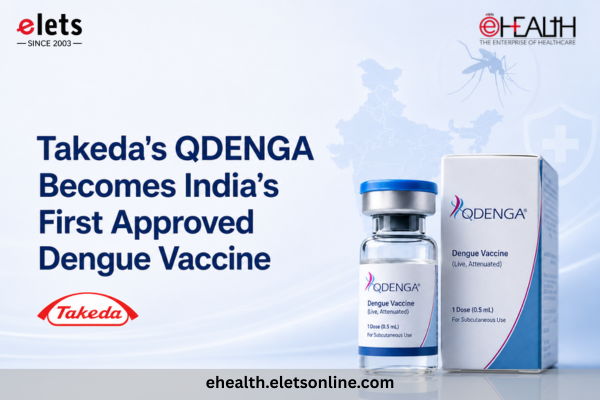
In a major boost to India’s public health preparedness, the Central Drugs Standard Control Organisation (CDSCO), under the Ministry of Health and Family Welfare, has granted marketing authorisation to QDENGA, making it the first dengue vaccine approved in the country. Manufactured by Takeda GmbH, Germany, and imported by Takeda Biopharmaceuticals India Pvt. Ltd., the vaccine is expected to strengthen India’s efforts to prevent and control dengue, one of the country’s most significant mosquito-borne diseases.

The approval follows a comprehensive scientific evaluation of the vaccine’s quality, safety, and efficacy under the Drugs and Cosmetics Act, 1940, and the Drugs Rules, 1945. QDENGA is a recombinant live attenuated tetravalent dengue vaccine developed using recombinant DNA technology and is designed to provide protection against all four dengue virus serotypes.
The vaccine is indicated for individuals aged 4 to 60 years and is administered as a two-dose regimen, with each 0.5 ml dose given three months apart. Unlike some earlier dengue vaccines, QDENGA does not require prior screening for previous dengue infection, making it more suitable for broader public health use.

The approval is supported by an extensive global clinical development programme conducted across more than eight countries, including Brazil, Thailand, Sri Lanka, and India. In addition, a pivotal Phase III clinical study involving Indian participants aged 4 to 60 years demonstrated favourable safety, immunogenicity, and efficacy outcomes.

Also Read: Redcliffe Labs Strengthens Integrated Diagnostics Business with Megavision Acquisition
QDENGA has already received regulatory approval in 42 countries, including the European Union, the United Kingdom, Switzerland, Indonesia, Malaysia, and Thailand. The vaccine has also secured World Health Organization (WHO) prequalification, with over 24 million doses distributed globally. According to post-marketing surveillance data, no significant safety concerns have been identified, reinforcing its strong global safety profile.
The approval marks a significant milestone in India’s fight against dengue and is expected to complement existing vector control, disease surveillance, early diagnosis, and case management initiatives under the National Vector Borne Disease Control Programme. The Ministry of Health and Family Welfare said the decision reflects its continued commitment to ensuring timely access to safe, effective, and quality-assured vaccines through a robust science-based regulatory framework.

 Like
Like
 Dislike
Be a part of Elets Collaborative Initiatives. Join Us for Upcoming Events and explore business opportunities. Like us on Facebook , connect with us on LinkedIn and follow us on Twitter , Instagram.
"Exciting news! Elets technomedia is now on WhatsApp Channels Subscribe today by clicking the link and stay updated with the latest insights!" Click here!