


Article
Reimagining Healthcare Financing in India’s Out-of-Pocket Economy
Reimagining Healthcare Financing in India’s Out-of-Pocket Economy
![]() By Dr. Asawari Savant, eHealth Network - 23 February 2026
By Dr. Asawari Savant, eHealth Network - 23 February 2026


As healthcare increasingly intersects with fintech, embedded finance is emerging as a powerful enabler of access and affordability in the healthcare sector. In a market where out-of-pocket spending dominates and elective care adoption is rising, seamless, tech-driven financing solutions are becoming critical to both patient experience and provider growth.
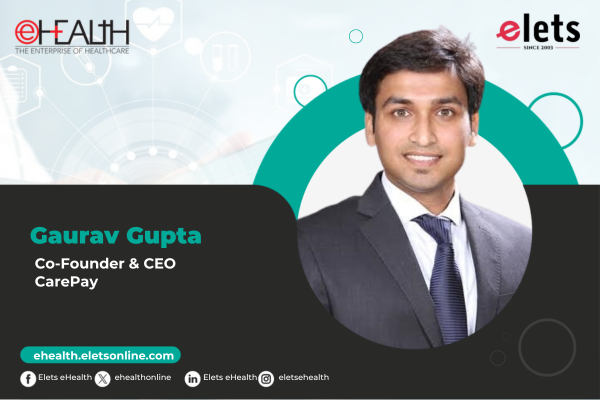
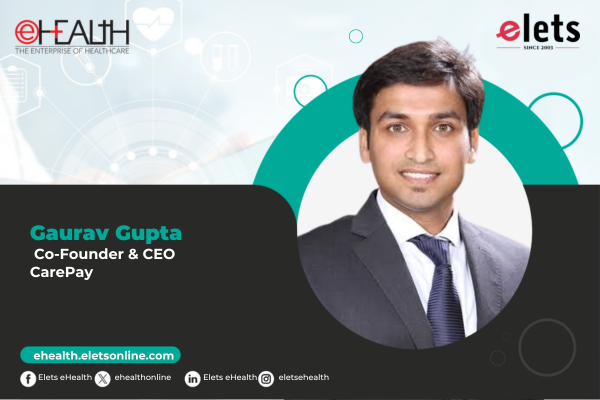
In this exclusive conversation, Gaurav Gupta, Co-Founder & CEO of CarePay, speaks with Dr. Asawari Savant from Elets News Network (ENN) about how platforms like CarePay are redefining the financial layer of healthcare delivery in India. Edited excerpts

How does CarePay’s technology enable seamless integration with hospitals, clinics, and healthcare providers?
CarePay is built as an embedded finance layer for care and wellness, designed to plug into the existing workflows of the providers (HIMS, CRMs, billing, payment gateways, and ABDM-compliant stacks). Instead of asking clinics to adopt a new workflow, we integrate into the existing checkout and counselling journey, so financing becomes a natural extension of how care is already sold and delivered. At the point of decision, our AI-led onboarding assistant (Careena AI) helps patients complete eligibility and documentation in a fully digital flow, compressing turnaround time and reducing operational burden on front-desk teams. This makes implementation lightweight for the provider: minimal training, faster patient conversion, and cleaner reconciliation—without disrupting clinical operations.
What impact does CarePay deliver to the healthcare industry?

For providers, CarePay is primarily a conversion and revenue engine. Elective and outcome-driven treatments often face drop-offs because patients want the outcome, but don’t want the upfront cash hit. By converting the decision from “₹Y today” to “₹X per month,” clinics can meaningfully increase treatment adoption and completion. Operationally, CarePay reduces friction at checkout through fast approvals and a guided journey, making it easier for clinic teams to offer structured payment options confidently. Providers also benefit from improved payment discipline and smoother workflows, because the financing process is standardised and digitally tracked end-to-end.
The role of AI evolving over the next 3–5 years in the healthcare financing space
AI will shift healthcare financing from being a generic “loan at checkout” into a context-aware financial layer embedded inside clinical journeys. Three changes are likely:
- Faster, more accurate risk decisions using richer signals (with appropriate consent), not just credit bureau scores, but behaviour, service context, and transaction patterns. This should expand access responsibly, especially for new-to-credit users, while reducing fraud.
- Better patient experience via AI agents, multilingual onboarding, document handling, nudges, and support, so care teams aren’t burdened with finance operations. This turns financing into an invisible utility.
- Lifecycle financing, not one-time EMIs – AI will enable bundled products such as treatment plans, follow-ups, repeat programs, and wellness memberships, helping providers build longer-term patient relationships and improving outcomes through continuity.
Are there any agreements/ plans or collaboration opportunities in the pipeline?
CarePay partners across the ecosystem: healthcare providers, lenders (banks/NBFCs), and distribution/enablement partners such as CRMs and practice-management platforms. This “platform” approach is important because adoption in healthcare isn’t only about underwriting, it’s equally about workflow fit and trust. On the provider side, we work with a growing network of clinics and centres across key elective categories (aesthetics, hair/derma, fertility, dental, etc.). On the financial side, we collaborate with multiple lending partners to ensure reliability, pricing competitiveness, and scale-readiness. In the pipeline, our focus is to deepen partnerships that make CarePay even more “native” to provider workflows, especially integrations with leading healthcare software and payment stacks, so financing becomes a default option rather than an add-on.
What are your plans for product & service enhancement for the coming year?
Our roadmap is guided by one principle: make financing feel like a seamless part of care delivery – simple for patients, effortless for providers, and safe for lenders.
Key roadmap themes:
- Deeper embedded integrations into existing workflows of the provider to reduce manual steps and improve reconciliation.
- AI-first patient onboarding and servicing (Careena AI evolution): higher completion rates, lower turnaround time, and better support across languages and channels.
- Smarter risk and fraud controls with more robust merchant/borrower profiling and dynamic credit policies by category—critical as we expand to larger-ticket treatments.
- Category expansion by phases: starting where EMIs unlock demand most efficiently (wellness & feel-good), then scaling into planned elective care, and later essential non-emergency care as risk and ops rails mature.
Elaborating on the present market scenario, what kind of business opportunities do you see in this segment?
India is witnessing a structural shift: health, wellness, and lifestyle outcomes are becoming mainstream consumption categories, especially for Millennials and Gen Z. People increasingly spend out-of-pocket on treatments that affect confidence, life timelines, daily function, and preventive certainty like aesthetics, hair/derma, fertility, dental, vision correction, wellness programs, and diagnostics.
This market is already large and growing fast, roughly ~$100B today and projected to approach ~$180B+ by 2030, and it is being accelerated by rising incomes, urbanisation, and the normalisation of EMI-based purchasing behaviour. The opportunity is especially attractive because the underlying spend is high out-of-pocket, and providers are actively looking for levers that improve conversion without discounting the medical value. In this segment, financing isn’t just about affordability; it becomes a growth and trust infrastructure for clinics, and a budgeting tool for consumers.

 Like
Like
 Dislike
Be a part of Elets Collaborative Initiatives. Join Us for Upcoming Events and explore business opportunities. Like us on Facebook , connect with us on LinkedIn and follow us on Twitter , Instagram.
Disclaimer: The views and opinions expressed in this article are solely those of the author and do not necessarily reflect the official policy or views of any organisation. The content is intended for informational and educational purposes only and should not be construed as medical advice.
"Exciting news! Elets technomedia is now on WhatsApp Channels Subscribe today by clicking the link and stay updated with the latest insights!" Click here!