


Article
India’s Mental Health Crisis Needs Structure, Scale and Serious Investment
India’s Mental Health Crisis Needs Structure, Scale and Serious Investment
![]() By eHealth Network - 29 January 2026
By eHealth Network - 29 January 2026


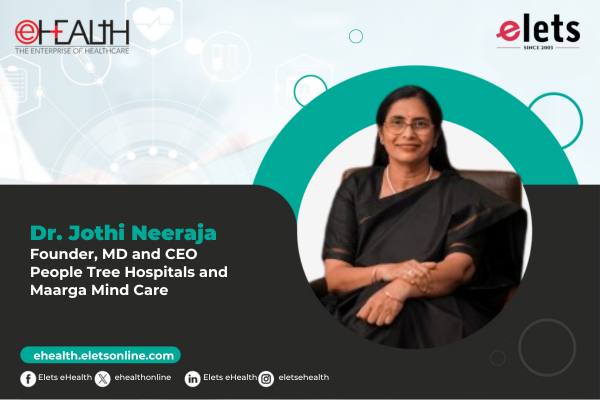
Mental health remains one of the most underserved areas of India’s healthcare ecosystem, despite rapidly growing need. In an exclusive interaction with Anuj Sharma of Elets News Network, Dr Jothi Neeraja, Founder, Managing Director and CEO of People Tree Hospitals and Maarga Mind Care, shares her journey of building a dedicated, patient-centric mental healthcare model in India. From integrating global clinical standards and advanced technologies to reimagining infrastructure with dignity and compassion, she outlines how Maarga Mind Care is redefining the way mental health services are delivered and perceived across the country.

Edited by: Abhineet Kumar | Elets News Network
Mental health is often described as the most neglected area within India’s healthcare ecosystem. What motivated you to create a dedicated mental healthcare facility like Marga Mind Care?

Mental health remains one of the most neglected areas of healthcare in India, despite the scale of suffering involved. What is particularly concerning is that the gap in mental health services in the country is more than 80 percent. A large number of people who require care simply do not have access to it.
This reality was the starting point for Marga Mind Care. We first established our mental health facility in Bengaluru seven years ago, and the experience there reinforced the urgent need for specialised, high-quality mental healthcare. Over the years, we realised that the burden of mental illness is not limited to one geography. With the growing pace of urbanisation, stress, anxiety and lifestyle-related mental health conditions are becoming increasingly common, especially in fast-growing cities.
That is what brought us to Gurugram. It is a rapidly developing city with a strong corporate presence, intense professional pressures and evolving social structures. All of this creates a significant demand for mental health services. Marga Mind Care in Gurugram has been designed to address this need in a comprehensive and compassionate manner.
You describe Marga Mind Care as a holistic mental health facility. Could you explain what that means in practical terms?
When we talk about holistic mental healthcare, we mean a complete continuum of care under one roof. The Gurugram facility is a 40-bed exclusive mental health hospital, offering a full range of services. These include outpatient consultations, online counselling, psychological therapies and a fully equipped inpatient facility.
We also provide round-the-clock mental health emergency services, which are crucial but often unavailable in private healthcare settings. Mental health crises do not follow office hours, and access to immediate care can be life-saving.
Our approach is patient-centric and evidence-based. Every treatment plan is personalised and guided by clinical protocols that are aligned with global standards. We are not merely treating symptoms. We are supporting long-term recovery, rehabilitation and reintegration into daily life.
One of the most striking aspects of the facility is that it does not resemble a traditional hospital. Why was this design philosophy important?
This was a very conscious decision. Mental health patients already come with a great deal of anxiety, fear and emotional vulnerability. Walking into a conventional hospital environment can amplify these feelings.
We wanted Marga Mind Care to feel safe, calming and dignified. The design is closer to that of a wellness retreat or a hospitality space rather than a medical institution. The aim is to create a positive environment that reduces stress and encourages healing.
Dignity of care is central to our philosophy. Mental health patients deserve the same quality of infrastructure, comfort and respect that patients in any other medical speciality receive. By creating a non-intimidating and aesthetically pleasing environment, we help patients and their families feel reassured from the moment they walk in.
The facility also integrates advanced technology such as neuromodulation and virtual reality therapy. How do these innovations improve clinical outcomes?
What you see here represents the latest advancements in psychiatric treatment. Neuromodulation therapies have transformed the way we treat several mental health conditions.
At Marga Mind Care, we offer treatments such as repetitive transcranial magnetic stimulation, transcranial direct current stimulation, virtual reality therapy and modern electroconvulsive therapy. These modalities are far more patient-friendly than older approaches and have shown excellent clinical outcomes, particularly in conditions such as severe depression, obsessive compulsive disorder, phobias and treatment-resistant illnesses.
Virtual reality therapy, for instance, allows controlled exposure in a safe and monitored environment, making it highly effective for anxiety disorders and phobias. Modern ECT is performed with advanced anaesthesia and monitoring, ensuring patient comfort and safety.
Technology, when combined with evidence-based clinical practice, enables better precision, faster recovery and improved patient experience.
You are a first-generation woman entrepreneur in healthcare. What challenges did you face while building People Tree Hospitals and later Marga Mind Care?
Healthcare is often perceived as a male-dominated sector, and there are unconscious biases that women professionals encounter, even today. I have been a practising clinician for nearly three decades, specialising in obstetrics and gynaecology. While that field has a strong presence of women, entrepreneurship in hospital management brings a different set of challenges.
People Tree Hospitals was the first hospital chain I started in Bengaluru. It is now a multi-speciality tertiary care hospital with over 300 beds and multiple branches. A few years after establishing People Tree, I decided to venture into mental healthcare.
That decision was met with significant resistance. Many colleagues and healthcare entrepreneurs discouraged me. They questioned the viability of mental health as a standalone, investor-ready model. I was often asked why I did not focus on women and child care instead, since that was my clinical background.
However, I believed that mental health was precisely the area where intervention was most needed. Unlike cardiology, oncology or nephrology, mental health had no dedicated private sector focus at scale.
Why is mental healthcare rarely integrated into multi-speciality hospitals in India?
One important reason is regulatory. Under the Mental Healthcare Act of India, mental health services require a separate licence and must adhere to stringent guidelines. These regulations are essential for patient protection, but they also mean that mental health cannot simply function as another department within a multi-speciality hospital.
As a result, mental health services are usually limited to government hospitals, medical colleges or large institutions such as national institutes. Private sector participation has been minimal.
This created a major gap. While India has seen a rise in single-speciality hospitals for cancer, fertility, renal care and gastrointestinal disorders, mental health remained excluded. Marga Mind Care was conceived to address this gap by creating a dedicated, compliant and high-quality mental healthcare model.
Stigma continues to be a major barrier to mental healthcare. How does Marga Mind Care work to reduce this stigma?
Stigma is only one part of the problem. A large number of people do not even know that help is available. Many families struggle in silence, unsure of where to go or whom to trust.
Mental illness affects not only the individual but also caregivers and family members, who often remain invisible in the conversation. Our mission is to create awareness, accessibility and acceptance.
We actively work to make mental healthcare stigma-free by normalising conversations, ensuring confidentiality and maintaining patient dignity at every stage. From infrastructure to clinical practice, everything is designed to reassure patients that seeking help is a sign of strength, not weakness.
How do you see the role of the younger generation in transforming mental healthcare in India?
There has been a very positive shift among younger generations. Mental health is now being recognised as a core healthcare need rather than something to be hidden or ignored.
More students are choosing psychology and mental health-related disciplines. I would strongly encourage young doctors to consider psychiatry as a specialisation. India currently has fewer than one psychiatrist per one lakh population, whereas global recommendations suggest at least three per one lakh. Given our population size and diversity, the requirement is even higher.
This shortage presents both a challenge and an opportunity. Young professionals entering this field can make a significant impact.
Digital health and artificial intelligence are transforming healthcare delivery. How are you leveraging technology to expand access?
Physical infrastructure alone cannot meet the scale of mental health needs in India, especially in remote and underserved regions. That is where digital solutions become critical.
We are working on an AI-enabled mental health application that will allow online consultations, guided interventions and early screening. This will help bridge the accessibility gap, particularly for people in rural and tier-three locations who may not have access to specialised centres.
Technology allows us to extend care beyond physical boundaries while maintaining clinical quality and continuity.
Ethical and sustainable healthcare practices are increasingly important. How do these principles shape your operations?
Ethics are non-negotiable in healthcare. They form the foundation of our work. At Marga Mind Care, ethical practice extends beyond clinical protocols to every aspect of patient interaction.
Compassionate care is essential in mental health. From security personnel and front-desk staff to nurses, therapists and doctors, every team member is trained to engage with empathy and respect.
We have also adopted sustainable practices such as paperless systems wherever possible. Sustainability and ethics are not separate goals. They are part of responsible healthcare delivery.
What are your long-term plans for Marga Mind Care?
The Gurugram centre is the second Marga Mind Care facility after Bengaluru and is part of a larger vision. Over the next three to four years, we plan to establish 25 to 30 Marga Mind Care centres across tier-one and tier-two cities in India.
We are also exploring a hub-and-spoke model to extend services to tier-three towns and rural areas through technology-enabled clinics. These centres will be digitally connected to larger hubs, ensuring access to specialised expertise.
Our goal is to build a national mental healthcare ecosystem that is accessible, ethical, evidence-based and patient-centred.

 Like
Like
 Dislike
Be a part of Elets Collaborative Initiatives. Join Us for Upcoming Events and explore business opportunities. Like us on Facebook , connect with us on LinkedIn and follow us on Twitter , Instagram.
Disclaimer: The views and opinions expressed in this article are solely those of the author and do not necessarily reflect the official policy or views of any organisation. The content is intended for informational and educational purposes only and should not be construed as medical advice.
"Exciting news! Elets technomedia is now on WhatsApp Channels Subscribe today by clicking the link and stay updated with the latest insights!" Click here!