

Article
Transforming Healthcare Research in India with AI-Driven Microscopy and Next-Gen Diagnostics
Transforming Healthcare Research in India with AI-Driven Microscopy and Next-Gen Diagnostics
![]() By Dr. Asawari Savant, eHealth Network - 28 August 2025
By Dr. Asawari Savant, eHealth Network - 28 August 2025


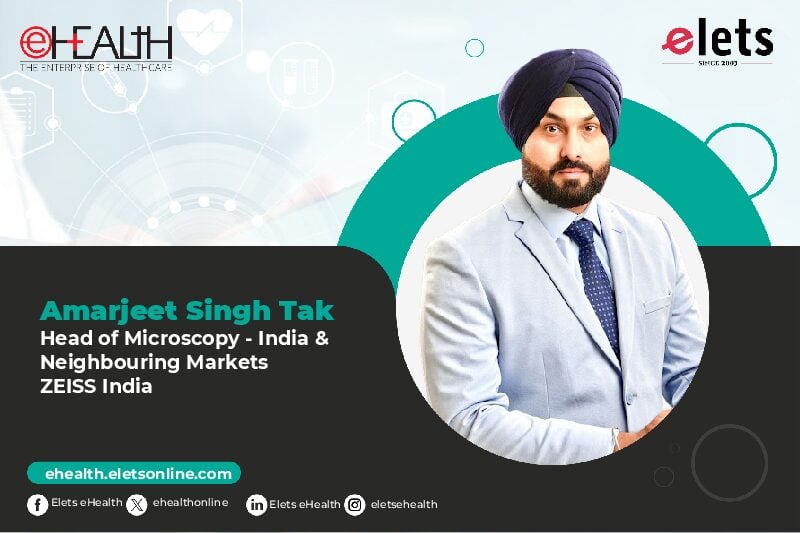
Precision, speed, and data-driven insights are becoming critical, yet many hospitals and research institutions face challenges in adopting AI-enabled microscopy solutions effectively. In an exclusive discussion, Amarjeet Singh Tak, Head of Microscopy – India & Neighbouring Markets, ZEISS India, shares with Dr. Asawari Savant of Elets News Network (ENN) how cutting-edge imaging and training initiatives are transforming patient care, accelerating translational research, and preparing a skilled workforce for the future of healthcare. Edited excerpts
How is ZEISS Microscopy transforming healthcare research and diagnostics in India through AI-enabled imaging solutions? Could you share examples of real-world applications in life sciences or pathology?
At ZEISS, we see AI not as a buzzword, but as a catalyst for faster, more accurate, and more accessible healthcare. AI-enabled imaging in microscopy allows us to process complex biological data in real time, identifying patterns, quantifying tissue structures, and even flagging abnormalities invisible to the human eye.

In digital pathology, for instance, our AI-powered platforms are helping pathologists detect cancerous changes earlier, significantly reducing reporting times from days to hours. We are also seeing applications in IVF and reproductive medicine, where AI imaging helps embryologists select the healthiest embryos, increasing success rates and improving patient outcomes. In forensic science, advanced imaging aids in high-precision tissue and trace analysis, strengthening evidence accuracy.
In life sciences research, AI-driven cell segmentation and tracking enable scientists to observe how cells behave under different drug candidates, accelerating drug discovery cycles. These are no longer proof-of-concept projects. Indian hospitals, IVF centres, biotech labs, and research institutions are already deploying these solutions to transform patient care and research impact.
With growing demand for precision and speed in clinical diagnostics, how is ZEISS supporting hospitals, labs, and research institutes in adopting digital and non-destructive microscopy workflows?
The future of diagnostics is digital-first and data-driven. ZEISS has been at the forefront of digitising microscopy workflows from capturing ultra-high-resolution images to managing them in secure cloud platforms for remote review.
A key enabler here is our ARIVIS software platform, a powerful, vendor-agnostic analysis tool that works seamlessly across various imaging systems, helping institutions integrate data from multiple sources into one analytical workflow.
For hospitals and labs, we provide end-to-end integration: digital slide scanners, AI analysis modules, and LIS connectivity. This ensures faster turnaround, greater reproducibility, and enables expert collaboration between pathologists, even across different geographies.
ZEISS has been actively collaborating with academic institutions. How do these partnerships help bridge the gap between research and industrial needs in the healthcare and med-tech sectors?
Academic brilliance needs industry scalability. Our partnerships with leading universities and medical colleges ensure that students and researchers have access to the same advanced imaging tools used in global industry and healthcare labs.
A flagship initiative is the ZEISS Ashoka Microscopy Academy, where we have introduced India’s first-of-its-kind Advanced Microscopy Professional Course. This program blends theory with extensive hands-on training, preparing participants to address real-world biomedical and industrial imaging challenges.
We also bring innovation to teaching through the ZEISS Digital Classroom, an integrated microscopy environment where professors can digitally access and control any student’s microscope, project live images to the entire class, and conduct interactive demonstrations. Our Dechead and Pentahead microscopes allow group learning, enabling multiple students to view the same sample simultaneously for collaborative understanding.
Through these initiatives and joint research projects, students work on live healthcare challenges, while industry benefits from validated, scalable solutions and a ready pool of highly skilled talent.
What role does microscopy play in accelerating translational research, especially in moving discoveries from bench to bedside, and how can this impact early disease detection and treatment outcomes?
Microscopy is the first lens through which many diseases are understood, and today its role extends across the spectrum from routine blood work to understanding lifestyle disorders like diabetes to life-threatening cancers.
In translational research, microscopy is indispensable in fields like genetic medicine, customised or precision medicine, gut microbiome research, and tumour cell studies. Advanced imaging enables scientists to visualise disease pathways at the cellular and molecular level, validate therapies, and adapt treatments to an individual’s unique genetic and physiological profile.
The result? Faster movement from lab discovery to patient treatment, early disease detection years before symptoms, and the ability to design interventions that are preventive as much as they are curative. This has transformative implications for public health, especially in countries like India with a dual burden of infectious and lifestyle diseases.
How do ZEISS’s training initiatives or industry exposure programs contribute to building a job-ready, innovation-driven healthcare research workforce in India?
Technology alone doesn’t transform healthcare; people do. That’s why we invest heavily in hands-on training programs, internships, and advanced microscopy workshops for students, researchers, and clinicians.
Our Centres of Excellence, in collaboration with institutions, serve as open innovation hubs where participants gain exposure to advanced microscopy techniques, AI-enabled workflows, and interdisciplinary applications. These programs ensure graduates enter the workforce with industry-grade competencies, reducing onboarding time and enabling them to contribute meaningfully from day one.
Also read: How India’s Pediatric Heart Care System Can Evolve: The Role of NGOs and Policy
From your experience in the med-tech and pharmaceutical sectors, what trends are redefining B2B engagements in healthcare imaging and diagnostics, and how should organisations prepare for the future?
Three trends are reshaping the sector:
- Platform thinking – Clients increasingly seek integrated ecosystems combining hardware, AI, and cloud-based data exchange rather than standalone products.
- Outcome-based partnerships – Buying decisions are shifting from cost-driven to outcome-driven, where the metric is improved patient care and operational efficiency.
- Collaborative innovation – Hospitals, startups, academia, and technology providers are co-developing solutions in accelerated cycles.
Organisations must prepare by investing in digital readiness, building interoperability into every solution, and forming collaborative networks that blend local insights with global best practices. This will not just be future-proof operations but also keep them at the cutting edge of healthcare transformation.

 Like
Like
 Dislike
Be a part of Elets Collaborative Initiatives. Join Us for Upcoming Events and explore business opportunities. Like us on Facebook , connect with us on LinkedIn and follow us on Twitter , Instagram.
Disclaimer: The views and opinions expressed in this article are solely those of the author and do not necessarily reflect the official policy or views of any organisation. The content is intended for informational and educational purposes only and should not be construed as medical advice.
"Exciting news! Elets technomedia is now on WhatsApp Channels Subscribe today by clicking the link and stay updated with the latest insights!" Click here!