


Article
Google.org Invests $30 Million in AI for Government and Public Health Innovation
Google.org Invests $30 Million in AI for Government and Public Health Innovation
![]() By Dr. Asawari Savant, eHealth Network - 24 September 2026
By Dr. Asawari Savant, eHealth Network - 24 September 2026


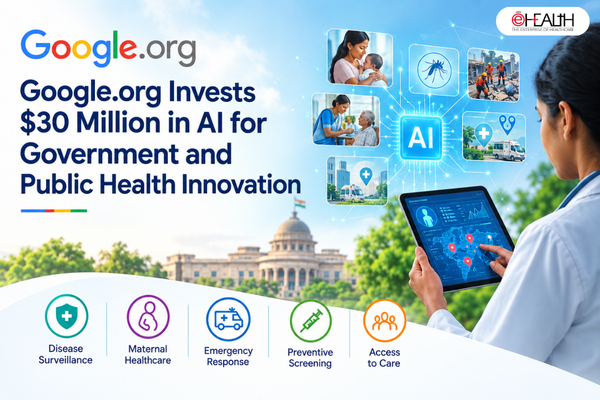
Artificial intelligence is increasingly moving beyond experimental applications in healthcare and into the delivery of public services, with Google.org announcing $30 million in funding for 15 organisations developing AI-powered solutions for governments and communities worldwide.
Announced under the Google.org Impact Challenge: AI for Government Innovation, the selected organisations were chosen from more than 2,600 proposals globally. The initiative focuses on using AI to address complex public-sector challenges spanning healthcare, emergency response, infrastructure, transportation and citizen services.
For the healthcare sector, the programme highlights how AI can support public health systems not only through clinical technologies, but also by strengthening disease surveillance, maternal healthcare, emergency medical coordination, preventive screening and access to care.

AI applications target critical public health gaps
Several of the selected projects have a direct healthcare or public health focus.

The Disaster Mitigation Research Center at Nagoya University is developing an AI-enabled approach to map emergency medical supply and demand in real time during disasters. The objective is to help coordinate patient care and better match medical resources with emerging needs during crisis situations.
Meanwhile, Froncort.AI is working on technology designed to help frontline health workers identify infectious disease clusters, including tuberculosis, malaria and dengue, which may not be adequately captured by conventional blanket intervention approaches.
Maternal health is another priority area. The Helium Health Foundation is developing an AI solution intended to help women identify early health risks and access specialised maternal healthcare in a more timely manner.
The initiative also includes Flexbone, which is working to help patients and caregivers identify affordable outpatient care irrespective of insurance status, potentially addressing a key barrier to access and care navigation.
At the population-health level, the University of Warwick is developing an approach to map disease risks and deploy mobile clinics to vulnerable communities for preventive screening interventions.
Together, these projects illustrate a broader application of AI in healthcare—one that extends beyond diagnosis and treatment to anticipatory public health, resource allocation, care access and community-level prevention.
From AI pilots to open-source public infrastructure
A notable feature of the Google.org programme is its focus on creating human-centred AI tools that can be adapted and shared.
The 15 selected organisations will participate in a dedicated Google.org Accelerator and receive pro bono technical support and guidance from Google engineers and product experts. Their projects are intended to produce open-source blueprints, allowing solutions to be adapted and potentially reused across different communities and government settings.
This model could be particularly significant for public health systems, where governments often face similar challenges but operate within different infrastructure, resource and population contexts.
Rather than treating AI as a standalone technology deployment, the initiative positions it as a tool that can be integrated into existing public-service systems—from health ministries and emergency response networks to municipal services and community-level programmes.
A broader shift in government AI adoption
The latest funding follows Google.org’s February 2026 launch of the AI for Government Innovation challenge. At the time, Google.org cited research showing a gap between public-sector expectations and implementation: while 80% of public servants surveyed said AI was empowering them, only 18% believed their governments were using AI effectively.
The selection of 15 organisations therefore points to a shift from discussions around the potential of AI in government towards developing practical applications that can address specific public-service challenges.
For healthcare systems, the projects demonstrate several emerging use cases: using AI to identify disease patterns, anticipate health risks, improve access to care, coordinate medical resources during disasters and take preventive services closer to vulnerable populations.
As governments globally continue to explore AI adoption, the success of such initiatives will depend not only on technological capability but also on factors including data quality, interoperability, privacy, governance, workforce readiness and the ability to integrate AI into existing health systems.
Google.org’s latest initiative offers another indication that the next phase of healthcare AI may increasingly be defined not just by what happens inside hospitals and laboratories, but by how intelligently technology can support population health and public-service delivery at scale.

 Like
Like
 Dislike
Be a part of Elets Collaborative Initiatives. Join Us for Upcoming Events and explore business opportunities. Like us on Facebook , connect with us on LinkedIn and follow us on Twitter , Instagram.
Disclaimer: The views and opinions expressed in this article are solely those of the author and do not necessarily reflect the official policy or views of any organisation. The content is intended for informational and educational purposes only and should not be construed as medical advice.
"Exciting news! Elets technomedia is now on WhatsApp Channels Subscribe today by clicking the link and stay updated with the latest insights!" Click here!