


Article
Why India’s Next Healthcare Leap Will Be Driven by Operational Excellence, Not Just More Hospital Beds
Why India’s Next Healthcare Leap Will Be Driven by Operational Excellence, Not Just More Hospital Beds
![]() By eHealth Network - 07 September 2026
By eHealth Network - 07 September 2026


Why the next phase of healthcare growth will depend on how effectively hospitals use the capacity they already have. 


 Like
Like
 Dislike
India’s healthcare demand is growing rapidly. New hospitals are being built, existing networks are expanding and significant capital is flowing into the sector through IPOs, private equity, mergers and acquisitions and strategic investments.
More beds will certainly be needed. But adding capacity is only one part of the answer.
A hospital can have hundreds of beds and still have considerable unused capacity. Beds may be blocked by delayed discharges, operating theatres may start late, diagnostic equipment may remain idle and specialists may not be utilised efficiently. The next phase of healthcare growth will therefore depend as much on how hospitals use existing capacity as on how much new capacity they build.
The Bed Is Only the Visible Unit
A hospital bed is the most obvious measure of capacity, but it is only the end point of a much larger system.
A patient needs a doctor, nurse, diagnostic support, pharmacy, operating theatre where required, billing, insurance coordination and a functioning support system around the bed. If any of these becomes a bottleneck, the bed itself becomes less productive.
Consider discharge delays. A patient who is clinically ready to leave but is waiting for documentation, billing, pharmacy clearance or insurance authorisation continues to occupy a bed. The hospital may have demand waiting outside, but cannot admit the next patient.
Planning discharges a day ahead, coordinating clinicians, nursing, pharmacy, billing and insurers early, and automating discharge documentation can release that capacity without building another room.
The same applies to operating theatres. A theatre that starts late, has frequent cancellations or remains unused between cases is lost capacity.
Where Hospitals Lose Capacity Every Day
Operational improvement often comes from fixing relatively ordinary problems.
Are first surgeries starting on time? Are cancellations being analysed? Is OPD waiting time affecting conversion to admissions? Are internal referrals being lost? Is expensive equipment sitting idle? Are claims being delayed because of documentation gaps? Are missed charges or billing errors creating revenue leakage?
These are not abstract management questions. They directly affect how much healthcare a hospital can deliver from the infrastructure it already owns.
Top tertiary hospitals typically achieve 72–78% occupancy, with the best-performing hospitals often exceeding 80%. EBITDA margins are typically 22–25%, ARPOB ₹55,000–₹80,000, depending on specialty mix and geography, ROCE 18–22%, ALOS 3.5–4.5 days and OT utilisation 80–85%. Claim denial rates are typically below 3–5%.
These numbers are outcomes. The real work happens in the processes that produce them.
Marketing and communication are also part of capacity utilisation. Many hospitals do excellent clinical work but do not communicate it sufficiently. Publishing meaningful clinical outcomes, scientific papers and quality initiatives can build credibility with referring doctors and patients. Regular patient engagement, community programmes, health-awareness initiatives and an active social-media presence can improve awareness of the hospital’s capabilities.
A hospital may have excellent doctors and outcomes, but if potential patients do not know about them, that capacity remains underused. Marketing should not simply mean advertising. It should communicate genuine clinical capability and create stronger engagement with patients, family physicians and the local community. Better communication, patient counselling and follow-up can improve footfalls and referrals, which in turn can improve utilisation of existing infrastructure.
The 24-Hour Hospital Problem
Hospitals are unusual businesses because they have to be ready even when demand is unpredictable.
An emergency department cannot close because it is a quiet afternoon. An ICU cannot simply reduce its capacity because occupancy has temporarily fallen. Specialist coverage, nursing, equipment, medical gases, infection control and other support services have to be maintained around the clock.
That makes utilisation particularly important.
The objective is not to push occupancy to the maximum possible level. A hospital needs enough capacity for emergencies and fluctuations in demand. The objective is to use available capacity well while maintaining patient safety and clinical quality.
This is where better forecasting, scheduling and daily operational dashboards can make a meaningful difference.
Technology Should Remove Friction
Technology can help, but only when it solves a real operational problem.
Digital queue management can reduce waiting. Electronic records can reduce duplication. Clinical Decision Support Systems can support clinical workflows. RFID can help track assets. Utilisation analytics can show where equipment is underused. Automated alerts can coordinate housekeeping and pharmacy. Better revenue-cycle systems can reduce billing errors and claim delays.
The test should be simple: does the technology remove a bottleneck, improve quality or release staff time?
Technology that adds another layer of work without changing the underlying process does little for productivity.
But technology can only take a hospital so far. Ultimately, it is the attitude of the people running the system that determines whether the last bit of effort is made to push performance from good to great. The willingness of staff to take ownership, solve problems and make that extra effort is often what shows up in the final numbers. People Still Determine Productivity
That last mile of execution is human.
Healthcare remains a people-intensive industry.
Doctors, nurses and allied professionals determine how effectively much of the system actually works. Appropriate nurse-to-bed ratios, training, performance management, career development and recognition can influence both productivity and retention.
Doctor engagement deserves particular attention. A hospital may have excellent infrastructure, but if its doctors do not actively prefer the hospital for their patients, that capacity may remain underused. Regular clinical engagement, listening to doctors’ concerns, recognising performance, supporting their practice and, where appropriate, well-designed incentive mechanisms can help ensure that doctors give the hospital priority when deciding where to see or admit patients. The objective should be a relationship built on clinical trust and mutual value, not simply transactional referral generation.
This is particularly relevant as India expands healthcare capacity beyond major cities. Specialist talent remains concentrated in urban centres. Attracting people to smaller cities requires more than a hospital building. Roads, transport, electricity, water, schools, housing, shopping and other aspects of everyday life also influence whether healthcare professionals are willing to relocate.
India also needs more medical and nursing education capacity. A limited talent pool increases competition for experienced professionals and can push up the cost of healthcare delivery.
A Hospital Productivity and Leakage Dashboard
Boards and hospital leadership teams do not need hundreds of indicators to understand whether their infrastructure is being used well. They need a dashboard that shows both underutilised capacity and avoidable leakage, while ensuring that efficiency does not come at the expense of patient experience.
A practical dashboard can track:
- Bed occupancy and ALOS
- OT utilisation and first-case-on-time performance
- OT cancellation rates
- OPD-to-IPD conversion
- Discharge turnaround time
- Diagnostic and equipment utilisation
- Workforce productivity
- Patient satisfaction score and key experience indicators
- Claim denial rates and deductions
- Billing errors and missed billing
- Revenue leakage
- ARPOB and EBITDA
The patient satisfaction measure is particularly important. A hospital can improve occupancy and financial performance in the short term while creating a poor patient experience. That is not sustainable operational excellence. Waiting time, communication, responsiveness, billing clarity, discharge experience and overall patient satisfaction should therefore sit alongside financial and productivity measures.
Revenue leakage is often hidden in simple operational gaps. A patient may occupy a twin-sharing room but be placed in a single-room category without proper authorisation or billing. Inventory may be consumed but not charged, or charged when it was not actually used. An OPD consultation may take place without the appropriate billing being captured. Internal referrals may be missed and the patient may leave the hospital for a service that was available within the same institution.
There are also less visible leakages. Poor paperwork can result in cashless denials or deductions from insurance claims. Weak follow-up with insurers can delay reimbursement. Old insurance tariffs may continue to be accepted even when they no longer reflect inflation and current costs. Pilferage and theft of medicines, consumables or other inventory can also add up over time.
None of these individually looks like a major financial issue. Together, they can materially affect hospital profitability, working capital and patient experience.
This is why a hospital dashboard should not only ask “How full are our beds?” It should also ask “How much of the capacity, revenue and patient trust we already have are we actually capturing?”
What Can Better Operations Actually Deliver?
The gains from operational improvement are not theoretical. Published hospital improvement studies have demonstrated substantial improvements from relatively straightforward interventions.
For example, an Indian study auditing OT utilisation found that theatres were starting late in 63.5% of cases, with significant cancellations. The authors concluded that planning, realistic scheduling, communication and resource management could improve utilisation.
Another tertiary-care study found that a structured approach to OT management increased first-case-on-time starts from 39.3% to 83.8%, while utilisation and case volumes also improved. Specially when there are visiting consultants attached to various hospitals this aspect needs special consideration as the delay creates an undesirable chain reaction, upsets incoming doctor procedures and their schedules and no one is happy.
A global case study showed lack of inventory efficiency contributed significantly to OT cancellation and even death due to unavailable critical inventory. This is a huge avoidable loss of revenue and reputation to a hospital. Utilising inventory optimisation practices including engaging with professional supply chain aggregators if required can help improve OT Utilisation.
These examples should not be treated as universal benchmarks. They do, however, demonstrate an important point: meaningful capacity can sometimes be created without adding a single bed.
One Hospital Can Produce More Than Another
Consider two hospitals with the same ₹1,000 crore investment. One operates at 82% occupancy, 84% OT utilisation and 24% EBITDA. The other operates at 61% occupancy, 62% OT utilisation and 13% EBITDA.
The capital invested is the same. The output is not.
That difference is created by thousands of decisions around scheduling, staffing, patient flow, procurement, billing, clinical coordination and asset utilisation.
This is why operational excellence should be treated as a growth strategy, not simply as a cost-control exercise.
Ask Before Adding the Next Bed
India will need more hospitals and more beds. The question for hospital boards should be what happens before the next bed is approved.
What capacity is currently underused? Where is the bottleneck? Can existing OT capacity support more cases? Can discharge processes release beds faster? Can equipment be used more effectively? Are doctors and nurses being deployed where demand actually exists? Are patients being lost because of poor experience or weak referral networks? Are avoidable billing and revenue leakages reducing the return from existing capacity?
Sometimes the best investment is another building. Sometimes it is a better process.
The next phase of India’s healthcare growth should measure success not only by the number of beds added, but by the productive capacity created from every bed, every operating theatre, every diagnostic machine and every healthcare professional. India needs more healthcare infrastructure. But before we build our way out of a capacity problem, we should make sure we are not carrying an execution problem into every new hospital we build.
The next healthcare leap will not simply come from building more capacity. It will come from making every unit of existing capacity work better, every day.
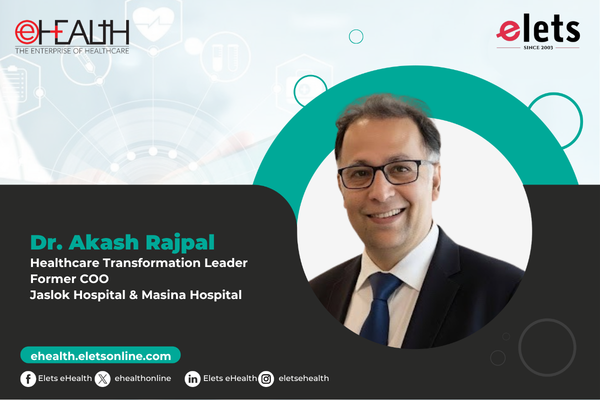
Views expressed by: Dr. Akash Rajpal, Healthcare Transformation Leader & Former COO- Jaslok Hospital & Masina Hospital
 Like
Dislike
Like
Dislike
Be a part of Elets Collaborative Initiatives. Join Us for Upcoming Events and explore business opportunities. Like us on Facebook , connect with us on LinkedIn and follow us on Twitter , Instagram.
Disclaimer: The views and opinions expressed in this article are solely those of the author and do not necessarily reflect the official policy or views of any organisation. The content is intended for informational and educational purposes only and should not be construed as medical advice.
"Exciting news! Elets technomedia is now on WhatsApp Channels Subscribe today by clicking the link and stay updated with the latest insights!" Click here!