


Interview
From AI Pilots to Enterprise Power: The Agentic AI Shift in Healthcare
From AI Pilots to Enterprise Power: The Agentic AI Shift in Healthcare
![]() By eHealth Network - 24 August 2026
By eHealth Network - 24 August 2026


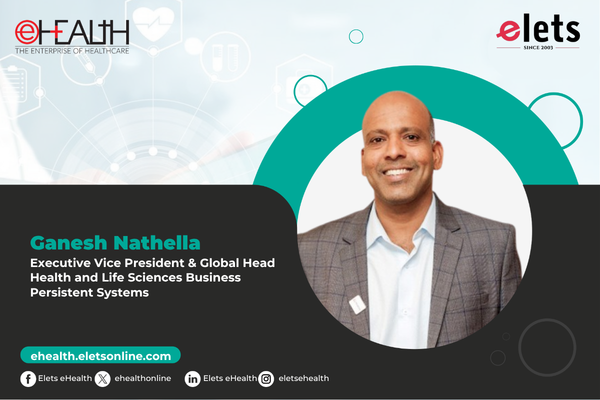
With Agentic AI moving healthcare from task automation to outcome-oriented decision-making, the industry is entering a new phase of digital transformation, one where data readiness, governance, trust and human oversight are as critical as the technology itself. In this exclusive conversation, Ganesh Nathella, Executive Vice President & Global Head of Health and Life Sciences Business at Persistent Systems, shares with Dr. Asawari Savant from Elets News Network (ENN), what it will take for Healthcare and Life Sciences organisations to move beyond AI experimentation and build secure, scalable and enterprise-ready AI capabilities. Edited excerpts

Healthcare has experimented with automation for years. What fundamentally changes when organizations move from workflow automation to Agentic AI?
Automation follows predefined rules, whereas Agentic AI can reason, adapt and act across interconnected workflows. The shift is no longer about automating tasks to improve efficiency. It is about orchestrating outcomes, requiring organizations to rethink accountability, governance and human oversight as AI moves beyond task execution into enterprise decision-making.
Claims management illustrates this shift well. Traditional automation efficiently processes claims that conform to predefined rules, while exceptions are routed for manual review. Agentic AI can interpret those exceptions, synthesize information from multiple systems, determine the appropriate course of action and either resolve the issue or escalate it with contextual recommendations. The value lies not just in automating individual tasks, but in streamlining end-to-end business processes.

In our work with one of the largest payors in the US, AI agents reduced days of manual coordination to hours while preserving human accountability for final decisions. The initiative strengthened payment integrity across fraud, waste, abuse and error detection, while improving payment accuracy throughout the claims lifecycle, enabling teams to focus on higher-value judgment and exception management.
Ultimately, the conversation is no longer centered on identifying which tasks can be automated. It is about determining which business outcomes can be confidently delegated to AI, while ensuring the governance, oversight and trust required to operate safely at enterprise scale.
Persistent has emphasized “Enterprise Data Readiness for AI” as a strategic priority. Why is data governance becoming as critical as the AI models themselves in healthcare transformation?
Even the most advanced AI models are only as effective as the data that powers them. In healthcare, where every decision carries clinical and regulatory implications, fragmented or poorly governed data creates risks that no model can overcome. Governance is therefore more than a compliance requirement. It is what makes AI trustworthy, traceable and safe to act upon.
As AI models become increasingly commoditized, competitive advantage shifts to the quality, structure and lineage of enterprise data. Healthcare organizations need interoperable standards such as FHIR, accurate master patient indexing and robust data provenance to ensure every AI-generated recommendation is explainable and traceable. This principle is embedded in Persistent’s 3C Framework, where Enterprise Data Readiness is built on a strong “Core,” which is an integrated foundation for secure, interoperable, governed, observable, and cost-controlled enterprise AI. The “Context” layer makes the enterprise data, processes, content and workflows reliable and traceably accessible to AI systems. Finally, the “Coordination” layer, where people, agents, applications, and systems collaborate with clear controls and accountability. This approach enables organizations to move confidently from AI experimentation to enterprise-scale adoption.
We see this consistently across provider and life sciences organizations, where the first phase of an AI program is rarely about the model itself. It is about establishing a trusted data foundation by consolidating fragmented source systems, resolving duplicate identities and implementing robust governance before AI is deployed. This foundation enables organizations to scale AI beyond pilots into production with greater confidence.
For example, we partnered with a global provider of life sciences and pharmaceutical commercialization services to build a centralized, cloud-native unified data platform, creating a scalable foundation for predictive, generative and Agentic AI workloads. More than a technology prerequisite, enterprise data readiness is what turns AI into an enterprise operating capability, one that is secure, governed and capable of delivering sustained business value.
Healthcare is a high-stakes environment for autonomous AI systems. What safeguards need to be in place before organizations can scale Agentic AI responsibly?
Scaling Agentic AI responsibly requires more than deploying advanced models. It demands a governance framework that defines where AI can operate autonomously, where human judgement remains essential and how every decision is monitored, explained and audited. Organizations should begin with targeted use cases and progressively expand autonomy as trust, evidence and operational maturity grow.
This rests on three fundamental principles: control, transparency and containment. Control establishes clear decision boundaries, allowing AI agents to act independently where appropriate while reserving clinical and regulatory decisions for human oversight. For example, a scheduling agent may autonomously rebook appointments, whereas decisions with clinical or regulatory implications require human sign-off. Transparency ensures every action is fully traceable and aligned with frameworks such as 21 CFR Part 11 and GxP, creating a complete audit trail. Containment focuses on validating Agentic AI in well-defined, lower-risk workflows, such as regulatory intelligence monitoring or inspection readiness support, before extending it to broader enterprise processes. This phased approach helps organizations establish the operational foundation needed to scale AI responsibly and sustainably.
At Persistent, we have operationalized these principles through Persistent GenAI Hub, our enterprise AI platform designed to accelerate the creation, deployment and management of Generative and Agentic AI applications at scale. By integrating seamlessly with existing infrastructure, enterprise data and applications, it enables organizations to rapidly build industry-specific AI solutions across multiple LLMs and cloud environments without vendor lock-in. Built on Responsible AI principles, GenAI Hub incorporates evaluation frameworks, human-in-the-loop validation and governance capabilities that help organizations operationalize the controls, transparency and oversight required to scale Agentic AI confidently in highly regulated healthcare environments.
Healthcare & Life Sciences continues to be a key growth driver for Persistent. What is fueling demand for AI-led transformation programs in this sector?
Healthcare and Life Sciences organizations are operating in an environment where cost pressures, workforce constraints and evolving compliance requirements are converging. AI presents an opportunity not simply to improve efficiency, but to scale expertise, accelerate decision-making and enhance operational effectiveness without a proportional increase in headcount or risk.
Three structural shifts are driving this momentum. First, organizations continue to balance cost optimization with increasingly complex regulatory expectations, as evolving medical device regulations and AI-specific requirements place greater demands on documentation, governance and oversight. Second, highly specialized quality, regulatory and clinical talent remains in limited supply, making it increasingly important to amplify expertise rather than expand teams. Finally, organizations are looking beyond isolated productivity gains towards enterprise-wide operational transformation. AI enables regulatory affairs teams to manage more submissions, quality teams to process more complaints and clinical operations teams to oversee more sites without a linear increase in resources. We see this demand most clearly across the medical devices, diagnostics and CRO sectors, where clients are leveraging AI to build faster, more resilient and operationally efficient organizations. The momentum behind AI is therefore driven not by novelty, but by its ability to create measurable business value.
For example, we are working with a leading provider of measurement and testing solutions and specialized pharmaceutical services to define its AI roadmap as part of a broader strategy to stabilize the business following a demerger and ensure operational continuity. More broadly, our experience shows that organizations realize the greatest value when AI is embedded within long-term business transformation, strengthening resilience, improving decision-making and creating a scalable foundation for future innovation.
Persistent increasingly talks about platform-led transformation instead of isolated AI deployments. Why is platform thinking becoming critical in healthcare modernization?
At Persistent, we believe AI creates the greatest enterprise value when it is embedded within a platform-led transformation strategy rather than deployed as a collection of isolated use cases. In Healthcare and Life Sciences, where organizations operate within complex clinical, regulatory and operational environments, sustainable AI adoption depends on a common digital foundation that brings together governance, data, security and AI capabilities at enterprise scale. A platform approach provides exactly that, enabling organizations to innovate with confidence while maintaining the consistency, resilience and oversight that the sector demands.
One of the biggest challenges organizations face is not deploying individual AI solutions but scaling them across the enterprise in a consistent and governed manner. Multiple disconnected AI tools often introduce fragmented data pipelines, inconsistent security models and separate compliance frameworks, making them increasingly difficult to manage, integrate and audit over time. A platform approach addresses this by establishing shared enterprise capabilities, including governance, identity, audit logging and reusable AI agents and services that can be leveraged across multiple business functions. This significantly accelerates subsequent AI deployments because the underlying foundation is already in place. We see this with clients building an internal Agentic AI backbone, where the same compliance, traceability and integration layer supports quality, regulatory and clinical use cases rather than being recreated for every new initiative. Ultimately, platform thinking transforms AI from a portfolio of pilots into an enterprise capability that can scale securely and sustainably.
For example, we are supporting a standalone global leader in kidney and vital organ therapy on its strategic IT and platform modernization journey through Agentic AI. By establishing a scalable digital foundation, the organization is creating the capabilities needed to accelerate AI adoption across the enterprise while maintaining the governance, interoperability and operational resilience required in a highly regulated healthcare environment. More broadly, this reflects our belief that lasting AI transformation is built not through isolated implementations, but through platforms that enable innovation to scale consistently across the organization.
How can organizations ensure AI systems remain compliant, auditable, and clinically trustworthy as they scale?
In a highly regulated industry such as Healthcare and Life Sciences, compliance, traceability and clinical trust cannot be designed in retrospect. They must be embedded into AI systems from the outset, with clinical expertise remaining central to validation and oversight. Equally important is continuous monitoring, as both AI models and the regulatory landscape continue to evolve throughout the lifecycle of an AI solution.
At Persistent, we believe trustworthiness is not simply an attribute of AI. It is an operational discipline that must be engineered into every stage of the AI lifecycle. That begins with designing traceability into the system from day one, ensuring every recommendation is supported by clear evidence and data lineage so clinicians and auditors can understand not only the outcome, but the rationale behind it. It also requires keeping domain experts engaged beyond deployment through continuous validation, performance monitoring and governance processes that detect model drift and ensure AI remains aligned with evolving clinical and regulatory expectations.
As AI becomes more deeply embedded within healthcare operations, organizations are increasingly applying the same governance principles to AI that have long underpinned regulated clinical systems, including version control, documented validation and structured change management. This disciplined approach enables organizations to scale AI responsibly while strengthening compliance, auditability and long-term clinical trust, ensuring innovation advances in step with governance.

 Like
Like
 Dislike
Be a part of Elets Collaborative Initiatives. Join Us for Upcoming Events and explore business opportunities. Like us on Facebook , connect with us on LinkedIn and follow us on Twitter , Instagram.
"Exciting news! Elets technomedia is now on WhatsApp Channels Subscribe today by clicking the link and stay updated with the latest insights!" Click here!