


Article
AI and Digital Platforms: The Future of Healthcare in India
AI and Digital Platforms: The Future of Healthcare in India
![]() By eHealth Network - 18 February 2026
By eHealth Network - 18 February 2026


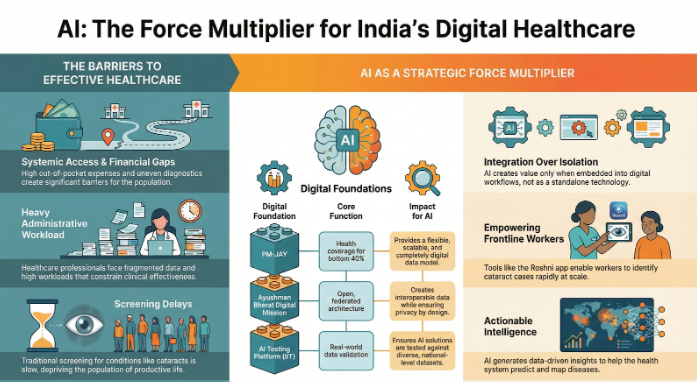
Indian healthcare is currently a system operating under the crushing weight of structural friction. High out-of-pocket expenses, vast access gaps, and uneven diagnostic capabilities do more than just strain the economy; they deprive the population of productive life-years. For frontline workers, the burden is a nonstop tide of administrative workload that decreases clinical effectiveness. To understand the shift currently underway, we must look past the buzzwords. India is not chasing AI as a luxury, but it is creating a force designed to bridge these systemic gaps. This is a strategic deployment where technology is finally being engineered to meet the scale of the crisis.
AI is Useless Without the “Digital Plumbing”
The most sophisticated AI is a hollow investment if it remains a standalone innovation. In the corridors of power and the wards of rural clinics, the regular is changing: AI creates value only when it is deeply embedded into the digital plumbing of existing workflows. If a tool does not solve a frontline worker’s problem, it has failed.

The strategy here moves beyond mere clinical accuracy to the generation of actionable intelligence. By integrating AI into daily digital systems, the goal is to build a national capacity to predict and map disease before it reaches a crisis point. As Sunil Kumar Barnwal, IAS, said:

“AI must become the force for the frontline healthcare workers by reducing the avoidable friction and helping the health workforce to act faster and more consistently.”
The “Rashni” Model—Scaling Frontline Detection
The “Rashni” model empowers non-professional frontline workers with AI-assisted screening tools. This is not just an efficiency gain; it is the reclamation of life for the population. By allowing less-specialised workers to identify cases with professional-grade accuracy, the system ensures that manageable conditions are caught before they lead to permanent disability. If screening relies solely on health professionals or facility-based services, the process can become time-consuming and significantly delayed.
Privacy by Design
In a move that challenges the legacy architectures of the West, India is deliberately avoiding a central repository for health data. Recognising that health information is the most sensitive data a citizen owns, the country has adopted a “federated architecture” under the Ayushman Bharat Digital Mission (ABDM).
This is Digital Public Infrastructure at its most sophisticated. Data is not sucked into a single, vulnerable government vault; it stays in the hospital where it was created. This privacy-by-design approach uses a consistent framework to allow access without central ownership.
The 15-Crore Family Foundation (PM-JAY & ABDM)
The engine driving this revolution is the huge scale of the Ayushman Bharat PM-JAY and Digital Mission. This is not just a policy; it is the world’s largest health insurance scheme, covering the bottom 40% of the population, which is roughly 15 crore families.
This is the data engine that makes AI viable at a national scale. Because PM-JAY is built on a 100% digital foundation, it provides a flexible, scalable model that allows state governments to expand benefits and beneficiary bases at the touch of a button. It provides the consistent digital environment that AI requires to inspire confidence and avoid bias, ensuring that innovation is built on a representative cross-section of the actual population.
Why AI “Lab Results” Aren’t Enough
The most significant hurdle for health-tech startups is the solutions tested on limited, single-hospital datasets that fail in the messy reality of the real world. To fix this, India is launching a rigorous new benchmark: the AI testing platform in collaboration with IIT.
Evidence of this shift is the “IIT Kanpur,” a high-stakes testing event that began recently and runs through January 24th. The mandate is clear: for an AI solution to be considered real, it must be stress-tested against valid, complex data. If a solution can survive the complexity and volume of Uttar Pradesh’s environment, it is ready to serve the entire country.
Conclusion: From Talk to Action
The mandate for Indian healthcare has moved from discussion to deployment. Success now hinges on a collaboration and partnership between the government, academia, and startups aligned under a single set of standards. India also needs to examine strategies to make innovations that strengthen and advance the national standards and guidelines.
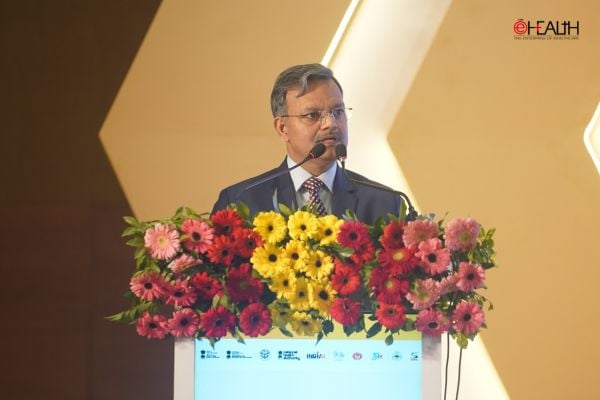
Views expressed by Sunil Kumar Barnwal, IAS, CEO (NHA), Government of India, at Uttar Pradesh AI & Health Innovation Conference

 Like
Like
 Dislike
Be a part of Elets Collaborative Initiatives. Join Us for Upcoming Events and explore business opportunities. Like us on Facebook , connect with us on LinkedIn and follow us on Twitter , Instagram.
Disclaimer: The views and opinions expressed in this article are solely those of the author and do not necessarily reflect the official policy or views of any organisation. The content is intended for informational and educational purposes only and should not be construed as medical advice.
"Exciting news! Elets technomedia is now on WhatsApp Channels Subscribe today by clicking the link and stay updated with the latest insights!" Click here!