



Article
How Japanese MedTech Companies Are Steering India Towards Viksit Bharat 2047
How Japanese MedTech Companies Are Steering India Towards Viksit Bharat 2047
![]() By Dr. Asawari Savant, eHealth Network - 11 January 2026
By Dr. Asawari Savant, eHealth Network - 11 January 2026


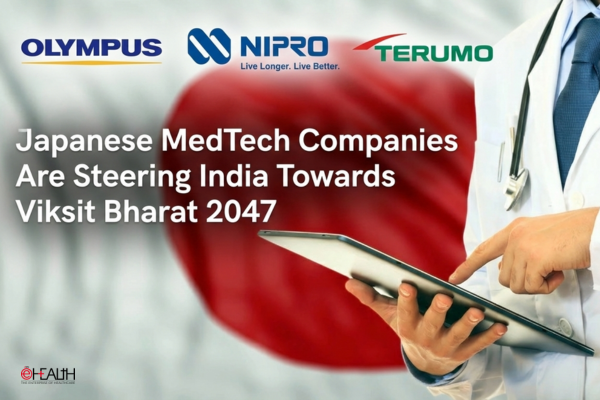
As India moves steadily towards its Viksit Bharat 2047 vision, healthcare has emerged as a critical pillar of national development. With a rising disease burden, widening access gaps, and growing demand for quality care, medical technology is playing an increasingly central role in strengthening outcomes, expanding reach, and building resilience across the healthcare system.
Recognising this, policymakers and industry leaders have emphasised the need for a robust, innovation-led MedTech ecosystem that is both scalable and inclusive. To achieve this ambition, technological advancement must be paired with strong global collaborations, sustained investments, and a focused effort on skill development so that innovation can translate into real-world impact.
At a recent conference, Hon’ble Health Minister, Shri J. P. Nadda, emphasised that achieving these goals will require “A trusted provider of high-quality healthcare” to ensure healthcare that is equitable, accessible, and affordable.

India’s MedTech sector, while still evolving, is gaining significant momentum. Growth in local manufacturing, increased R&D activity, and the rise of digital health solutions such as AI-enabled diagnostics, remote monitoring, and connected devices are transforming care delivery. These advancements are helping to reduce costs, improve precision, and expand quality healthcare beyond urban centres, while partnerships with global MedTech leaders are bringing advanced capabilities, operational expertise, and long-term ecosystem thinking.

Japan’s Role in Strengthening India’s MedTech Ecosystem
Among India’s international partners, Japan has emerged as a key collaborator in advancing MedTech innovation. The India–Japan partnership is built on shared priorities around universal health coverage, digital health, advanced medical science, and continuous skill development for healthcare professionals. This alignment has translated into deeper cooperation across medical devices, training, and infrastructure development.
Japanese MedTech companies operating in India are increasingly focusing on localisation and adapting global technologies to Indian clinical needs, strengthening domestic manufacturing, and investing in education-led engagement with healthcare professionals. This approach is helping bridge gaps in access while ensuring that quality and safety standards remain uncompromised.
“For us at Terumo India, innovation is not just about bringing new devices into the country. It is equally about strengthening the ecosystem built around them,” says Shishir Agarwal, President and Managing Director, Terumo India Pvt. Ltd. “That is why we continue to invest in clinical education, skill development, and hands-on training, ensuring that the partnership between healthcare professionals and the MedTech industry truly comes alive.”
Such ecosystem-led thinking is becoming increasingly important as India seeks to move beyond incremental improvements toward long-term, sustainable healthcare transformation.
Building Skills, Access, and Long-Term Impact
Beyond technology, a future-ready healthcare system depends on clinicians who are trained in advanced procedures, institutions that enable continuous learning, and partnerships that prioritise patient-centric outcomes. Japanese MedTech companies are contributing across this spectrum, combining innovation with education, training, and local collaboration.
“Guided by our spirit of WA-gokoro, Nipro brings advanced dialysis, hospital care and pharma-packaging solutions that strengthen access, safety and digitalised care,” says Milind Pappu, Director, Nipro Medical India. “Through training, clinical collaborations and expanding made in India manufacturing, we co-create affordable, high-quality healthcare for every community.”
Similarly, growing investments in advanced imaging, minimally invasive procedures, and outreach-based training are helping take quality care to underserved regions while lifting clinical standards across the country, in line with the rapid expansion of India’s general surgical devices market, estimated at USD 1.79 billion in 2025 and projected to reach USD 3.13 billion by 2030.
“By deploying advanced imaging, endoscopy, and minimally invasive surgical technologies, setting up an R&D offshore development centre, and expanding service capabilities,” says Naoshi Kikumoto, Managing Director, Olympus India. “Training over 2,000 healthcare professionals in partnership with institutes and medical associations, conducting Endoscopy Outreach through the Endo-Bus to improve access in rural India, and supporting higher infection-control standards.”
Also read: Digital Twins: Bringing a New Revolution from Device to Patient Healthcare Landscape
Towards a Healthier, More Resilient India
As India accelerates towards its Viksit Bharat 2047 goals, MedTech is set to play a defining role in strengthening healthcare infrastructure, expanding diagnostic reach, and improving patient outcomes. Reflecting this momentum, the Indian medical device market is expected to grow to ₹2.5 lakh crore by 2030.
By integrating innovation with local relevance and long-term ecosystem development, global MedTech partnerships, particularly with Japan, are helping India build healthcare systems that are inclusive, resilient, and future-ready. In doing so, healthcare is being positioned not just as a sector of growth, but as a cornerstone of national progress.
This alignment is also translating into broader and more equitable access to advanced care on the ground. Highlighting this shift, Shishir Agarwal adds that “This collaboration is no longer just about technology transfer,” he says. “It has evolved into a shared commitment to co-create solutions tailored to India’s unique disease patterns and healthcare realities.”
Together, Japanese MedTech’s quality-driven approach and India’s clinical expertise are forming a strong partnership that, through innovation and skill development, is steadily advancing India’s healthcare goals under Viksit Bharat 2047.
Views expressed by: Shishir Agarwal, President and Managing Director, Terumo India Pvt. Ltd; Milind Pappu, Director, Nipro Medical India and Naoshi Kikumoto, Managing Director, Olympus India.

 Like
Like
 Dislike
Be a part of Elets Collaborative Initiatives. Join Us for Upcoming Events and explore business opportunities. Like us on Facebook , connect with us on LinkedIn and follow us on Twitter , Instagram.
Disclaimer: The views and opinions expressed in this article are solely those of the author and do not necessarily reflect the official policy or views of any organisation. The content is intended for informational and educational purposes only and should not be construed as medical advice.
"Exciting news! Elets technomedia is now on WhatsApp Channels Subscribe today by clicking the link and stay updated with the latest insights!" Click here!