



Article
Healthcare AI Has Trust Issues, But India Could Change That
Healthcare AI Has Trust Issues, But India Could Change That
![]() By Dr. Asawari Savant, eHealth Network - 24 October 2026


India has discovered a fascinating new product category: the AI announcement. Every few weeks brings another mission, framework, initiative or roadmap. The language is impressive. The operational detail is often harder to find.

In healthcare, this gap matters. In February 2026, the government launched the Strategy for Artificial Intelligence in Healthcare for India (SAHI) and the Benchmarking Open Data Platform for Health AI (BODH). SAHI is meant to provide a national framework for responsible adoption; BODH, developed by IIT Kanpur with the National Health Authority, is intended to test health AI against diverse, anonymized real-world data before deployment at scale.
That’s more than bureaucratic housekeeping. Done well, it could become a genuine national advantage. But only if strategy becomes shared infrastructure: something hospitals, researchers and startups can actually use.
India’s opportunity is not merely to build more AI. It is to chart the map to where AI works, where it fails and when it deserves to be trusted.

Intelligence Is No Longer Scarce, Trust Is
The AI industry still behaves as though intelligence is scarce. It is not. Models are improving rapidly; context windows are expanding; reasoning and prediction are getting stronger. The world is manufacturing machine intelligence at a pace that seemed implausible only a few years ago.
Trust is a different story. The important question is no longer simply, “Can an AI system produce an answer?” It is, “When should a clinician believe it?”
A higher benchmark score cannot answer that on its own. Trust comes from consistent performance in real clinical settings, across different machines, institutions, patient populations and disease patterns. It also comes from knowing how a system fails, how often it drifts and who is accountable when it does.
In healthcare, validation is not a final compliance step. It is the bridge between a promising model and a usable product.
Hospitals Should Not Have To Reinvent Validation
Today, hospitals that adopt AI too often become accidental validation labs. Each institution must decide which data matter, what performance threshold is acceptable, how bias will be measured and when a model needs recalibration.
Some local validation will always be necessary; a model that works in one setting may behave differently in another. But local responsibility should not mean starting from zero. Without a common baseline, hospitals recreate similar protocols, startups repeatedly prove the same claims and lessons remain trapped inside individual deployments.
Imagine asking every hospital to independently establish that an MRI scanner works before it can be used. That would sound absurd because medical devices sit within shared standards, evidence requirements and regulatory pathways. Healthcare AI needs an equivalent foundation—one suited to systems that learn, drift and interact with changing clinical environments.
A shared foundation would not remove institutional judgement. It would make that judgement faster, more comparable and better informed.
Validation Infrastructure Is Part of The Product
The industry often treats evaluation as merely pending paperwork after the exciting part i.e. the model has been built. They’ve got the sequence backwards.
A model generates outputs. Validation determines whether those outputs are reliable enough to inform care. Without evidence, monitoring and accountability, a model is a technical artefact, not a clinical product.
This distinction matters commercially as well as clinically. If every deployment requires a new answer key, new thresholds and a new proof of safety, scale becomes painfully expensive. The cost is not only slower procurement. It is duplicated work across hospitals, developers and regulators.
The strongest healthcare AI companies will therefore compete on more than model accuracy. They will compete on the quality of their evidence, the speed of their validation, the clarity of their failure modes and their ability to learn safely from deployment.
The Durable Advantage Is The Learning Loop
At 5C Network, the visible layer is AI-assisted radiology. The less visible asset is the system underneath: millions of studies, radiologist reviews, corrections, false positives, missed findings, disagreements and edge cases. This feedback can create institutional memory. A correction can reveal a blind spot. A disagreement can sharpen an evaluation rule. An edge case can become a test the system must pass in future. The model gets attention; the learning loop creates durability.
This is the overlooked business of healthcare AI. The defensible advantage is not simply a model frozen at a moment in time. It is the infrastructure that continuously compares predictions with clinical reality, surfaces failure and improves the evidence around the system.
And that principle extends beyond radiology. In any high-stakes field, the winner will not merely produce intelligence. It will make intelligence legible, auditable and dependable.
Turn SAHI And BODH From Intent Into Infrastructure
SAHI and BODH point in the right direction. SAHI frames the governance challenge; BODH aims to provide a mechanism for systematic testing. The question now is whether they become operating infrastructure or remain ‘admirable intent’.
To become useful, the system needs more than a portal and a set of benchmark scores. It needs representative datasets across regions and populations; transparent evaluation protocols; versioned benchmarks; clear routes for hospitals and startups to participate; independent audit; post-deployment monitoring; and guidance that connects evidence to procurement and clinical use.
It also needs humility. A national benchmark cannot certify that a model will work everywhere, forever. What it can do is establish a credible common baseline, expose gaps earlier and make local validation more efficient.
If India gets this right, hospitals will spend less time reinventing evaluation. Startups will spend less time proving the same claim in incompatible ways. Regulators and buyers will have better evidence. Most importantly, trust will accumulate instead of resetting with every deployment.
That’s the difference between announcing an ecosystem and building one.
Also read: Government Approves ₹1,600 Crore for 41 Pharma, MedTech Innovation Projects Under PRIP
Draw The Map Before Chasing More Gold
We may have spent the first phase of the AI boom looking for gold in the models. The next phase will be less glamorous and more consequential: deciding how intelligence is tested, trusted and scaled.
India will spend the next decade joining the rush for ever-larger models. But it can, in parallel, also build the validation infrastructure that helps an entire market move from demonstration to dependable use.
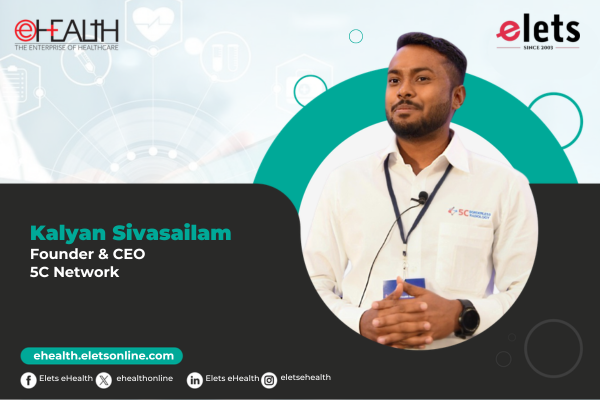
Views expressed by: Kalyan Sivasailam, Founder & CEO, 5C Network

 Like
 Dislike
Be a part of Elets Collaborative Initiatives. Join Us for Upcoming Events and explore business opportunities. Like us on Facebook , connect with us on LinkedIn and follow us on Twitter , Instagram.
Disclaimer: The views and opinions expressed in this article are solely those of the author and do not necessarily reflect the official policy or views of any organisation. The content is intended for informational and educational purposes only and should not be construed as medical advice.
"Exciting news! Elets technomedia is now on WhatsApp Channels Subscribe today by clicking the link and stay updated with the latest insights!" Click here!