




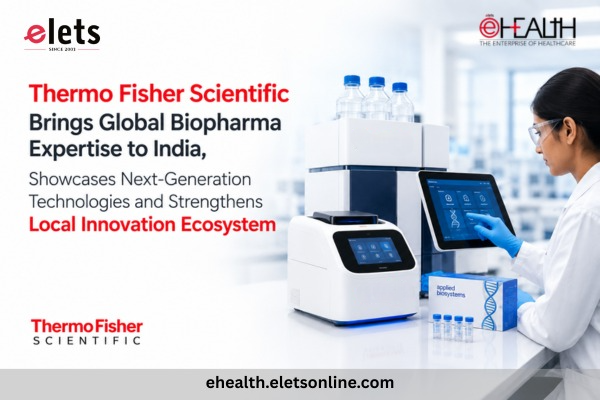
As India accelerates its transition towards biologics, advanced therapeutics and large-molecule research, Thermo Fisher Scientific brought together global experts, scientists, researchers and industry leaders at Hyderabad Genome Valley.

Powered by innovations across its Orbitrap and Vanquish platforms, the two-day Biopharma Summit 2026, focused on the evolving biopharmaceutical landscape and the technologies, expertise and ecosystem capabilities required to accelerate biotherapeutic development, from discovery and analytical characterisation to process development, manufacturing and ultimately patient impact. The summit featured expert sessions on complex biotherapeutics, biologics and biosimilars, fusion proteins, oligonucleotide therapeutics, GLP-1 receptor agonists and advanced analytical workflows, alongside industry discussions on the future of biologics in India.
A key highlight of the summit was the launch of two analytical technologies in the Indian market — the Orbitrap Excedion Mass Spectrometer and Vanquish Amplify UHPLC system. Designed to address the growing complexity of biological molecules and pharmaceutical research, the technologies strengthen analytical capabilities for applications involving proteins, peptides, oligonucleotides and other advanced therapeutic modalities.
Speaking during the summit, Tony Acciarito, President, APMEA, Thermo Fisher Scientific, highlighted the importance of building long-term capabilities in India as the biopharma sector evolves.

“The strategy is simple. Build capability on the ground. That requires investment, and the investment has to be long-term, not short-term.”
The company’s leadership noted that India’s role within the Asia-Pacific innovation ecosystem is strengthening, supported by policy momentum, increasing biotechnology investment, growing research capabilities and the emergence of novel therapeutics. At the same time, access to advanced technologies, scientific talent and stronger industry-academia collaboration remain important areas for ecosystem development.
Building capability closer to Indian customers
The summit also highlighted Thermo Fisher Scientific’s broader investment in India’s scientific and biopharmaceutical ecosystem. The company’s Customer Experience Centre (CEC) and Bioprocess Design Centre (BDC) in Hyderabad provide customers and partners with access to advanced technologies, application expertise, workflow demonstrations and hands-on technical engagement.
During the visit to the centres, the role of these facilities in enabling real-world technology adoption and scientific capability development was demonstrated. The centres are designed not merely as demonstration spaces, but as collaborative environments where customers can evaluate technologies, receive technical training and work with experts to address scientific and manufacturing challenges.
Thermo Fisher also highlighted its wider network of approximately 10 capability partnerships across India, involving academic institutions, research organisations and government agencies. These collaborations include institutions such as IIT Guwahati, KIIT, C-CAMP, the Atal Incubation Centre, the Central Forensic Science Laboratory and FSSAI.
Srinath Venkatesh, Managing Director, India and South Asia, Thermo Fisher Scientific, said that India’s growth in biologics is creating an increasing need for access to world-class technologies, skilled talent and greater productivity across the research and development value chain.
The company identified three key areas where it can contribute to India’s evolving biopharma ecosystem: expanding access to advanced technologies, developing industry-ready talent, and helping customers improve productivity and reduce time-to-market.
From technology launches to knowledge sharing
Beyond product introductions, the Biopharma Summit created a platform for knowledge exchange across the biopharma value chain. Sessions explored analytical challenges associated with novel biologics and biosimilars, advanced characterisation of complex biotherapeutics, oligonucleotide analysis, antibody-drug conjugates and GLP-1 receptor agonists. A dedicated panel also examined the opportunities and challenges involved in accelerating biotherapeutics in India, from discovery to patient impact.
Day two continued with discussions on India’s biopharma landscape, inert LC workflows for oligonucleotide analysis, continuous bioprocessing, high-resolution mass spectrometry in antibody-drug conjugate development, GLP-1 analysis and impurity characterisation, culminating in a panel on balancing innovation, speed and affordability in the future of biologics.
AI emerges as an enabler of scientific productivity
Artificial intelligence was another significant theme emerging from the leadership discussion. Thermo Fisher outlined an enterprise-wide AI strategy centred on operational excellence, embedding AI into products and services, and enhancing customer experience.
The company is increasingly exploring how generative AI can convert complex scientific data into meaningful insights, accelerate analytical and clinical workflows, strengthen cybersecurity and improve the speed with which customers can translate data into decisions. Thermo Fisher expects AI to increasingly become part of standard ways of working over the next three to five years, with customer impact remaining the key measure of success.
Strengthening India’s position in the global biopharma ecosystem
The discussions also underscored the importance of collaboration across industry, academia, regulators and government in strengthening India’s position in the global biopharma landscape. Thermo Fisher highlighted the complementary strengths emerging across the Asia-Pacific region and the importance of connecting scientific expertise, translational capabilities and commercialisation opportunities across geographies.
The company’s leadership also pointed to growing interest in India and Southeast Asia as potential locations within evolving China Plus One manufacturing strategies, while emphasising that the transition of complex and highly regulated manufacturing operations requires significant planning and time.
Talent remains central to India’s next phase of growth
While technology and infrastructure are critical, talent emerged as one of the most significant challenges for the rapidly evolving life sciences sector. Thermo Fisher emphasised the need for stronger industry-academia partnerships to prepare talent for emerging areas such as biologics, advanced therapeutics and analytical sciences.
The company is continuing to work with academic and innovation ecosystems to develop industry-ready skills, while also investing in its own workforce and capabilities in India.
The Biopharma Summit 2026 builds on Thermo Fisher Scientific’s previous Orbitrap Summit and is intended to evolve into an annual platform for scientists, researchers and industry experts. The company sees such forums as opportunities not only to share knowledge, but to create conversations that generate new ideas, strengthen collaboration and accelerate innovation.
With India’s biopharma ecosystem entering a phase defined by complex biologics, advanced analytical science, AI-enabled workflows and increasing global integration, Thermo Fisher Scientific’s continued focus on technology access, capability building, talent development and long-term customer partnerships signals a broader commitment to supporting India’s journey towards becoming a stronger global hub for life sciences innovation.

 Like
Like
 Dislike
Be a part of Elets Collaborative Initiatives. Join Us for Upcoming Events and explore business opportunities. Like us on Facebook , connect with us on LinkedIn and follow us on Twitter , Instagram.
"Exciting news! Elets technomedia is now on WhatsApp Channels Subscribe today by clicking the link and stay updated with the latest insights!" Click here!