


Interview
Future-Proofing Allied Healthcare Education: Preparing India’s Workforce for the AI-Driven Healthcare Era
Future-Proofing Allied Healthcare Education: Preparing India’s Workforce for the AI-Driven Healthcare Era
![]() By Dr. Asawari Savant, eHealth Network - 13 July 2026
By Dr. Asawari Savant, eHealth Network - 13 July 2026


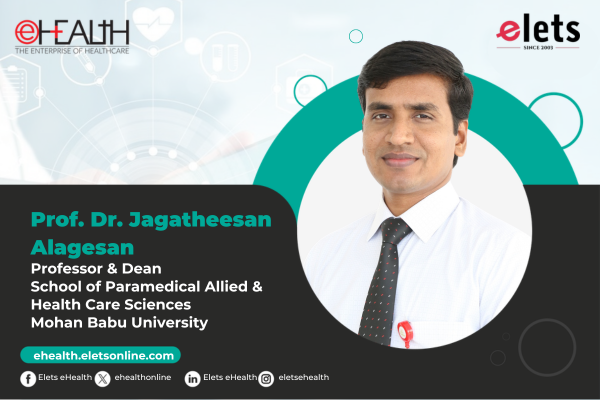
As India’s healthcare ecosystem rapidly embraces digital transformation and advanced medical technologies, the demand for highly skilled, future-ready allied healthcare professionals has never been greater. In this conversation, Prof. Dr. Jagatheesan Alagesan, Professor & Dean, School of Paramedical Allied and Health Care Sciences, Mohan Babu University shares with Dr. Asawari Savant from Elets News Network (ENN) how academia, industry, and policymakers can collaborate to reshape paramedical education, ensuring graduates are equipped with the competencies required to strengthen healthcare delivery in a technology-driven era. Edited excerpts

India’s healthcare ecosystem is witnessing a rising demand for skilled allied healthcare professionals. How do you see paramedical education evolving over the next five years?
India’s healthcare ecosystem is at a pivotal stage, with demand for allied healthcare professionals growing significantly faster than the supply of adequately trained personnel. Over the next five years, paramedical education must evolve from broad-based training to specialized, competency driven programs that reflect the increasing complexity of modern medicine. As fields continue to advance, curricula must mirror this specialization through focused educational pathways.

Simultaneously, healthcare is becoming increasingly digital. Future allied health professionals must be equipped to work alongside technologies such as Artificial Intelligence, telemedicine platforms, electronic health records, and remote patient monitoring systems. Strengthening standardization through frameworks like the National Commission for Allied and Healthcare Professions will be crucial to ensure quality, consistency, and workforce.
We will see stronger academia-industry collaboration, with apprenticeship-based training and clinical immersion becoming central to education. The future belongs to industry-aligned, technology enabled programs to produce professionals capable of strengthening healthcare delivery at every level.
Digital health, AI-assisted diagnostics, and assistive technologies are reshaping patient care globally. How should paramedical education adapt to these technological disruptions?
Paramedical education must evolve from teaching technical procedures to developing digital competence, critical thinking, and adaptability for a technology driven healthcare environment. As patient care increasingly incorporates AI-assisted diagnostics, telemedicine, electronic health records, wearable monitoring devices, and assistive technologies, students must be trained to use these tools effectively while preserving patient safety.
The curriculum should integrate core AI and digital health literacy, including telehealth platforms, health informatics, data management, and the role and limitations of AI in clinical practice. Equally important is fostering the ability to critically interpret technology generated information and apply it ethically in patient care.
Institutions must also invest in faculty upskilling and smart training infrastructure such as high-fidelity simulation labs and virtual learning environments. Dedicated training in AI ethics, data privacy, and patient safety should be embedded across programs. Ultimately, the goal is to create technologically fluent professionals who can leverage innovation responsibly while delivering high-quality, patient centred care.
With healthcare systems becoming increasingly technology-driven, how important is it for universities to integrate clinical exposure, simulation-based learning, and industry-oriented training into paramedical education?
The integration of clinical exposure, simulation-based learning, and industry-oriented training is no longer an enhancement to paramedical education, it is an absolute necessity. As healthcare becomes increasingly technology driven and patient care more complex, theoretical knowledge alone is insufficient to prepare students for real-world clinical environments.
Clinical exposure provides the foundation for professional competence by enabling students to apply theoretical knowledge, develop clinical reasoning, and understand healthcare workflows in authentic settings. Simulation-based learning serves as a critical bridge between theory and practice, allowing students to safely master procedures, strengthen decision-making skills, and build confidence without compromising patient safety.
Industry-oriented training ensures that education remains aligned with evolving healthcare technologies and workforce needs. Partnerships with hospitals, diagnostic centres, and healthcare organizations provide valuable exposure to current practices and improve employability. Together, these elements create clinically competent, technologically proficient, and industry-ready professionals capable of delivering safe, efficient, and high-quality patient care.
The integration of AI, digital diagnostics, and assistive healthcare technologies is transforming modern medicine. How should allied healthcare education adapt to prepare students for this technology-led future?
Allied healthcare education must move beyond traditional, rote learning and adopt a technology-integrated approach to prepare students for a rapidly evolving healthcare landscape. As AI, digital diagnostics, telemedicine, and assistive technologies become central to patient care, technology should be embedded within the curriculum rather than taught as a standalone subject.
Students need foundational competencies in AI literacy, digital health systems, medical informatics, data management, and technology-assisted clinical workflows. While they are not expected to become AI developers, they must understand how AI supports diagnostics, patient monitoring, and clinical decision-making, while recognizing its limitations and ensuring human oversight.
Allied healthcare education should strengthen simulation-based learning, virtual patient encounters, case-based training, and hands-on exposure to advanced technologies. Faculty development is equally important to support this transition. Ultimately, allied healthcare education must produce technologically fluent, adaptable professionals who can use innovation responsibly while delivering patient-centred care.
Industry exposure has become a defining factor in healthcare education today. How do hospital partnerships, internships, and hands-on clinical training contribute to improving student employability and readiness?
Industry exposure has become a defining factor in healthcare education because it bridges the gap between academic learning and real-world clinical practice. Healthcare employers increasingly seek graduates who are not only knowledgeable also capable of functioning effectively in fast-paced clinical environments from day one.
Hospital partnerships play a crucial role by ensuring curricula remain aligned with current industry standards, emerging technologies, and workforce needs. These collaborations expose students to real clinical workflows, multidisciplinary teamwork, patient interactions, and modern healthcare systems. Internships and supervised clinical placements provide structured opportunities to apply theoretical knowledge and gain confidence under professional guidance.
Industry-oriented training also facilitates mentorship, professional socialization, and smoother transitions into employment. Public-private partnerships further strengthen employability by providing hands-on experience with contemporary technologies and practices. Repeated clinical exposure helps bridge the skill gap, enabling graduates to enter the workforce as competent, adaptable, and industry-ready professionals capable of delivering high-quality patient care.
Mohan Babu University has been focusing on experiential learning and industry-aligned education across healthcare disciplines. How does this approach help in nurturing future-ready allied healthcare professionals?
Mohan Babu University’s focus on experiential learning and industry-aligned education plays a vital role in nurturing future-ready allied healthcare professionals. By moving beyond traditional classroom instruction, the university emphasizes hands-on learning through advanced laboratories, structured clinical training, internships, simulation-based experiences, and exposure to real healthcare environments. This enables students to develop practical competence, clinical reasoning, and professional confidence before entering the workforce.
Strong partnerships with healthcare organizations ensure that learning remains aligned with current industry standards, technologies, and workforce expectations. Students gain valuable exposure to modern healthcare systems and multidisciplinary collaboration. The university also promotes technological awareness through engagement with evolving areas such as digital health, telemedicine and technology-enabled patient care.
This approach develops critical thinking, communication, problem-solving, adaptability, and lifelong learning skills. By combining experiential learning with industry integration, Mohan Babu University prepares graduates who are employable, innovative, and capable of contributing meaningfully to an evolving healthcare ecosystem.
Also read: AI, Automation and the Evolution of Fertility Care in India
Healthcare education today requires a balance between academic knowledge, practical skills, and technological adaptability. How is Mohan Babu University preparing students to meet these evolving industry expectations?
Mohan Babu University prepares students for evolving healthcare industry expectations by integrating academic rigor, practical skills, and technological adaptability into a unified learning framework. Strong theoretical foundations are reinforced through industry-aligned curriculum.
Practical learning is emphasized through advanced laboratories, simulation-based training, clinical rotations, internships, and hands-on exposure. This immersive approach helps students develop clinical competence, professional confidence, and workplace readiness. Through collaborations with hospitals and healthcare organizations, students gain valuable insight into current clinical practices, multidisciplinary teamwork, and industry expectations.
Recognizing the rapid digital transformation of healthcare, the university also integrates emerging technologies such as AI-assisted diagnostics, telemedicine, medical informatics, wearable technologies, and digital health systems into the learning experience. This ensures graduates are prepared for technology-enabled healthcare environments. By combining academic excellence, experiential learning, and technological fluency, Mohan Babu University develops future-ready allied healthcare professionals who can adapt, innovate, and contribute meaningfully to modern healthcare delivery.
With the rising demand for healthcare professionals in India and the limited availability of government seats in MBBS and allied medical courses, what measures do you think the government should take to bridge the gap between the demand for and access to quality healthcare education?
India’s healthcare workforce challenge cannot be addressed solely by increasing the number of MBBS seats. The government must adopt a broader strategy that expands both medical and allied healthcare education while ensuring quality, affordability, and employability. Increasing educational capacity should be accompanied by stronger infrastructure, qualified faculty and robust accreditation systems.
A key priority should be the effective implementation of the National Commission for Allied and Healthcare Professions (NCAHP) framework to standardize curricula and quality assurance across institutions. Equal attention must be given to allied healthcare disciplines that form the backbone of healthcare delivery.
The government should encourage public-private partnerships, expand scholarships and financial support, and strengthen access in underserved regions. Additionally, integrating digital health, telemedicine, and technology-enabled learning can help prepare a future-ready workforce. The goal should not simply be to produce more healthcare professionals, but to develop well-trained, employable graduates capable of meeting India’s growing healthcare needs.

 Like
Like
 Dislike
Be a part of Elets Collaborative Initiatives. Join Us for Upcoming Events and explore business opportunities. Like us on Facebook , connect with us on LinkedIn and follow us on Twitter , Instagram.
"Exciting news! Elets technomedia is now on WhatsApp Channels Subscribe today by clicking the link and stay updated with the latest insights!" Click here!