



Article
Leadership Driving the Next Era of Healthcare Innovation
Leadership Driving the Next Era of Healthcare Innovation
![]() By Dr. Asawari Savant, eHealth Network - 06 June 2026
By Dr. Asawari Savant, eHealth Network - 06 June 2026


There was a time when healthcare was largely reactive. A patient fell sick, a diagnosis was made, a prescription followed. That linear model is quietly dissolving. Today, the conversation is shifting from treatment to anticipation, from intervention to prediction. And at the center of this shift is not just technology, but leadership that understands how to use it meaningfully.
The modern healthcare leader is no longer defined by how efficiently systems are managed, but by how effectively they are reimagined. The convergence of pharma, diagnostics, digital health, and artificial intelligence has created a landscape where boundaries are increasingly irrelevant. What matters now is how these elements are integrated to create outcomes that are faster, more precise, and more patient-centric.
Artificial intelligence is often described as the biggest disruptor in healthcare, but that is only partly true. AI, in isolation, is just capability. Its real impact depends on how leaders deploy it. Whether it is predicting disease risk through population data, optimizing lab operations through real-time analytics, or personalizing therapy using genomic insights, the difference lies in intent and execution.

Take diagnostics, for example. Traditionally seen as a backend service, it is now emerging as a central driver of clinical decision-making. With advances in data analytics and automation, laboratories are moving beyond generating reports to providing actionable insights. Leaders who recognize this shift are transforming labs into intelligence hubs, where data is not just produced, but interpreted in a way that directly influences patient care.

In pharma, the transformation is equally profound.
Drug development is no longer confined to long, linear pipelines. AI-driven molecule discovery, real-world evidence, and adaptive clinical trials are compressing timelines and improving success rates. But innovation here is not just about speed. It is about relevance. Leaders in this space are increasingly focused on therapies that are not only effective, but also accessible and aligned with real-world patient needs.
Technology, meanwhile, is extending healthcare far beyond hospital walls. Remote monitoring, wearable devices, and telemedicine platforms are redefining how care is delivered. The patient is no longer a passive recipient but an active participant. This shift demands a different kind of leadership, one that prioritizes continuity of care over episodic treatment, and engagement over transactions.
However, the real challenge is not adopting technology, it is integrating it.
Healthcare systems are notoriously fragmented, with data scattered across platforms and stakeholders operating in silos. Visionary leaders are addressing this by building ecosystems rather than institutions. They are focusing on interoperability, data standardization, and collaborative networks that bring together clinicians, technologists, and policymakers.
Another defining feature of this new leadership is the ability to balance innovation with responsibility. As AI becomes more embedded in clinical workflows, questions around ethics, data privacy, and algorithmic bias cannot be ignored. Leaders must ensure that technology enhances clinical judgment rather than replacing it, and that patient trust is not compromised in the pursuit of efficiency.
There is also a growing recognition that healthcare cannot be improved in isolation from broader societal factors. Preventive health, lifestyle management, and population-level interventions are gaining prominence. Predictive models are enabling early identification of risk, but their success depends on how effectively they are translated into actionable strategies. This requires collaboration beyond healthcare, into public health, policy, and community engagement.
Importantly, this transformation is not being driven by technology companies alone. Clinicians, laboratorians, and healthcare administrators are increasingly stepping into leadership roles that influence innovation. They bring with them a deep understanding of ground realities, ensuring that solutions are not just technically sound, but clinically relevant.
What sets these leaders apart is not just their ability to adopt new tools, but their willingness to question old assumptions. They understand that incremental improvements are no longer enough. The scale of challenges facing healthcare, from rising chronic disease burden to resource constraints, demands a more fundamental shift.
In this context, prediction is not just a technological capability; it is a strategic mindset. It is about anticipating patient needs, identifying system inefficiencies before they escalate, and designing interventions that are proactive rather than reactive. Leaders who embrace this mindset are not just improving healthcare, they are redefining it.
Also read: Leveraging Precision Diagnostics, AI and Data‑Led Decision‑Making
Platforms that bring together diverse perspectives, across pharma, medtech, AI, and healthcare delivery, play a crucial role in accelerating this shift. They create spaces where ideas can be challenged, refined, and scaled. More importantly, they help bridge the gap between innovation and implementation.
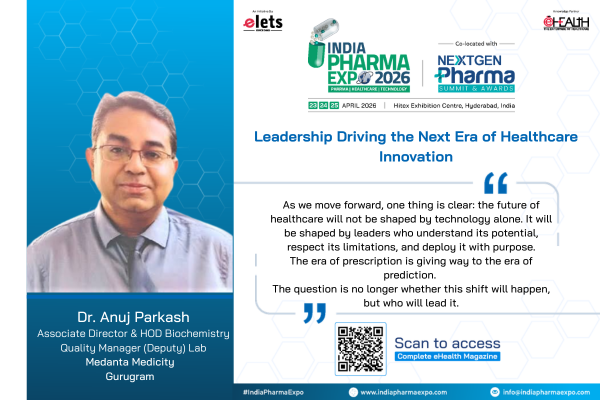
As we move forward, one thing is clear: the future of healthcare will not be shaped by technology alone. It will be shaped by leaders who understand its potential, respect its limitations, and deploy it with purpose.
The era of prescription is giving way to the era of prediction. The question is no longer whether this shift will happen, but who will lead it.
Views expressed by: Dr. Anuj Parkash, Associate Director & HOD Biochemistry, Quality Manager (Deputy) Lab, Medanta Medicity, Gurugram

 Like
Like
 Dislike
Be a part of Elets Collaborative Initiatives. Join Us for Upcoming Events and explore business opportunities. Like us on Facebook , connect with us on LinkedIn and follow us on Twitter , Instagram.
Disclaimer: The views and opinions expressed in this article are solely those of the author and do not necessarily reflect the official policy or views of any organisation. The content is intended for informational and educational purposes only and should not be construed as medical advice.
"Exciting news! Elets technomedia is now on WhatsApp Channels Subscribe today by clicking the link and stay updated with the latest insights!" Click here!