


Article
The Rise of Clinical Intelligence: How AI Is Redefining Decision-Making in Indian Healthcare
The Rise of Clinical Intelligence: How AI Is Redefining Decision-Making in Indian Healthcare
![]() By Dr. Asawari Savant, eHealth Network - 11 December 2025
By Dr. Asawari Savant, eHealth Network - 11 December 2025


Modern India’s healthcare sector stands at the crossroads of compassion and technology, making it essential not just to scale but strategically improve efficiency, while preserving trust. Here comes the phenomenal role of AI. AI is way ahead of just a technological advancement; it is reshaping the Indian healthcare system by predicting the bottlenecks even before they occur, redefining operational aspects and even by prompting the clinical teams to take preventive actions in real time. Thus, AI is being recognised as “clinical intelligence” that is augmenting the judgements of the physician rather than replacing them. Owing to the benefits, it is being widely accepted by the hospitals around the country. NASSCOM has stated that AI and data technologies in healthcare will contribute up to $30 billion to India’s GDP by 2025.
The Diagnostic Revolution
Artificial intelligence is significantly transforming medical imaging. For example, at AIIMS New Delhi, the Radiology Department uses a clinically‐approved AI algorithm to help triage chest radiographs—handling daily volumes of up to about 1,000 scans. The algorithm flags potential abnormalities and routes them for radiologist review, while the hospital reiterates that human verification remains mandatory.
In the broader Indian context, the radiologist‐to‐scan ratio is extremely low: industry reports suggest that for every 100 diagnostic scans undertaken daily, only about one radiologist is available to interpret them, underscoring the workforce gap.

This gap has helped drive the adoption of AI-powered diagnostic tools. Health-tech firm Qure.ai, for instance, has partnered with AstraZeneca to deploy its chest-X-ray AI solution globally, reaching more than 5 million scans across 20+ countries to inform early lung-cancer risk detection. These kinds of interventions hold particular promise in underserved regions where radiologist availability is limited.

Beyond Imaging: The Expanding Frontier
Clinical intelligence of AI is not limited to radiology. It has become a strategic differentiator, allowing hospitals to achieve sustainable growth. AI has proven itself by converting hospital inefficiencies into opportunities for better profits and care.
One of India’s largest private healthcare networks, Apollo Hospitals, is successfully using AI solutions to streamline the medical documentation, interpret diagnostic images, predict disease risk and guide treatment plans for better customisation. Beyond that, AI’s clinical intelligence has been well documented in areas like forecasting hospital admissions, reducing diagnostic turnaround times, streamlining bed occupancy, speeding up discharge approvals and many more.
In India, the market for AI-based surgical robots is expected to become $901 million by 2030. Recently, Dr. Prabhakar Kore used the Penumbra device to perform an AI-enabled pulmonary mechanical thrombectomy. This demonstrates the transformative role of AI in guiding the minimally invasive procedures with life-saving precision.
Meanwhile, the Ayushman Bharat Digital Mission is continuously driving digital health adoption. It has already created health IDs for over 500 million individuals, while linking approximately 300 million health records with nearly 200,000 registered facilities. This digital infrastructure will serve as the foundation upon which clinical AI systems will operate to provide data-driven insights at unprecedented scale.
Challenges on the Horizon
AI is capable of creating a much-needed cultural shift in the healthcare system from a reactive to a proactive approach. However, it demands leadership, commitment, and nerve to let AI augment the clinical decisions and trust in the data-driven insights. Along with this, as India’s healthcare system is fragmented, there is a need to improve the quality and availability of the data without compromising the privacy of the patients. Additionally, AI has been able to spread its roots across the metropolitan hospitals of India, yet rural India is way behind. To overcome this, it is essential to train the physicians even in rural areas with the development of high-end healthcare infrastructure.
Also read: A New Framework for Measuring Digital ROI in Healthcare Beyond Leads and CPL
The Road Ahead
Despite these hurdles, the path seems clear. AI is the future of the modern and equitable healthcare system in India. Hospitals and clinics that would integrate this clinical intelligence will see a positive shift in terms of operational predictability, better patient flow, and higher staff satisfaction. All this will get translated into sustainable growth and patient trust for those organisations.
Integration of AI in India’s healthcare system will allow the country with 1.46 billion people to meet the pressing public health needs. Clinical intelligence offers no panacea, but it is a powerful new tool that is capable of augmenting the quality of care being delivered to all who need it.
So, no more the question is to what extent AI will reshape Indian healthcare, but how considerately and equitably will the AI-led transformation unfold.
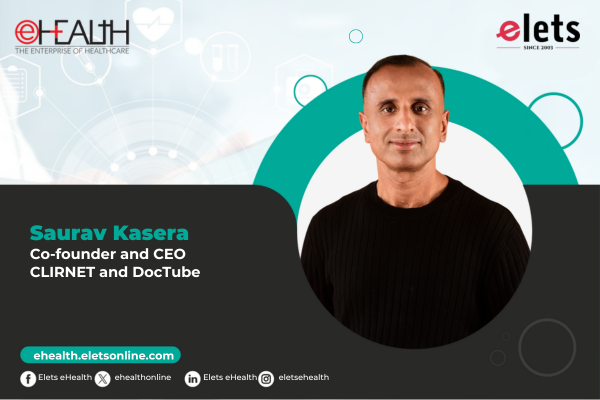
Views expressed by: Saurav Kasera, Co-founder and CEO, CLIRNET and DocTube

 Like
Like
 Dislike
Be a part of Elets Collaborative Initiatives. Join Us for Upcoming Events and explore business opportunities. Like us on Facebook , connect with us on LinkedIn and follow us on Twitter , Instagram.
Disclaimer: The views and opinions expressed in this article are solely those of the author and do not necessarily reflect the official policy or views of any organisation. The content is intended for informational and educational purposes only and should not be construed as medical advice.
"Exciting news! Elets technomedia is now on WhatsApp Channels Subscribe today by clicking the link and stay updated with the latest insights!" Click here!