



Health IT
WHO SEARO, Wadhwani AI Sign Pact for Responsible Public Health AI
WHO SEARO, Wadhwani AI Sign Pact for Responsible Public Health AI
![]() By eHealth Network - 03 November 2026


The World Health Organization’s South-East Asia Regional Office (WHO SEARO) and the Lords Education and Health Society (LEHS), through its Wadhwani AI programme, have signed a two-year Project Collaboration Agreement to advance the responsible design, evaluation and use of artificial intelligence in India’s public health system. The agreement runs from 1 November 2026 to 31 October 2028.

WHO SEARO announced the agreement on 30 October 2026. It said the partnership will build and share evidence on how AI performs in real public health programmes, strengthen capacity among programme managers and health workers, and pass practical lessons on to other Member States of the WHO South-East Asia Region. The move comes as India works on its own SAHI roadmap for AI in healthcare, which assigns owners and timelines to the national strategy.
Why WHO wants evidence on responsible AI in public health
According to WHO SEARO, the collaboration responds to a gap between promise and proof. AI tools for screening, diagnosis and disease tracking are spreading quickly, but there is limited robust evidence on their safety and effectiveness in real-world settings. WHO also pointed to the need for appropriate governance and for protecting equity, privacy and human rights as these tools enter government programmes.
That concern echoes a wider debate in the sector about whether healthcare AI can earn clinicians’ and patients’ trust. WHO said it will document evidence in a solution-agnostic way, so that the findings inform public health decisions rather than promote any single product.

What the WHO SEARO and Wadhwani AI agreement covers
The agreement sets out four objectives:
- Generate evidence: technical briefs, case studies and evaluation reports on the design, validation and deployment of AI, covering operational feasibility, safety, effectiveness, cost-effectiveness and user adoption.
- Map integration pathways: identify the enablers of and barriers to institutional adoption, workflow integration and the integration of AI into government digital health platforms, where the responsible government authorities request it.
- Record implementation lessons: document the full AI lifecycle in diagnostics and screening, risk stratification, and disease tracking and modelling, from problem identification and data collection to validation, monitoring and evaluation.
- Build capacity: produce training material and knowledge assets for public health programme managers and the health workforce, and share them with India and other countries in the region.
How Wadhwani AI’s “Small AI” approach fits in
Wadhwani AI is a non-profit programme of LEHS that builds AI solutions meant to reach the last mile and serve vulnerable populations. It works with Central and State governments, non-profits and academic institutions to identify public health needs, develop and test AI tools, and support their rollout inside government programmes.
WHO highlighted the organisation’s resource-efficient approach, described as “Small AI”. It aims to cut computing requirements and dependence on servers and networks, including through offline models where feasible, so that tools can work in clinics and field settings with weak connectivity. Low-cost AI is already changing public health screening in India, as seen when DeepTek cut the price of AI TB screening this week.
What it means for India’s health AI ecosystem
For India, the agreement adds an international evaluation layer to a fast-growing national effort. The Centre has been building research and validation capacity through initiatives such as the IndiaAI–ICMR partnership on responsible healthcare AI. Evidence on cost, adoption and workflow fit is what state health departments typically need before scaling a tool beyond a pilot.
WHO SEARO said the collaboration builds on its ongoing support to Member States for strengthening digital health systems and adopting AI responsibly. Details of the agreement are available in the official WHO SEARO announcement, and more on the programme’s health work is on the Wadhwani AI website.
Key takeaways
- WHO SEARO and LEHS, through Wadhwani AI, signed a two-year agreement on responsible AI in India’s public health system, valid from 1 November 2026 to 31 October 2028.
- The work will produce evidence on AI safety, effectiveness, cost-effectiveness and adoption, plus lessons on integrating AI into government digital health platforms.
- Findings and training material will be shared with India and other WHO South-East Asia Member States.
FAQ
Who signed the WHO SEARO AI agreement?
The World Health Organization’s South-East Asia Regional Office signed it with the Lords Education and Health Society (LEHS), acting through its non-profit Wadhwani AI programme.
How long will the collaboration last?
The Project Collaboration Agreement is valid for an initial two years, from 1 November 2026 to 31 October 2028.
Which AI uses will it study?
It will draw on experience in diagnostics and screening, risk stratification, and disease tracking and modelling across the AI lifecycle.
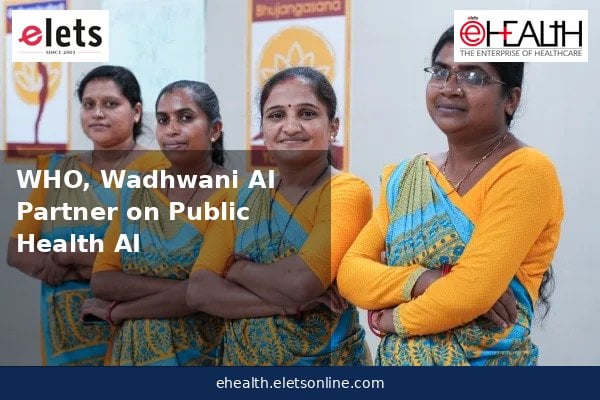
Featured image: Community health workers associated with Wadhwani AI’s health programmes. Photo: Wadhwani AI.

 Like
 Dislike
Be a part of Elets Collaborative Initiatives. Join Us for Upcoming Events and explore business opportunities. Like us on Facebook , connect with us on LinkedIn and follow us on Twitter , Instagram.
"Exciting news! Elets technomedia is now on WhatsApp Channels Subscribe today by clicking the link and stay updated with the latest insights!" Click here!