



News
Surgy Health Launches SurgyOne, an Agentic AI-First HIS/EHR for Mid-Market Hospitals in India and the GCC
Surgy Health Launches SurgyOne, an Agentic AI-First HIS/EHR for Mid-Market Hospitals in India and the GCC
![]() By eHealth Network - 27 October 2026


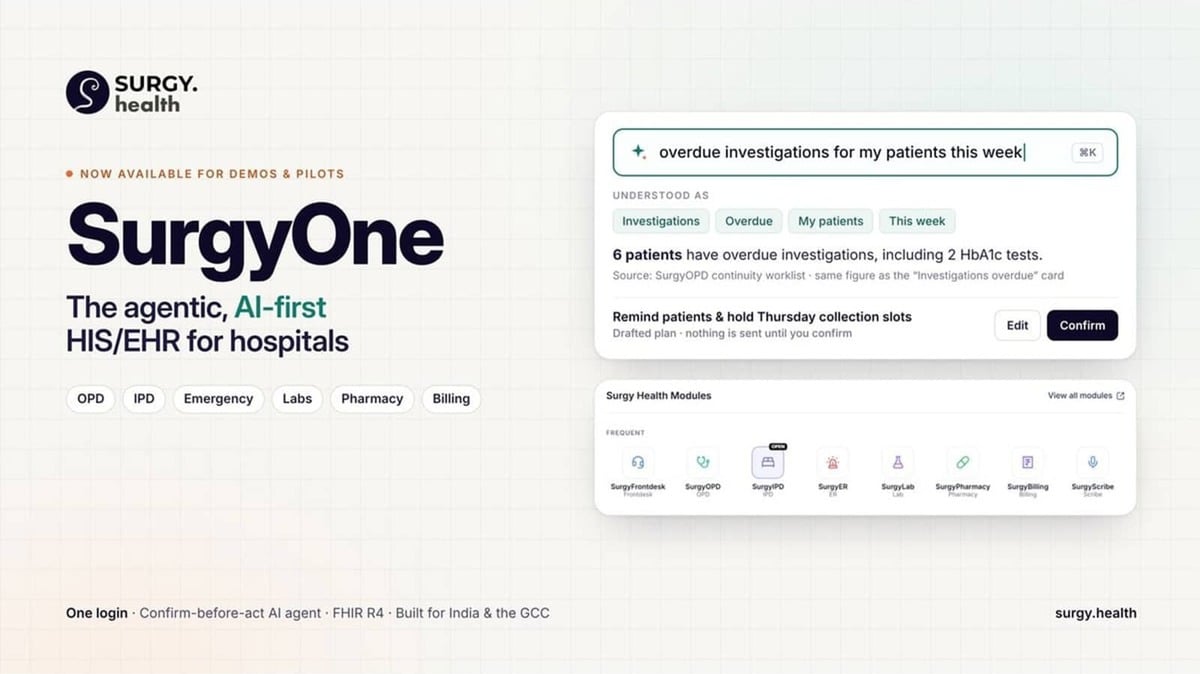
Bengaluru-based hospital software company Surgy Health has launched SurgyOne, an agentic, AI-first hospital information system (HIS) and electronic health record (EHR) aimed at mid-market multi-specialty hospital groups in India and the Gulf Cooperation Council (GCC) countries. The platform is now open for demonstrations and pilots, and the company’s first hospital deployment is under contract and slated to go live between December 2026 and January 2027.

One record, six modules, an agent inside each
SurgyOne launches with six core modules: SurgyOPD for outpatient care, SurgyIPD for inpatients, SurgyER for emergency, SurgyLabs for laboratory and radiology, SurgyPharmacy and SurgyBilling. All of them run on a single login and a single patient record, so information captured at registration, in a consultation or at the bedside does not need to be re-entered downstream.
Unlike conventional hospital systems where AI tools sit outside the system of record as separate applications, SurgyOne embeds an AI agent within every module. Staff can query it in plain language from the search bar on any screen. For example, a consultant can ask for overdue investigations for their patients this week, and the agent answers from live hospital records while citing the source of each figure. The agent can only see what the signed-in user is permitted to see.
Confirm-before-act guardrails
When a request leads to a follow-up task, such as reminding patients, holding sample-collection slots or alerting a ward, the agent drafts a plan and waits for approval. Nothing is sent, booked or posted until a staff member confirms it, and every step is logged under that user’s name. Surgy Health says clinical decisions remain with clinicians: the agent cannot order tests, sign results, triage or discharge patients.

Module-level predictive tools add a further layer. SurgyIPD continuously tracks early-warning scores and flags patients likely to be ready for discharge 24 to 48 hours ahead; SurgyER suggests triage acuity and raises sepsis, stroke and heart-attack protocols; and SurgyBilling screens claims for denial risk before submission, building each charge from a clinical event rather than manual entry.
“Most hospitals we speak to run core systems that are close to twenty years old, and every AI tool they buy sits outside them,” said Mohammed Jamil Nasir, Founder, Surgy Health, who leads product and technology. “We built SurgyOne the other way round. The agent already knows the patient, the queue and the bill.”
Built for ABDM, FHIR and data-protection rules
SurgyOne exchanges data on the HL7 FHIR R4 standard and is designed to work with the Ayushman Bharat Digital Mission (ABDM) in India and with NPHIES, Saudi Arabia’s national platform for insurance eligibility, pre-authorisation and claims. Location-level settings apply local requirements ranging from consent under India’s Digital Personal Data Protection (DPDP) Act to GST and ZATCA e-invoicing and Arabic-language documentation.
On data residency, the company says the agent is designed to run on MedGemma, Google’s open medical AI models, hosted and managed on Surgy Health’s own infrastructure so that patient records are not passed to a third-party AI service. Each module’s agent first runs in “shadow mode” with actions disabled, until it clears an evaluation that includes clinician-written cases.
Building on an existing AI product base
SurgyOne extends a suite of AI tools that Surgy Health says it already runs for 10 hospital groups, with over 4,000 healthcare users across more than 500 centres in India, Kuwait and Bahrain. These include SurgyScribe for ambient clinical documentation, which the company says cut note-taking time at Apollo Clinic in Kuwait from 10–15 minutes to about 1–1.5 minutes per consultation; SurgyFrontdesk, an AI voice agent for patient calls and bookings; SurgyCRM, used by groups including Mediversal Hospitals in Bihar; and SurgyLearn, which DCDC Kidney Care has used to train and certify more than 1,800 employees. SurgySettle for insurance claims and TPA reconciliation and SurgyInsight for conversational analytics are in pilot.
“Hospital groups already rely on us for documentation, patient calls and staff training,” said Pankaj Singh Brijwal, Co-founder, Surgy Health, who leads growth. “SurgyOne brings their core operations onto the same system.”
Why it matters
The launch targets a well-known pain point in Indian hospital IT: rising technology budgets layered on top of ageing, poorly integrated core systems. Providers in the CII-EY HealthTech Survey 2025 said they expect IT innovation budgets to rise 20–25% over the next two to three years, while citing legacy systems and integration as major barriers. For mid-sized hospital chains, an HIS with AI built in, ABDM-ready interoperability and human-in-the-loop controls could ease that transition, though real-world outcomes will become clearer once the first deployment goes live.

 Like
 Dislike
Be a part of Elets Collaborative Initiatives. Join Us for Upcoming Events and explore business opportunities. Like us on Facebook , connect with us on LinkedIn and follow us on Twitter , Instagram.
"Exciting news! Elets technomedia is now on WhatsApp Channels Subscribe today by clicking the link and stay updated with the latest insights!" Click here!