



News
Apollo Hospitals Launches AI-Assisted Stroke Care Programme With 5G-Connected Ambulances on World Stroke Day
Apollo Hospitals Launches AI-Assisted Stroke Care Programme With 5G-Connected Ambulances on World Stroke Day
![]() By eHealth Network - 29 October 2026


Apollo Hospitals has launched an AI-assisted stroke care programme in Hyderabad, using World Stroke Day on 29 October to put a connected, technology-led pathway at the centre of how it treats one of India’s leading causes of death and long-term disability.

The hospital describes the initiative as a “360 degree” programme that links every stage of a stroke patient’s journey, from the first emergency assessment through specialised intensive care to rehabilitation and follow-up at home. The aim is to cut the delays and hand-off gaps that often decide how much brain function a patient recovers.
Connected care from the ambulance onwards
Speed is the core of the model. According to Apollo, the emergency and intervention arm includes 5G-connected ambulances and rapid stroke assessment, so that clinical teams can begin evaluating a patient before arrival. Eligible patients can then receive clot-busting thrombolysis or mechanical thrombectomy, including in selected cases up to 24 hours after symptoms begin.
“The emergency and intervention services include 5G-connected ambulances, rapid stroke assessment, clot-busting treatment through thrombolysis and mechanical thrombectomy for eligible patients, including selected cases up to 24 hours from symptom onset,” said Dr Sandeep Nayani, Consultant Neurologist, Apollo Hospitals.

Neuro-ICU monitoring and MRI-integrated theatres
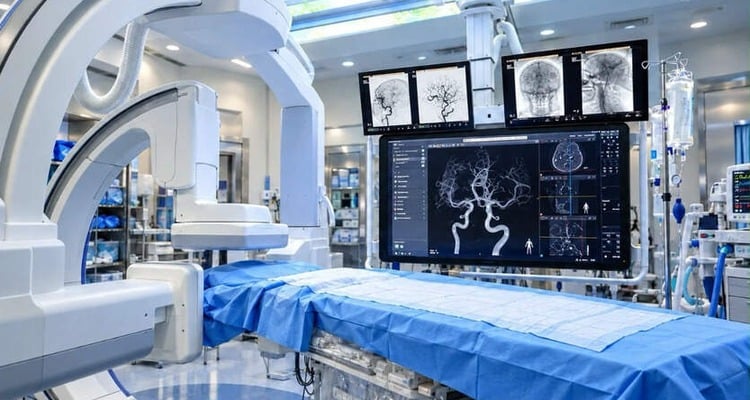
Beyond the emergency window, the programme brings in advanced neuro-ICU monitoring and, where applicable, MRI-integrated operating theatre capabilities to support complex treatment. Rehabilitation and home-based follow-up close the loop, giving patients and families a single, continuous care plan rather than a series of separate episodes.
“The 360 degree stroke care programme integrates emergency assessment, advanced neuro-intensive care, rehabilitation and home-based follow-up to provide patients with a connected pathway to recovery,” said Dr Suresh Girgani, Consultant Neurointerventional Radiologist, Apollo Hospitals.
Why it matters
Stroke outcomes depend heavily on how quickly treatment starts, and many patients in India still reach a stroke-ready hospital too late for the most effective interventions. Connected ambulances, AI-assisted assessment and integrated imaging are increasingly being used by large hospital networks to compress that timeline and to standardise decisions across emergency, imaging and neurology teams.
Apollo also used the launch to urge the public to recognise stroke symptoms early and treat them as a medical emergency, and to call its stroke emergency helpline, 1066, for immediate help.

 Like
 Dislike
Be a part of Elets Collaborative Initiatives. Join Us for Upcoming Events and explore business opportunities. Like us on Facebook , connect with us on LinkedIn and follow us on Twitter , Instagram.
"Exciting news! Elets technomedia is now on WhatsApp Channels Subscribe today by clicking the link and stay updated with the latest insights!" Click here!