




Blog
India’s Life Sciences Sector Accelerates Towards Novel Drug Discovery | BCG–HealthKois Report
India’s Life Sciences Sector Accelerates Towards Novel Drug Discovery | BCG–HealthKois Report
![]() By eHealth Network - 20 July 2026
By eHealth Network - 20 July 2026


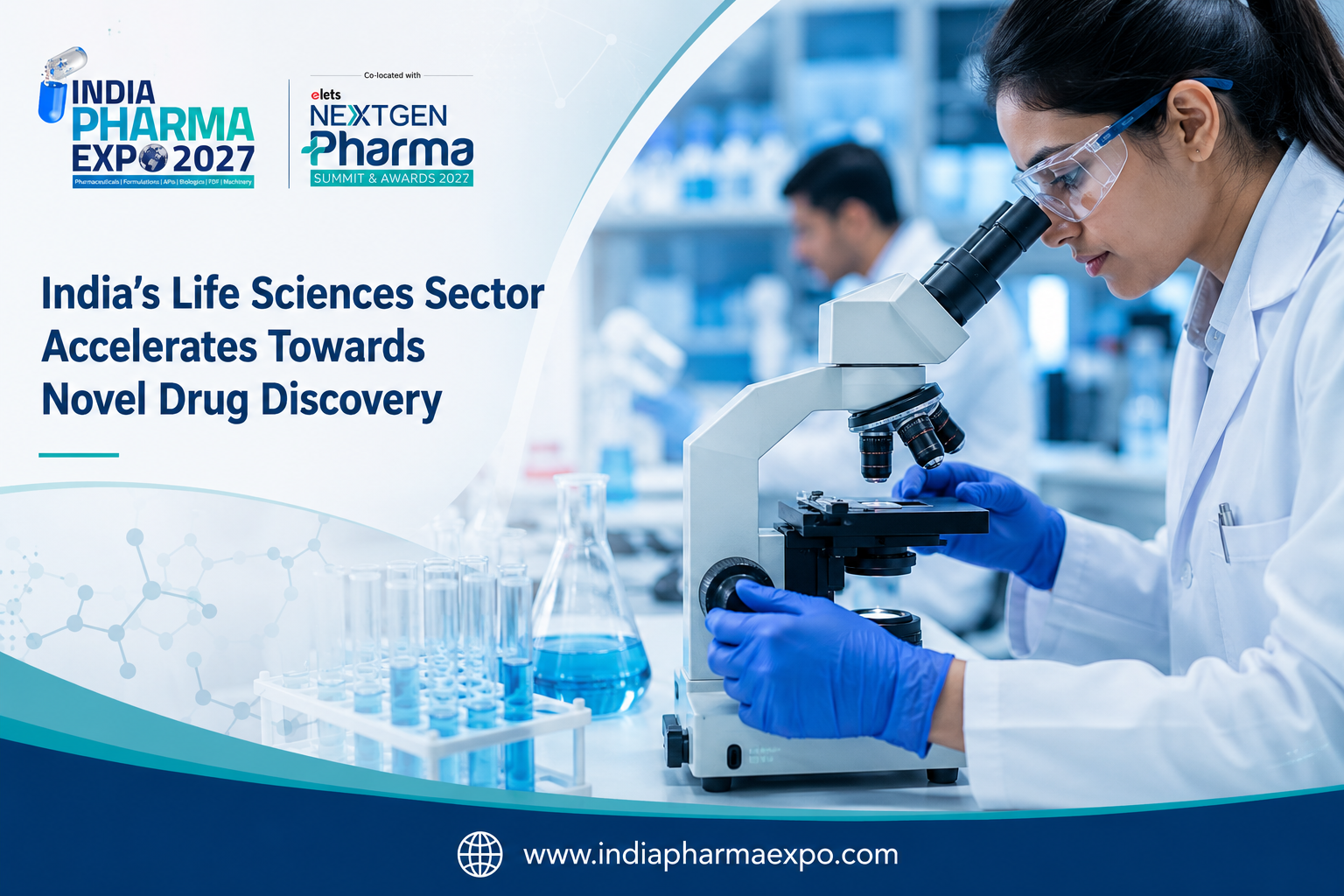
Industry Collaboration Will Define India's Next Growth Phase | India Pharma Expo 2027 


 Like
Like
 Dislike
PE/VC investments double, innovation pipelines expand and India positions itself as a global hub for science-led pharmaceutical innovation.
For decades, India’s pharmaceutical success has been built on manufacturing excellence, affordable generics, and global supply chain leadership. Today, however, the country’s life sciences ecosystem is entering a fundamentally different phase, one driven by scientific innovation, novel drug discovery, advanced therapeutics, artificial intelligence, and globally competitive intellectual property.
A newly released joint report by Boston Consulting Group (BCG) and HealthKois, titled Built on Scale, Turning to Science: India’s Pharma and Life Sciences Innovation Opportunity, highlights how India’s pharmaceutical industry is steadily transitioning from a scale-driven generics model to an innovation-led ecosystem capable of creating globally relevant therapies.
The report draws on insights from more than 30 founders, pharmaceutical executives, investors, researchers, and ecosystem leaders across India and international markets. Supported by extensive analysis of patents, venture investments, innovation pipelines, and global datasets, the study presents compelling evidence that India’s life sciences sector is gaining significant momentum.
More importantly, it argues that the next five years will determine whether India successfully converts its advantages in scientific talent, manufacturing capability, patient diversity, digital infrastructure, and cost competitiveness into a globally sustainable innovation engine.
India’s Strong Manufacturing Base Creates the Foundation for Innovation
India already occupies a critical position in the global pharmaceutical landscape.
The country is the world’s third-largest pharmaceutical producer by volume, supplies nearly 60% of global vaccines, and fulfils close to 40% of the United States’ generic medicine demand. These capabilities have established India as one of the world’s most dependable pharmaceutical manufacturing hubs.
According to the report, this manufacturing strength now provides the ideal platform to support a much broader innovation agenda. Instead of limiting growth to contract manufacturing and generic production, Indian pharmaceutical companies are increasingly investing in original drug discovery, advanced biologics, precision medicine, AI-enabled drug development, and platform technologies.
The report suggests that India’s competitive advantage will increasingly come not only from producing medicines efficiently but also from creating new therapies that address unmet global healthcare needs.
Investment Momentum Signals Growing Confidence
One of the report’s strongest indicators of India’s innovation trajectory is the significant increase in private capital flowing into pharmaceutical innovation.
Private equity and venture capital investments in India’s pharmaceutical sector have grown 2.1 times over the past five years, reaching US$731 million in FY2026.
The broader biotechnology ecosystem is expanding equally rapidly. India’s biotech startup landscape has increased from approximately 1,500 companies to nearly 2,400 startups, reflecting growing entrepreneurial activity across drug discovery, diagnostics, digital therapeutics, biotechnology platforms, and precision medicine.
Meanwhile, the country’s innovation pipeline has expanded by nearly 1.5 times, with more than 1,095 active drug discovery programmes spread across 195 companies.
Patent activity further demonstrates this shift. Pharmaceutical patent families originating from India increased dramatically from approximately 716 in 2015 to 2,995 in 2024, increasing India’s contribution to global pharmaceutical patents from roughly 3–4% to nearly 10%.
The report notes that this growth represents a qualitative transformation rather than simply higher volumes. Indian companies are increasingly originating novel molecules, licensing proprietary technologies globally, and competing alongside established international innovators.
Four Structural Enablers Are Strengthening India’s Innovation Ecosystem
The report identifies four major developments that are collectively accelerating India’s pharmaceutical innovation ecosystem.
Government Support for Translational Research
Approximately US$5 billion in government funding has been directed towards early-stage scientific research and translational innovation. This support is helping bridge the critical gap between laboratory discoveries and commercial drug development.
Stronger Academia–Industry Collaboration
Indian universities and research institutions are increasingly partnering with industry through technology transfer offices, collaborative research programmes, and innovation incubators. This creates clearer pathways for academic discoveries to become commercially viable therapies.
Faster Regulatory Processes
Regulatory reforms have substantially reduced drug development approval timelines.
Processes that previously required 180 to 270 days can now often be completed within 60 to 120 days, significantly improving India’s attractiveness for innovative research programmes and clinical development.
Shared Research Infrastructure
Innovation clusters such as Genome Valley and C-CAMP are enabling startups and research companies to access sophisticated laboratory infrastructure without requiring heavy capital investments.
These developments are already translating into globally competitive innovations.
Among the report’s most notable examples are BIRSA 101, India’s first indigenously developed CRISPR-based therapeutic, and NexCAR19, an indigenous CAR-T therapy priced at approximately one-tenth the cost of comparable international treatments, making advanced cancer therapies substantially more accessible.
Multiple Innovation Pathways Are Emerging
Unlike previous decades when innovation largely centred on manufacturing efficiency, Indian companies are now pursuing multiple scientific and commercial pathways.
Small molecule therapeutics continue to dominate the innovation landscape, accounting for nearly 49% of PE/VC investment and approximately 58% of active pharmaceutical patents.
At the same time, artificial intelligence and digital therapeutics are attracting nearly 17% of private investment, reflecting growing confidence in technology-enabled drug discovery and digital healthcare solutions.
Several high-profile international partnerships illustrate the increasing global recognition of India-origin innovation.
Among the most significant examples is Glenmark’s US$700 million upfront licensing agreement with AbbVie, carrying milestone payments of up to US$1.2 billion.
Additional examples include partnerships with Almirall and Astria Therapeutics, ImmunoACT’s collaboration with Cipla to commercialise indigenous CAR-T therapies across South Africa, Algeria, and Morocco, and Peptris’ licensing of India’s first AI-discovered drug candidate to Revio Therapeutics.
These transactions indicate that global pharmaceutical companies increasingly view India not merely as a manufacturing destination but as a valuable source of scientific innovation.
India’s Competitive Advantage Lies in Cost, Data and Talent
The report argues that India’s greatest opportunity lies in combining several structural advantages rather than attempting to compete directly with mature innovation ecosystems on research spending alone.
India possesses one of the world’s largest and most genetically diverse patient populations, creating unique opportunities for precision medicine and population-specific therapies.
Clinical trial costs remain 50–60% lower than those in the United States, while the country’s expanding digital health infrastructure and large-scale healthcare datasets create fertile ground for AI-enabled research.
Combined with a deep scientific workforce and manufacturing expertise, these factors position India to build competitive strengths in cost-disruptive innovation, data-driven drug development, and scalable life sciences platforms.
Structural Challenges Continue to Limit Growth
Despite the positive momentum, the report highlights several structural challenges that must be addressed if India aims to become a leading innovation hub.
Although India carries nearly 15% of the global disease burden, it currently accounts for only around 4% of global clinical trials, indicating significant untapped research potential.
Annual pharmaceutical R&D expenditure also remains comparatively modest at US$2–3 billion, compared to approximately US$70–75 billion invested annually in the United States.
Access to specialist venture capital remains another major constraint.
Only 10–15% of Indian venture capital firms possess deep pharmaceutical and biotechnology expertise, compared with roughly 60% in the United States. Expanding patient capital with strong scientific understanding will be essential for supporting long-term drug discovery programmes.
The report concludes that strengthening early-stage financing, expanding translational research, improving clinical trial capacity, building specialist regulatory capabilities, and nurturing scientific talent will determine whether India’s innovation ambitions can be fully realised.
Industry Leaders See a Historic Shift
“India’s innovation trajectory is gaining real momentum, and its evolution into a sustained innovation engine is well underway,” said Priyanka Aggarwal, Managing Director and Senior Partner, BCG India and Southeast Asia Leader, Healthcare Practice. “We are seeing a fundamental shift in ambition from replication to origination, and from process excellence to scientific discovery. Realizing this potential will require building specialist biotech capital, deepening academia–industry partnerships, creating fast-track regulatory pathways, and bridging the talent gap in R&D and innovation.”
“What stands out is that there is no single playbook — Indian companies are proving multiple routes to global relevance: developing novel science in India first and taking it worldwide, out-licensing India-origin innovation to global players, and spinning breakthroughs out of academic labs,” said Abhinav Anand, Partner, BCG. “Zydus, for example, developed indigenous molecules like Saroglitazar and Desidustat in India and is now scaling them globally. Glenmark took a different route — advancing a first-in-class asset through global development, culminating in a $700 million upfront licensing deal with AbbVie, one of the largest such transactions for an India-origin molecule.”
“For years, the conversation around Indian healthcare innovation was about cost and scale. That is changing,” said Charles Janssen, Co-Founder and Managing Partner, HealthKois. “We are seeing India-origin science licensed by global pharma majors, and indigenous CAR-T therapies treating patients at a fraction of the global cost. Capital that understands the science and is willing to back it through the early, uncertain years will be the difference between a handful of breakout successes and a durable innovation engine.”
“India is at a genuinely exciting inflection point, shifting from replication to origination, with multiple forces converging to make that possible,” said Ajay Mahipal, Co-Founder and General Partner, HealthKois. “India is building a differentiated advantage by combining cost, data and scientific talent in ways few countries can match. Our role is to fuel that engine by providing patient capital, domain expertise and specialist networks that help companies scale.”
Looking Ahead: Industry Collaboration Will Define India’s Next Growth Phase
As India enters its next phase of pharmaceutical evolution, collaboration between innovators, manufacturers, investors, regulators, researchers, technology providers, and global healthcare companies will become increasingly critical. The transition from a generics-led economy to an innovation-driven life sciences powerhouse will require sustained investment, strategic partnerships, stronger translational research, and platforms that facilitate knowledge exchange and commercial collaboration.
These themes are expected to take centre stage at the India Pharma Expo 2027, scheduled to be held from 11–13 March 2027 at HITEX Exhibition Centre, Hyderabad. Bringing together pharmaceutical manufacturers, biotech innovators, MedTech companies, AI-driven healthcare startups, regulators, investors, researchers, and global industry leaders, the event will serve as a strategic platform to explore emerging opportunities in novel drug discovery, advanced manufacturing, precision medicine, clinical research, digital health, and international collaborations. As India’s innovation ecosystem accelerates, India Pharma Expo 2027 aims to foster the partnerships and business conversations that can help transform the country’s scientific capabilities into globally competitive healthcare innovations.
 Like
Dislike
Like
Dislike
Be a part of Elets Collaborative Initiatives. Join Us for Upcoming Events and explore business opportunities. Like us on Facebook , connect with us on LinkedIn and follow us on Twitter , Instagram.
"Exciting news! Elets technomedia is now on WhatsApp Channels Subscribe today by clicking the link and stay updated with the latest insights!" Click here!