



Pharma
Bulk Drug Scheme Worth ₹7,000 Crore Gets Finance Panel Nod
Bulk Drug Scheme Worth ₹7,000 Crore Gets Finance Panel Nod
![]() By eHealth Network - 28 November 2026


The Finance Ministry’s Expenditure Finance Committee (EFC) has approved a new ₹7,000 crore bulk drug scheme to boost domestic manufacturing of active pharmaceutical ingredients (APIs), drug intermediates and key starting materials, Informist reported on 27 November 2026, citing a person familiar with the discussions. The proposal now needs Union Cabinet approval.

The scheme, drawn up by the Department of Pharmaceuticals (DoP), is meant to go beyond the existing production-linked incentive (PLI) model and also support research and development, capacity creation, infrastructure, financing and industry-academia partnerships. The government has not yet made an official announcement.
What the bulk drug scheme proposes
According to the Informist report and earlier details reported by Business Standard on 9 November, the proposed design includes:
- Outlay: ₹5,000 crore for production-linked incentives and ₹2,000 crore for R&D, common infrastructure and capital subsidies, of which ₹500 crore is earmarked for R&D.
- Platform approach: 52 molecule sets treated as manufacturing platforms, covering more than 300 intermediates and downstream APIs, instead of support for individual products.
- Brownfield too: both greenfield and brownfield plants would be eligible, so companies could claim support for expanding existing capacity.
- Longer window: an eight-year scheme with six years of production incentives, and the option to declare two “zero-production” years.
The R&D money is proposed for areas such as fermentation, strain development, biocatalysis, enzyme engineering and continuous-flow chemistry, Business Standard reported.

Why a new scheme is needed
The current ₹6,940 crore PLI scheme for bulk drugs, approved in 2020, has drawn investment but struggled to turn it into output. By June 2026 it had attracted actual investment of ₹5,210.74 crore against commitments of about ₹4,330 crore, but production stood at about ₹3,270 crore against a lifecycle target of ₹37,378 crore, and incentive payouts were only about ₹87.5 crore, according to Business Standard. Industry executives blame aggressive Chinese pricing, high utility and input costs and weak value-chain integration.
Pharmaceuticals Secretary Manoj Joshi had said earlier that the EFC would clear the scheme first, followed by the Cabinet. Industry has long asked for this kind of support; API makers sought import curbs and help with GMP upgrades in their Budget 2026 wish list, and the government had earlier invited fresh applications under the bulk drug PLI scheme.
What it means for API makers
If the Cabinet approves it, the scheme could support capacity expansion at existing API plants and help newer projects through slow early years. Investment in the upstream value chain is already picking up: Assam recently laid the foundation of a ₹750 crore pharma KSM plant in Golaghat, and Anuh Pharma has added 525 TPA of bulk drug capacity at Tarapur.
Key takeaways
- The EFC has cleared a ₹7,000 crore bulk drug scheme, Informist reported; Cabinet approval is next.
- The plan covers 52 molecule platforms and more than 300 intermediates and APIs, for both new and existing plants.
- It responds to weak output and low payouts under the current bulk drug PLI scheme.
FAQ
What is the new bulk drug scheme?
It is a proposed ₹7,000 crore Department of Pharmaceuticals scheme to boost domestic manufacturing of APIs, intermediates and key starting materials, combining production incentives with support for R&D and infrastructure.
Has the scheme been approved?
The Finance Ministry’s Expenditure Finance Committee has approved it, according to Informist. It still needs Union Cabinet approval before it is formally notified.
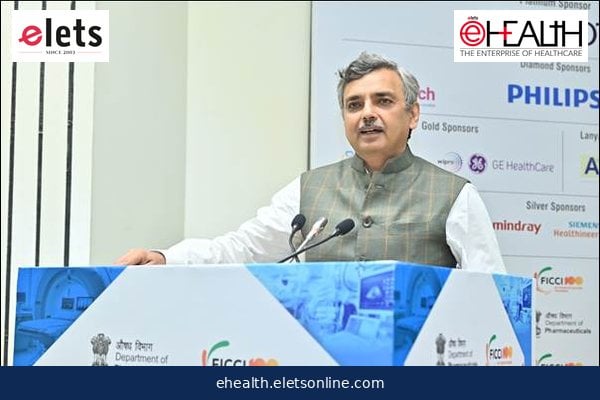
Featured image: Manoj Joshi, Secretary, Department of Pharmaceuticals, at India Medical Device 2026 in New Delhi. Photo: PIB

 Like
 Dislike
Be a part of Elets Collaborative Initiatives. Join Us for Upcoming Events and explore business opportunities. Like us on Facebook , connect with us on LinkedIn and follow us on Twitter , Instagram.
"Exciting news! Elets technomedia is now on WhatsApp Channels Subscribe today by clicking the link and stay updated with the latest insights!" Click here!