




The Union Ministry of Health and Family Welfare has proposed amendments to the Drugs Rules, 1945, that would let the Central Licensing Approving Authority or a State Licensing Authority immediately suspend the manufacturing licence of a drug declared Not of Standard Quality (NSQ) on assay, dissolution, related substances, impurities or sterility. The draft, announced by PIB Delhi on 4 November 2026, is open for 30 days of public consultation.

Why immediate NSQ licence suspension is on the table
Under the present Drugs Rules, 1945, suspension or cancellation of a manufacturing licence follows a prescribed process that includes a show-cause notice. The Health Ministry said that gap between a Government Analyst declaring a drug NSQ and formal regulatory action can leave substandard stock in circulation and make effective recall harder. The draft closes that window for five critical quality parameters that determine whether a medicine is safe and effective for patients.
The proposal follows deliberations at the 65th meeting of the Drugs Consultative Committee (DCC) on 20 December 2024 and recommendations of the 92nd meeting of the Drugs Technical Advisory Board (DTAB) on 24 April 2025, according to the official PIB release.
What manufacturers must do before a licence is restored
Suspension would continue until the manufacturer completes an effective root-cause analysis and implements Corrective and Preventive Action (CAPA) to the licensing authority’s satisfaction. Revocation would be allowed only after those measures are verified. The draft also amends Form 13 so that the Government Analyst’s test report is endorsed to the Drugs Controller General of India (DCGI), the State or UT Licensing Authority that covers the manufacturing site, and the manufacturer and marketer named on the label.
That reporting chain is meant to speed coordinated action across CDSCO, state regulators and commercial stakeholders. It sits alongside recent quality-enforcement moves, including the CDSCO halt on Sun Pharma eye-drop production at its Assam plant and the ministry’s push for states to enforce batch testing of raw materials, excipients and finished drugs.
How the draft fits India’s wider drug-quality agenda
India’s post-marketing surveillance already flags NSQ batches through central and state laboratory alerts. The draft would harden the licence consequence when critical tests fail, while other Drugs Rules changes continue to reshape the supply chain — including the new 12-month residual shelf-life floor for imported drugs. Manufacturers that have invested in inspection readiness, from plants clearing audits with zero Form 483 observations to sites addressing USFDA observations, will read the draft as another reason to keep CAPA, sterility assurance and analytical methods audit-ready.
Stakeholders can send objections or suggestions within 30 days of the Gazette copies becoming available to the Under Secretary (Drugs), Ministry of Health and Family Welfare, Kartavya Bhawan-1, New Delhi, or by email to drugsdiv-mohfw[at]gov[dot]in. The draft text is available on the e-Gazette portal.
Key takeaways
- Manufacturing licences could be suspended at once when a Government Analyst declares a drug NSQ on assay, dissolution, related substances, impurities or sterility.
- Restoration would require verified root-cause analysis and CAPA to the licensing authority’s satisfaction.
- Form 13 reports would go to the DCGI, the relevant state/UT licensing authority, and the manufacturer and marketer; 30-day public consultation is open.
FAQ
Which NSQ failures would trigger immediate licence suspension?
The draft covers five critical parameters: Assay, Dissolution, Related Substances, Impurities and Sterility, as declared in a Government Analyst’s report.
Can a suspended manufacturing licence be restored?
Yes, but only after the manufacturer completes root-cause analysis and CAPA and the licensing authority verifies those measures.
How long is the public consultation?
Stakeholders have 30 days from the date Gazette copies of the draft rules are made available to the public to file objections or suggestions.
Also read: AstraZeneca Gets Delhi HC Relief in ₹151 Crore NPPA Inhaler Case · Revised Schedule M Compliance and Its Impact on Healthcare
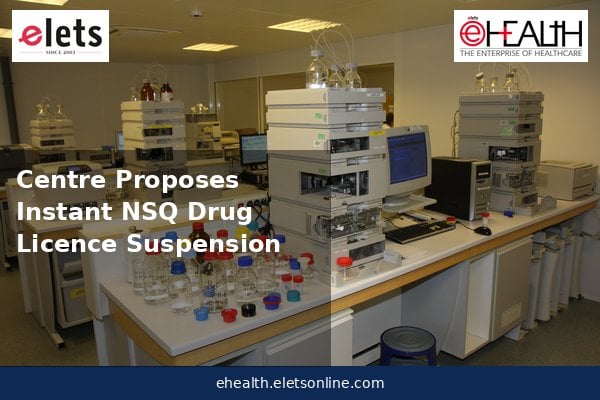
Featured image: HPLC instruments in a pharmaceutical quality-control laboratory (representative). Photo: Root66 / Wikimedia Commons (CC BY-SA 3.0).

 Like
 Dislike
Be a part of Elets Collaborative Initiatives. Join Us for Upcoming Events and explore business opportunities. Like us on Facebook , connect with us on LinkedIn and follow us on Twitter , Instagram.
"Exciting news! Elets technomedia is now on WhatsApp Channels Subscribe today by clicking the link and stay updated with the latest insights!" Click here!