


News
WHO Declares Ebola Emergency: Why India’s Pharma & Healthcare Industry Is Watching Closely
WHO Declares Ebola Emergency: Why India’s Pharma & Healthcare Industry Is Watching Closely
![]() By eHealth Network - 23 May 2026
By eHealth Network - 23 May 2026


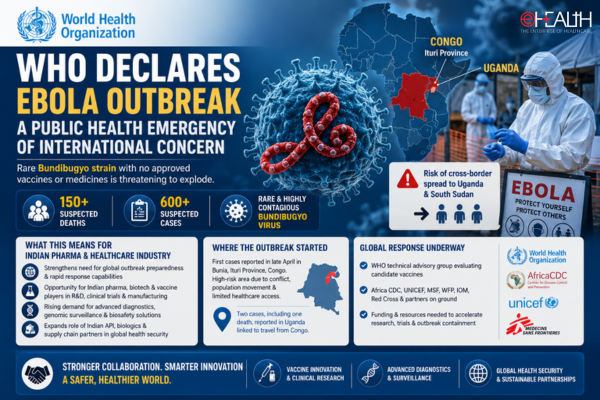
The World Health Organization’s (WHO) declaration of the Ebola outbreak in Congo and Uganda as a Public Health Emergency of International Concern (PHEIC) is drawing significant attention from India’s pharmaceutical, biotech, diagnostics, and healthcare sectors, particularly as the outbreak involves the rare Bundibugyo strain of Ebola for which no approved vaccine or targeted treatment currently exists.

The outbreak has already resulted in nearly 150 suspected deaths and more than 600 suspected cases across affected regions in Central Africa, prompting renewed global focus on infectious disease preparedness, rapid-response healthcare systems, vaccine innovation, and emergency medical infrastructure.
For India’s pharma and healthcare industry, the development presents both a strategic healthcare challenge and a long-term innovation opportunity. Indian vaccine manufacturers, biologics companies, CROs, diagnostics players, and public health institutions have increasingly positioned themselves as critical contributors to global outbreak preparedness and affordable healthcare manufacturing ecosystems.

Industry experts believe the latest Ebola emergency could accelerate global demand for next-generation vaccines, molecular diagnostics, antiviral therapeutics, AI-enabled disease surveillance, and scalable cold-chain logistics — areas where Indian healthcare and pharma companies are rapidly expanding capabilities.

The outbreak also reinforces the growing importance of pandemic preparedness investments among Indian pharmaceutical companies and healthcare providers. Following COVID-19, several Indian firms strengthened capabilities in vaccine manufacturing, genomic surveillance, biologics research, and emergency healthcare supply chains, making the sector more globally integrated than ever before.
Healthcare analysts note that global agencies may increasingly collaborate with emerging-market pharmaceutical manufacturers, including Indian companies, for affordable vaccine production, clinical research support, diagnostics deployment, and healthcare workforce scalability.
The WHO has clarified that the Ebola outbreak does not currently meet pandemic-level criteria similar to COVID-19 and has not recommended border closures. However, the emergency declaration is expected to unlock funding support, international scientific collaboration, and accelerated research initiatives.
The situation also highlights growing opportunities for Indian healthtech and digital health companies involved in telemedicine, outbreak analytics, AI-led surveillance, remote diagnostics, and healthcare data management. As global healthcare systems continue shifting toward preventive and digitally connected care models, epidemic response infrastructure is becoming a critical area of investment for governments and healthcare enterprises worldwide.
Also Read: CLIRNET Crosses 650,000 Healthcare Professionals, Expands Digital Medical Learning Ecosystem
Industry observers believe the evolving outbreak could further strengthen India’s role as a strategic global healthcare partner in vaccine manufacturing, public health response, medical innovation, and affordable healthcare delivery over the coming decade.

 Like
Like
 Dislike
Be a part of Elets Collaborative Initiatives. Join Us for Upcoming Events and explore business opportunities. Like us on Facebook , connect with us on LinkedIn and follow us on Twitter , Instagram.
"Exciting news! Elets technomedia is now on WhatsApp Channels Subscribe today by clicking the link and stay updated with the latest insights!" Click here!