



Article
Digital Health, Tele-medicine and Wearable CGMs: India’s Quiet Healthcare Revolution
Digital Health, Tele-medicine and Wearable CGMs: India’s Quiet Healthcare Revolution
![]() By Dr. Asawari Savant, eHealth Network - 05 December 2025
By Dr. Asawari Savant, eHealth Network - 05 December 2025


In clinics and living rooms across India, healthcare is changing hands. What once required a long wait at a hospital is now moving to screens and sensors. Telemedicine has matured from a pandemic stopgap into a national service layer. Wearables that track glucose in real time are helping people manage diabetes with fewer guesswork spikes. And the country’s digital rails are stitching records together so information travels with the patient, not the other way around. The shift is not flashy. It is practical, citizen-facing, and measurable.
Telemedicine grows from pilot to public utility
India’s national tele-medicine platform, eSanjeevani, is no longer an experiment. According to the Ministry of Health and Family Welfare, it has delivered more than 36 crore teleconsultations since 2020, with lakhs of providers onboarded and a nationwide hub-and-spoke network that connects specialist hubs to Ayushman Arogya Mandirs and district facilities. That volume is not a vanity metric. It signals a service that citizens trust for first-contact care, follow-ups, and specialist advice that might otherwise require costly travel.
Behind those screens sits a domestic technology stack. The Centre for Development of Advanced Computing notes that eSanjeevani is indigenously built and now runs across more than a lakh health facilities as spokes, supported by thousands of specialist hubs. A public platform managed in India can evolve with clinical protocols, language needs, and privacy rules set by Indian regulators.

ABDM’s rails and a record that follows the patient
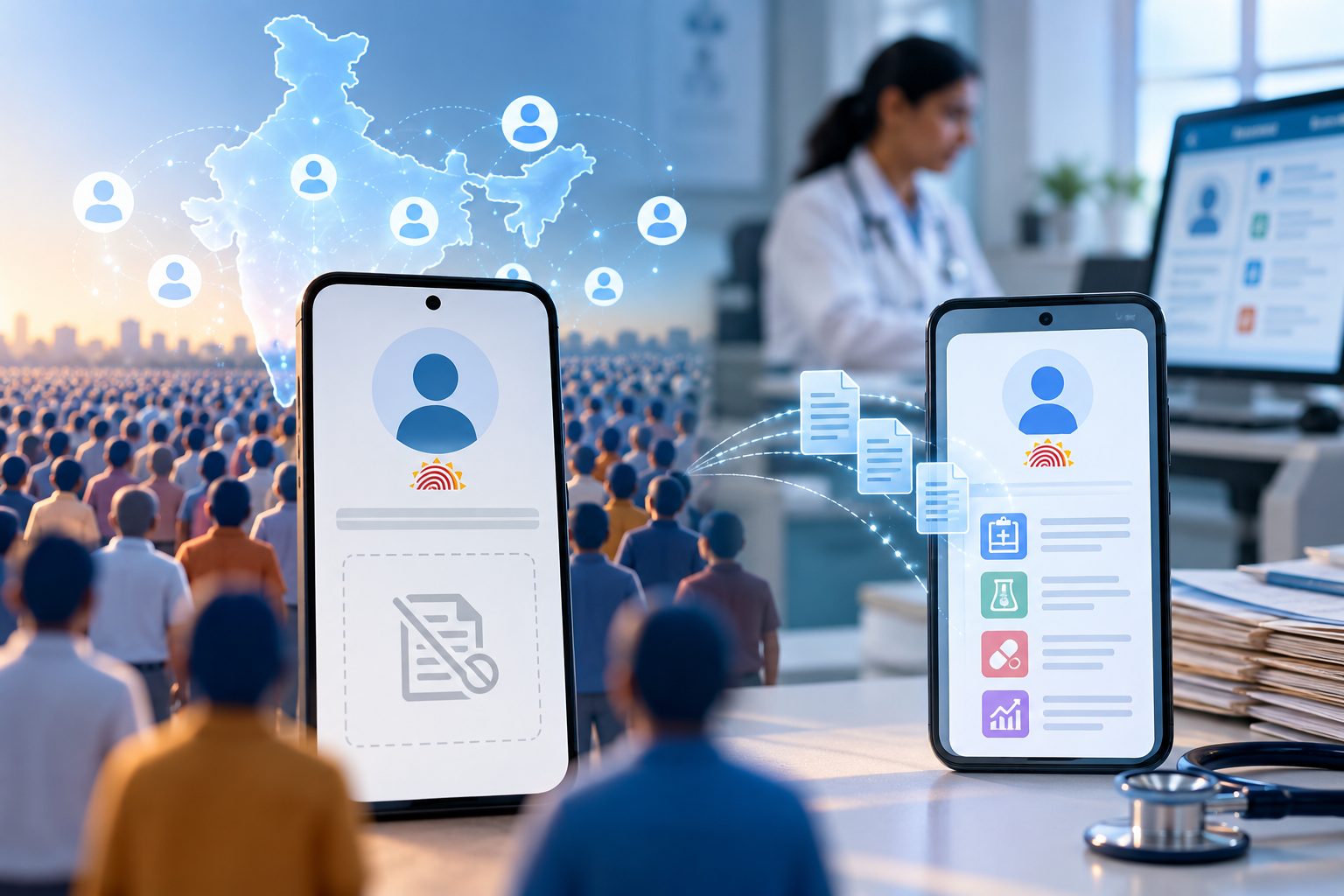
The Ayushman Bharat Digital Mission is the plumbing that makes digital care usable at scale. It enables citizens to create an Ayushman Bharat Health Account, link health records with consent, and let providers retrieve those records when needed. The National Health Authority leads this rollout, along with registries for facilities and professionals that make discovery and referrals simpler. Care is easier when data can move safely and verifiably.

The diabetes burden and the rise of CGMs
India’s diabetes challenge is stark. A government brief summarising the ICMR-INDIAB study reported that about 10.1 crore Indians live with diabetes, with an additional 13.6 crore in prediabetes. That scale explains why continuous glucose monitoring has moved from niche device to mainstream conversation in urban clinics. CGMs turn invisible fluctuations into visible patterns, allowing patients and clinicians to adjust food, sleep, exercise, and medication with evidence rather than intuition.
Expert recommendations referenced by Indian societies and the ICMR describe how CGM data can be used to assess “time in range,” guide therapy changes, and support high-risk groups such as people with type 1 diabetes or pregnancy-related diabetes. The point is not gadgetry. It is adherence and outcomes. When patients can see cause and effect, lifestyle changes stick longer, and medication is titrated with fewer surprises.
Access, affordability, and the rural test
Digital health wins only if it closes the distance. eSanjeevani’s spoke-and-hub design routes specialist time into places that do not have specialists on site, and does so without the travel and informal costs that keep rural families from care. For chronic conditions, CGMs are still a stretch for many households. Prices need to fall, insurance pathways need clarity, and public programs can pilot targeted coverage for high-risk patients where the avoided hospitalisations pay for the sensors many times over. The policy lesson is familiar. Start with groups where the return is largest, then scale with local manufacturing and procurement.
Also read: From Cloud Adoption to Cyber Resilience: Securing India’s Healthcare Sector
Privacy and safety are design choices
As adoption grows, so will scrutiny. Consent, data minimisation, and audit trails are not footnotes. They are the social contract that keeps citizens willing to share sensitive health information. ABDM’s architecture is built around consented exchange, and the telemedicine stack is operated by public institutions accountable to Indian law. The same care must extend to private apps that plug into this ecosystem, particularly those collecting CGM data. Growth is durable only when trust is earned daily.
Digital health in India has crossed the threshold where the question is no longer “does it work,” but “how do we make it routine?”
The answers are within reach.
Measure results and publish them so clinicians and citizens see the value, not just the intent. A phone, a sensor, and an interoperable record will not replace hospitals. They will make hospitals smarter by keeping people stable for longer and by catching trouble early.
That is the quiet revolution underway, one call, one consent, and one data point at a time.
Views expressed by: Neeraj Katare, Founder, Tracky

 Like
Like
 Dislike
Be a part of Elets Collaborative Initiatives. Join Us for Upcoming Events and explore business opportunities. Like us on Facebook , connect with us on LinkedIn and follow us on Twitter , Instagram.
Disclaimer: The views and opinions expressed in this article are solely those of the author and do not necessarily reflect the official policy or views of any organisation. The content is intended for informational and educational purposes only and should not be construed as medical advice.
"Exciting news! Elets technomedia is now on WhatsApp Channels Subscribe today by clicking the link and stay updated with the latest insights!" Click here!