


Article
From Cloud Adoption to Cyber Resilience: Securing India’s Healthcare Sector
From Cloud Adoption to Cyber Resilience: Securing India’s Healthcare Sector
![]() By Dr. Asawari Savant, eHealth Network - 27 November 2025
By Dr. Asawari Savant, eHealth Network - 27 November 2025


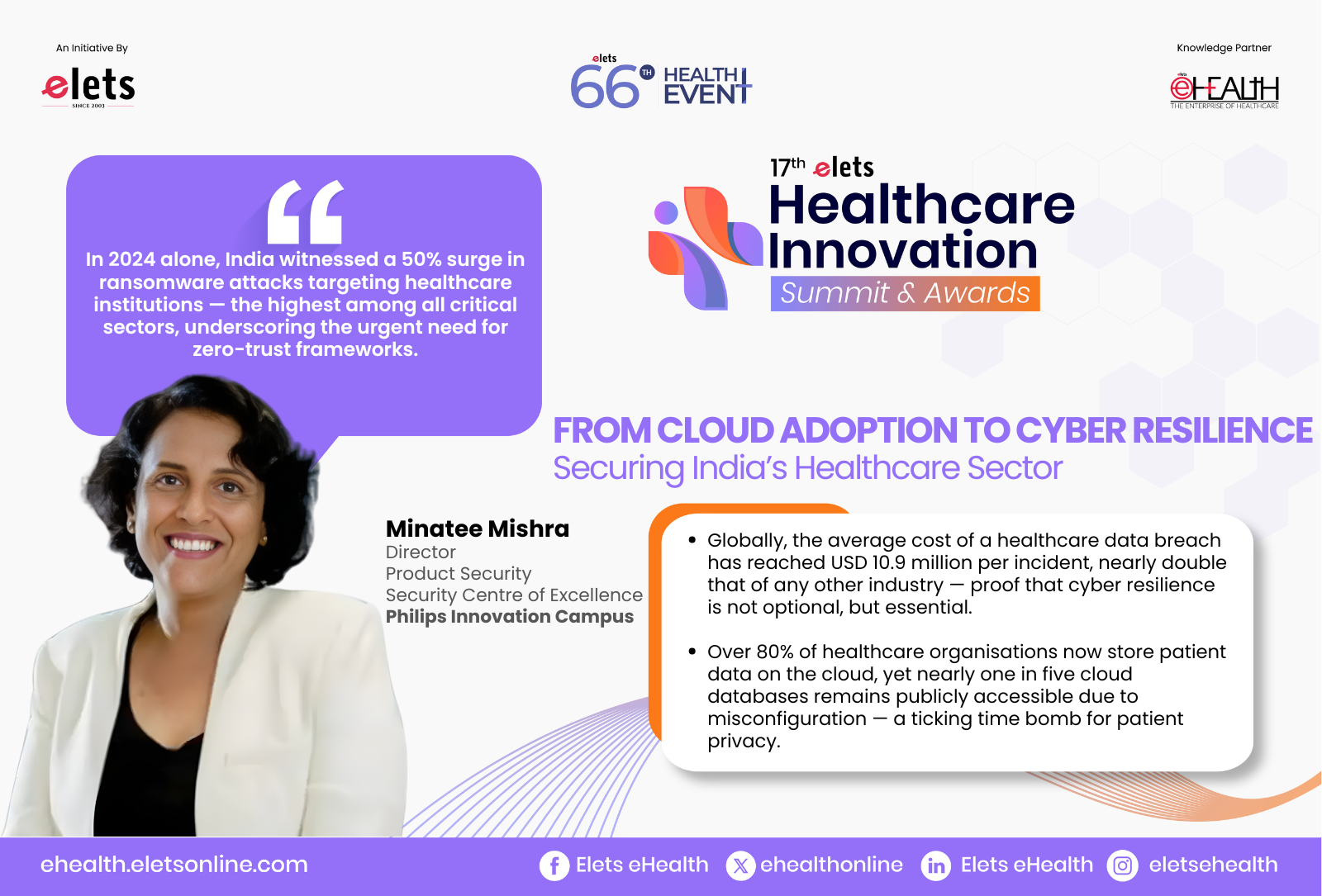
India’s healthcare sector is undergoing a rapid digital transformation, driven by advancements in artificial intelligence, cloud computing, and data-driven innovation. Hospitals, startups, and health-tech providers are embracing technologies that enable advanced diagnostics, personalised care, and operational efficiencies—bridging workforce gaps and reducing costs. However, this evolution brings a surge in cybersecurity risks that must be addressed with urgency and precision.

The New Face of Healthcare and Its Risks
India ranks among the top countries globally in exposed healthcare IPs¹, with research indicating that India has over 10% of 14,000+ public-facing systems vulnerable to cyber threats. A significant portion of these exposures, nearly one-third, stems from unsecured DICOM ports used for medical imaging. The widespread adoption of cloud infrastructure introduces additional risks, including misconfigurations, outdated software, and weak authentication mechanisms.
Healthcare remains one of the top targets for ransomware. The sector faces a potent combination of risks and sophisticated threat actors. Compounding this, ransomware continues to evolve rapidly, driven by ransomware-as-a-service kits that lower the barrier to entry for attackers and amplify the scale of impact.

Recent Breaches Underscore the Threat
Recent breaches have highlighted the devastating impact of cyberattacks on India’s healthcare ecosystem. The ransomware attack on AIIMS, for instance, crippled operations for several days and compromised nearly 40 million patient records. Similarly, the ICMR data breach exposed personal information of over 815 million citizens, one of the largest such incidents in the country’s history. Together, these events underscore the escalating scale and sophistication of cyber threats in healthcare as well as the urgent need for proactive, sector-wide defences.

Why Healthcare Is a Prime Target
Healthcare has become one of the most attractive targets for cybercriminals due to the unique combination of high-value data, operational dependence, and technological complexity it presents. Patient records, rich in personal and medical details, are highly sought after for identity theft because of their permanence and depth, unlike financial data, which can often be reset or replaced. The sector’s role as critical infrastructure also makes it especially vulnerable; even minor disruptions can endanger patient care and safety, forcing hospitals and healthcare providers to prioritise swift recovery and, in some cases, pay ransoms to restore operations.
Adding to the challenge is the inherently complex IT environment of healthcare organisations, which rely on a mix of legacy systems, connected medical devices, and diverse vendor networks—each with its own patching and maintenance requirements. Many of these older systems remain operational but lack modern security safeguards, leaving potential gaps for exploitation. Further compounding the risk are supply chain vulnerabilities, where breaches in third-party systems can cascade across networks.
A striking example was the 2024 London hospital outage, traced back to a compromised pathology service provider for the National Health Service in England3. The incident revealed just how interconnected and fragile the healthcare ecosystem can be, highlighting the urgent need for coordinated cybersecurity measures across public and private healthcare entities.
Safeguarding the Sector: A Strategic Approach
To secure India’s healthcare future, organisations must move from reactive protection to proactive resilience. This begins with a clear, layered security strategy encompassing technology, governance, and people.
1- Risk Assessment
Conduct end-to-end risk assessments to identify risks in the ecosystem. Integrating these insights into a unified mitigation roadmap that aligns with organisational goals.
2- Mitigation Roadmap Essentials
- Security Hygiene: Prioritise vulnerabilities from an attacker’s perspective. This includes patching systems, segmenting networks to limit lateral movement, enforcing multi-factor authentication (MFA), and implementing robust backup and recovery mechanisms.
- Incident Response Planning: Develop and routinely test security incident response protocols to minimise downtime.
- Regulatory Alignment: Ensure compliance with the DPDP Act and other relevant frameworks. Create organisational security policies to enforce regular compliance.
- Zero Trust Architecture: Enforce least-privilege access, robust identity management, and MFA.
- Device Security: Patch, encrypt, and monitor medical devices for anomalies.
- Supply Chain Security: Regularly vet third-party vendors, request attestations, and review their Bill of Materials (BOMs).
- Cloud Security: Cloud adoption must be guided by a clear security strategy to manage new risks and an expanded threat surface.
- Continuous Monitoring: Detect anomalies and intrusions early.
- Employee Training: Educate staff on phishing, ransomware, and social engineering threats.
The above must be done at a regular frequency to ensure that the security posture is maintained.
3- Information Sharing
As demonstrated across various geographies and sectors, establishing an Information Sharing and Analysis Centre (ISAC) to exchange threat intelligence and best practices significantly enhances the security posture of healthcare systems.
Also read: The Future of Care Is Intelligent: How AI Is Redefining Healthcare Service Delivery
Charting a Secure Path Forward
Digital transformation holds immense promise for India’s healthcare sector—but only if cybersecurity is embedded at its core. By aligning technology strategies with robust security frameworks, healthcare organisations can safeguard patient trust, ensure operational resilience, and unlock innovation for improved health outcomes. At Philips, we believe embedding cybersecurity into every stage of product design and innovation is essential to earning patient trust and enabling safe, connected care
Views expressed by: Minatee Mishra, Director, Product Security – Security Centre of Excellence, Philips Innovation Campus
Disclaimer: The views expressed are for general informational purposes only and reflect industry perspectives on healthcare cybersecurity. They do not constitute legal advice or specific product representations by Philips.
References
- The Global State of Internet of Healthcare Things (IoHT) Exposures on Public-Facing Networks by Censys: https://www.censys.com/blog/state-of-internet-of-healthcare-things?
- Health-ISAC 2025 Annual Threat Report: https://health-isac.org/wp-content/uploads/Health-ISAC_2025-Annual-Threat-Report.pdf
- NHS Breach: https://www.england.nhs.uk/2024/06/synnovis-cyber-attack-statement-from-nhs-england/

 Like
Like
 Dislike
Be a part of Elets Collaborative Initiatives. Join Us for Upcoming Events and explore business opportunities. Like us on Facebook , connect with us on LinkedIn and follow us on Twitter , Instagram.
Disclaimer: The views and opinions expressed in this article are solely those of the author and do not necessarily reflect the official policy or views of any organisation. The content is intended for informational and educational purposes only and should not be construed as medical advice.
"Exciting news! Elets technomedia is now on WhatsApp Channels Subscribe today by clicking the link and stay updated with the latest insights!" Click here!