



News
AIIMS Performs India’s First Robot-Guided Deep Brain Stimulation
AIIMS Performs India’s First Robot-Guided Deep Brain Stimulation
![]() By eHealth Network - 29 November 2026


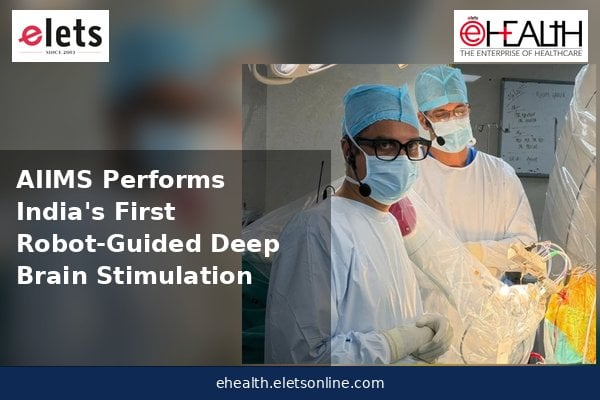
Neurosurgeons at the All India Institute of Medical Sciences (AIIMS), New Delhi, have performed India’s first robot-guided deep brain stimulation (DBS) for Parkinson’s disease. The operation on 25 November 2026 used an AI algorithm to map abnormal brain signals and guide electrode placement. It was led by Dr P Sarat Chandra, head of neurosurgery, with Dr Ido Strauss of Tel Aviv University, The Indian Express reported.

The procedure adds to the institute’s growing use of technology in care, after AIIMS Delhi rolled out BHASHINI voice prescriptions institute-wide.
What is robot-guided deep brain stimulation?
DBS is offered to Parkinson’s patients whose symptoms are no longer controlled by medicine. Surgeons implant thin electrodes deep in the brain, connected to a pacemaker-like device placed under the skin near the chest. The electrodes send small, steady pulses that calm the abnormal activity behind tremor, stiffness and slow movement.
Other AIIMS faculty involved in the surgery were Prof Ramesh Dadamani, Prof Satish Verma and Prof Dattaraj.

How AI maps the brain’s “handbrake”
The robotic approach places electrodes using beta oscillations, a rhythm of electrical activity in the brain’s movement circuits. In a healthy brain, this rhythm fades once movement begins. In Parkinson’s, it keeps surging. Dr Chandra compared it to a car’s handbrake that stays on while the car is moving.
- An AI algorithm analyses the brain’s signals and builds a heat map of where beta activity is strongest.
- The surgeon uses that map to decide the final position of the electrode.
- The robot works alongside microelectrode recording, in which doctors listen to the activity of individual neurons to confirm the target.
At a workshop held with the surgery, Dr Genela Morris of Tel Aviv University demonstrated an AI-based method of reading these signals as an operation proceeds. Dr Elavarasi, associate professor of neurology at AIIMS, said AI helps identify entry and exit zones, reduces errors and shortens the time taken to find the target, but does not replace human judgment.
Less invasive, but evidence still building
According to the AIIMS team, the robotic method needs only a coin-sized patch of scalp to be shaved, and the electrode passes through a 2.5 mm hole. The fixation caps used in conventional surgery are not needed. Dr Elavarasi stressed that there is no direct evidence yet that robotic DBS is better than conventional DBS, and long-term outcomes will need comparative studies. DBS also does not cure Parkinson’s or stop it from progressing.
The cost remains a barrier. The DBS implant starts at about ₹10 lakh at AIIMS, while the surgery itself is technically free; private hospital costs can exceed ₹35 lakh. Patients are selected by a multidisciplinary team, based on motor fluctuations and a good response to levodopa.
Why it matters for neurosurgery in India
Movement disorder care has been expanding in India, with private hospitals such as Yatharth’s advanced brain stimulation centre in Faridabad and Fortis Escorts’ Parkinson’s and movement disorders clinic adding dedicated services. Bringing AI-guided robotic targeting into a public institute could help standardise a complex procedure, in line with wider AI adoption in clinical imaging such as MGM Healthcare Malar’s AI-powered MRI.
FAQ
Does deep brain stimulation cure Parkinson’s disease?
No. DBS eases symptoms such as tremor and stiffness and can improve quality of life in suitable patients, but it does not stop the disease from advancing.
How much does DBS cost at AIIMS?
The implant starts at about ₹10 lakh at AIIMS, while the surgery itself is technically free, according to the institute’s neurology team.
Featured image: Robot-guided deep brain stimulation surgery at AIIMS New Delhi. Photo: Special arrangement, via The Indian Express.

 Like
 Dislike
Be a part of Elets Collaborative Initiatives. Join Us for Upcoming Events and explore business opportunities. Like us on Facebook , connect with us on LinkedIn and follow us on Twitter , Instagram.
"Exciting news! Elets technomedia is now on WhatsApp Channels Subscribe today by clicking the link and stay updated with the latest insights!" Click here!